CSIRO Publishing Books Journals About Us Shopping Cart You are here: Journals > International Journal of Wildland Fire   
International Journal of Wildland Fire
  Published on behalf of the International Association of Wildland Fire
 
Search
 
 
  Advanced Search
   

Journal Home
About the Journal
Editorial Board
Contacts
Content
Online Early
Current Issue
Just Accepted
All Issues
Special Issues
Sample Issue
20-Year Author Index
For Authors
General Information
Notice to Authors
Submit Article
For Referees
General Information
Review Article
For Subscribers
Subscription Prices
Customer Service
Print Publication Dates

 e-Alerts
Subscribe to our Email Alert or RSS feeds for the latest journal papers.

 Connect with us
facebook   youtube

Training

Publication Workshops


Table of Contents     |     Next Issue >>  

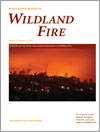
International Journal of Wildland Fire International Journal of Wildland Fire
Volume 21 Number 1 2012


A review of logistic regression models used to predict post-fire tree mortality of western North American conifers 

Travis Woolley, David C. Shaw, Lisa M. Ganio and Stephen Fitzgerald

pp. 1-35

Post-fire tree mortality logistic regression models are an important tool in forest management. We review post-fire coniferous tree mortality logistic regression models in western USA and synthesise explanatory variables, model limitations, factors influencing model scope and model validation efforts. Considering previous use of logistic regression models, we recommend future research.


Evaluation of satellite-derived burned area products for the fynbos, a Mediterranean shrubland 

Helen M. de Klerk, Adam M. Wilson and Karen Steenkamp

pp. 36-47

Can satellite products help managers accurately map fire boundaries? We tested the ability of burned area algorithms run on MODIS satellite data to identify burned areas in the Mediterranean shrublands of South Africa. To this end, we compared these satellite derived products with fire boundaries that had been carefully mapped in the field.


Fire frequency analysis in Portugal (1975–2005), using Landsat-based burnt area maps 

Sofia L. J. Oliveira, José M. C. Pereira and João M. B. Carreiras

pp. 48-60

Vegetation flammability was weakly dependent on time since last fire; extensively forested areas had short fire return intervals and a high dependence on fuel age; ignoring small fires has little or no effect on the estimates of Weibull function parameters; disregarding censored fire return intervals overestimates fire frequency.


Effects of high fire frequency in creosote bush scrub vegetation of the Mojave Desert 

Matthew L. Brooks

pp. 61-68

Abundance of native perennial plants continued to decrease with subsequent fires, whereas abundance of the invasive annual grass Bromus rubens increased equally after single or multiple fires. Thus, revegetation of native perennials is most warranted following multiple fires and control of B. rubens is equally warranted after any fire.


Fire effects on gross inorganic N transformation in riparian soils in coniferous forests of central Idaho, USA: wildfires v. prescribed fires 

Akihiro Koyama, Kirsten Stephan and Kathleen L. Kavanagh

pp. 69-78

Wildfires had a higher effect on gross ammonium transformation rates in soils than prescribed fires relative to their controls. Both types of fires significantly increased soil nitrate concentrations. This was not caused by increased nitrate production, but decreased nitrate uptake by soil microbes.


The importance of piled wood debris on the distribution of bird-dispersed plants in burned and logged Mediterranean pine forests 

J. Rost, J. M. Bas and P. Pons

pp. 79-85

We analysed if wood piles built up as erosion barriers in burned areas determined the distribution of bird-dispersed plants. We found a higher cover of these plants within piles than outside them on the dry southern slopes. Therefore, wood piles are important to the occurrence of bird-dispersed plants in burned and managed Mediterranean forests.


Reconstructing fire history in central Mongolia from tree-rings 

Amy E. Hessl, Uyanga Ariya, Peter Brown, Oyunsannaa Byambasuren, Tim Green, Gordon Jacoby, Elaine Kennedy Sutherland, Baatarbileg Nachin, R. Stockton Maxwell, Neil Pederson, Louis De Grandpré, Thomas Saladyga and Jacques C. Tardif

pp. 86-92

The purpose of this paper is to report on fire history research from three sites located along a 300-km north–south transect in central Mongolia and to highlight the potential of this region as a test case for understanding the relationships between climate change, fire and land use.




IJWF Outstanding Associate Editor Award 2011: Douglas J. McRae 


pp. 93-93


Subscriber Login
Username:
Password:  

Current Issue
Volume 21 (3)

 New Submission & Review System
This journal is now using ScholarOne Manuscripts as its submission and peer review system. See our Notice to Authors for more information about this transition.

 Online Early
Keep up-to-date with articles that have just published Online Early. This peer-reviewed and edited content is available well before being allocated to an issue.

Feature Product
Burning Issues
The role of fire in Australia's ecosystems, and how to manage fire both for safety and for diversity.
More


Top  Email this page
 
Legal & Privacy | Contact Us | Help

CSIRO

© CSIRO 1996-2012