Resilience and Transformation
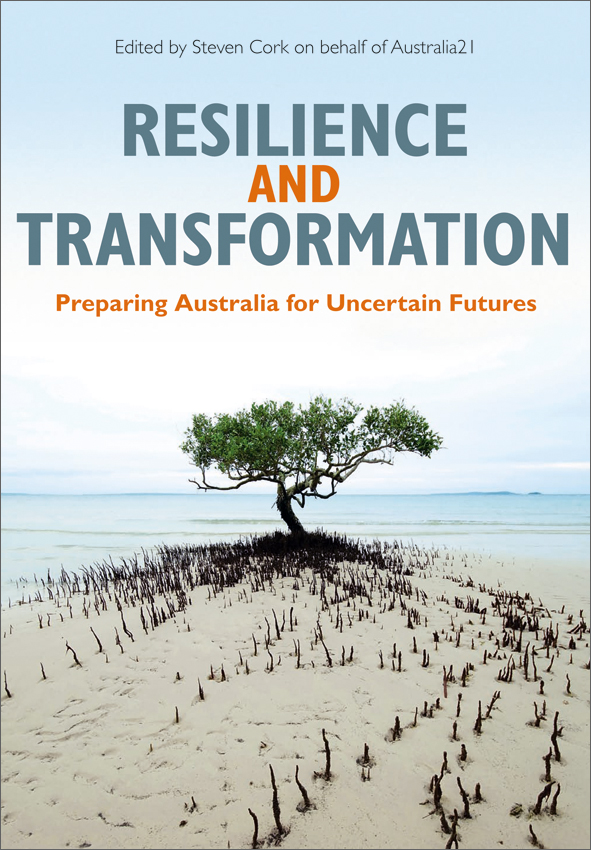
Preparing Australia for Uncertain Futures
Edited by: Steven Cork





Explores what factors contribute to Australia's resilience, what trends are apparent, and what actions are required to better prepare us.
Resilience and Transformation explores what factors contribute to Australia’s resilience, what trends are apparent, and what actions are required to better prepare us for the immediate and longer term future. + Full description
Resilience is a word used more and more across societies worldwide as decision makers realise that predicting and controlling the future does not work and that preparing for uncertainty and surprise is vital. Many viewpoints have emerged on how to assess and achieve resilience of individuals, organisations, communities and ecosystems, but rarely has the resilience of a nation been considered. As Australia moves into a millennium that promises major economic, social, technological and environmental change, Australia21 has assembled some of Australia’s leading thinkers to give their perspectives on the extent and direction of resilience across our nation’s social, economic, ecological and disaster management systems.
- Short descriptionDetails
ePDF | August 2010ISBN: 9780643098138
Publisher: CSIRO Publishing
Available from eRetailers
ePUB | August 2010
ISBN: 9780643102149
Publisher: CSIRO Publishing
Available from eRetailers
Features
- Outlines what contributes to Australia's resilience, what trends are apparent, and what actions are required to better prepare us for the immediate and longer tem future.
- Brings together opinions and analyses by leading thinkers across a range of disciplines and sectors of Australian society.
- Aims to get Australians thinking about how well prepared Australia is for future challenges and opportunities and how we can build resilient cities, and resilient food production, energy, water, transport health and education systems.
- A new perspective on the challenges and opportunities that Australia might face in the future and the strengths and weaknesses of its preparedness.
Contents
OverviewOrganisations and economies
Governance and security
Energy and settlements
Health and education
Environment and society
Disaster preparedness and recovery
View the full table of contents (PDF).
Authors
Over the past 28 years, Steven Cork has blended ecology, physiology, psychology and economics as an internationally recognised researcher, advisor, facilitator and, for several years, as a policy officer in the Australian government. He led CSIRO’s agenda-setting research on nature’s benefits to humans and played a leading role in developing the Millennium Ecosystem Assessment’s scenarios for the world’s possible ecological and social futures. He works now as a consulting strategist and futurist. He leads Australia 21’s ‘Tipping Points’ and ‘Resilience’ projects, exploring Australia’s preparedness for a range of plausible futures.Australia21 is a non profit company whose core focus is multidisciplinary inquiry on issues of strategic importance to Australia in the 21st century.
Related titles