
19 POSTPARTUM ANESTROUS TREATMENT WITH INTRA-VAGINAL PROGESTERONE DEVICE OR CALF REMOVAL FOR 120 HOURS IN SUCKLED CROSSBRED DUAL PURPOSE COWS
F. Perea-Ganchou A , E. Soto-Belloso B , R. Palomares-Naveda B , A. De Ondiz B , H.J. Hernandez-Fonseca B , D. Carrillo A , G. Castellanos A and R. Gonzalez-Fernandez CA Departamento de Ciencias Agragrias, Universidad de los Andes, Trujillo, Venezuela
B Grupo de Investigadores de la Reproduccion Animal de la Region Zuliana (GIRARZ), Maracaibo, Zulia, Venezuela. email: hjhernan@cantv.net
C Venezolana de Inseminacion Artificial y Transplante de Embriones (VIATECA), Villa del Rosario, Zulia, Venezuela.
Reproduction, Fertility and Development 16(2) 132-132 https://doi.org/10.1071/RDv16n1Ab19
Submitted: 1 August 2003 Accepted: 1 October 2003 Published: 2 January 2004
Abstract
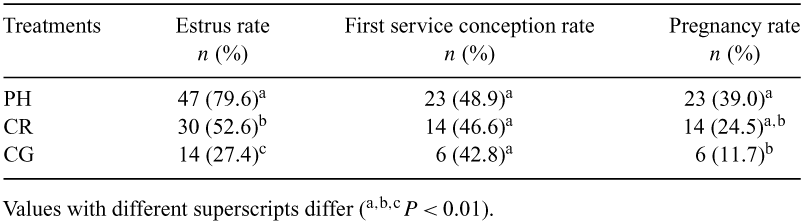
Postpartum anestrus is the main reproductive problem that affects crossbred cattle production in Venezuela. (Soto et al., 2002 Theriogenology 57, 1503–1510; Soto et al., 2000 Revista Científica FCV-LUZ 10, 391–398). In order to reduce the postpartum anestrus and lower the calving to conception interval, 167 crossbred (Bos indicus × Bos taurus) anestrous cows between 90 and 130 days postpartum with body condition score 3 (scale 1–5) were randomly allotted to one the following treatments: 1) PH (n = 59), intravaginal sponge (IS) impregnated with 250 mg of medroxyprogesterone acetate (MAP) during 7 days + 50 mg of MAP and 5 mg of 17β-estradiol (17β-E) i.m. at the day of sponge insertion (Day 0), plus 500 IU of eCG i.m. at Day 5 and1.5 mg of 17β-E i.m. at Day 8 (PREGNAHEAT-E, VIATECA, Villa del Rosario, Venezuela); 2) CR (n = 57), 120-h temporary calf removal; and 3) CG (n = 20), control group. Work was performed in a commercial farm located in a subhumid tropical forrest region. Estrus, first service conception and pregnancy rate were analyzed by chi-square analysis. The intervals to conception were analyzed using analysis of variance (GLM) and the means was compared by least square means method. To evaluate the treatment effect, the interval to conception of each pregnant cow during the first 100 days were considered for the analysis. This interval (days) was significantly (P ≤ 0.05) higher in the PH treatment (155.9 ± 7.3) compared to control (174.4 ± 8.1) but no differences were shown between PH and CR (161.0 ± 7.8). Other results are shown in Table 1. PH treatment improved the estrus and pregnancy rates and shorten the interval to conception indicating that this is a promising anestrous treatment for suckled crossbred dual purpose cows under tropical conditions.
|