
152 SURVIVAL OF BIOPSIED DAY 15 BOVINE CONCEPTI RE-TRANSFERRED TO SYNCHRONIZED RECIPIENT HEIFERS
R. Lee A , M. Berg A , L. McGowan A , J. Peterson A , A. Ledgard A and N. Li AAgResearch, Hamilton, Waikato, New Zealand
Reproduction, Fertility and Development 18(2) 183-184 https://doi.org/10.1071/RDv18n2Ab152
Published: 14 December 2005
Abstract
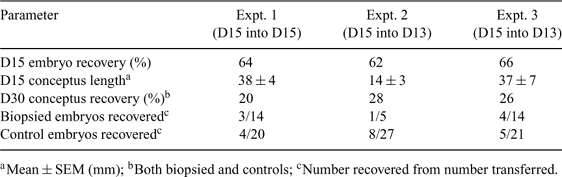
In cattle, a significant proportion of in vitro-produced (IVP) blastocysts do not result in viable pregnancies after transfer to recipient surrogates. Betteridge et al. (1980 J. Reprod. Fert. 59, 205–216) showed that it was possible after superovulation to recover elongated bovine embryos up to Day 17, transfer them into synchronized recipient cows, and have them develop further. We investigated the feasibility of recovering cattle embryos at Day 15, taking a sample of the trophoblast and transferring the embryos into recipients afterward for further development. The biopsied material could be used later to evaluate gene expression and correlate the profile retrospectively with developmental potential. With this approach, a larger amount of material is available for study and only embryos surviving to the elongation stage would be examined. In our experience, 30–40% of transferred blastocysts do not develop to the elongation stage. In three separate experiments, IVP embryos were generated using abattoir derived oocytes and cultured in SOF-aa supplemented with BSA (Thompson et al. 2000 J. Reprod. Fert. 118, 47–55). Six graded Day 7 (Day 0 = day of IVF) blastocysts were transferred into synchronized recipient heifers (n = 10 for each experiment). At Day 15 of gestation, concepti were flushed from the uteri after slaughter with EmCare Flush (ICPbio, Ltd., Suckland, New Zealand) containing 25 mg/mL kanamycin sulfate and then put into EmCare Hold. Conceptus lengths were measured and a proportion of those >30 mm long were cut off (5–15 mm) at one end and the trophoblast kept for future analysis. Pairs of cut or uncut (control) concepti were loaded into 0.25-mL embryo transfer straws. Each pair was transferred nonsurgically into recipients synchronized at Days 15 (Expt. 1, n = 17) or 13 (Expts. 2 and 3, n = 16 and 17, respectively) of the estrous cycle. The time between embryo flush and transfer to a recipient was noted. At Day 30, embryo survival was assessed at slaughter and compared using the Fisher's exact and chi-square. Day 15 conceptus lengths varied between 1 and 140 mm. The time between flush and transfer varied between 13 and 126 min and did not affect the ability of the concepti to subsequently establish pregnancies. Transfer to an earlier uterine environment did not significantly improve embryo survival. The proportion of embryos recovered at Day 30 was not affected by the biopsy. Up to 10 mm can be removed from 40–10 mm concepti without effect on subsequent survival. However, the overall survival post-Day 15 transfer is still too low for practical application.
|