
262 ICSI OF EQUINE OOCYTES WITH SEX-SORTED FROZEN–THAWED SEMEN RESULTS IN LOW CLEAVAGE RATE BUT NORMAL EMBRYO DEVELOPMENT AND PREGNANCIES
S. Colleoni A , M. Spinaci B , R. Duchi A , B. Merlo B , C. Tamanini B , G. Lazzari A , G. Mari B and C. Galli A BA Laboratorio di Tecnologie della Riproduzione, Istituto Sperimentale Italiano Lazzaro Spallanzani, CIZ srl, Cremona, Italy;
B Facoltà di Medicina Veterinaria, Università di Bologna, Bologna, Italy
Reproduction, Fertility and Development 21(1) 228-229 https://doi.org/10.1071/RDv21n1Ab262
Published: 9 December 2008
Abstract
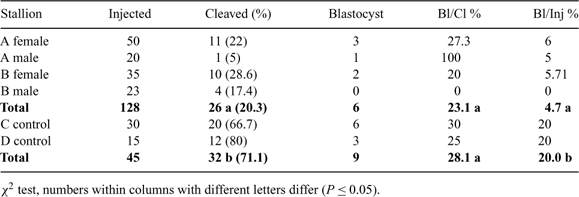
Sorting of sperm by flow cytometer has allowed selection of offspring of predetermined sex in several species by artificial insemination, although the success rate is often lower than with non-sexed semen. In horses, the problem was partially overcome with hysteroscopic insemination using sex-sorted fresh sperm. However, when sex-sorted frozen–thawed sperm were used the pregnancy rate was heavily reduced in comparison with non-sexed frozen–thawed semen. Because it has been demonstrated that in vitro assisted reproductive techniques, namely intracytoplasmic sperm injection (ICSI), has permitted live foals to be obtained using sperm with low fertility in the field, in this study we investigated the possibility of using ICSI with sexed-sorted frozen–thawed sperm for equine embryo production in vitro. Briefly, semen was collected from two Standardbred stallions of proven fertility (Stallions A, B), sorted using a MoFlo SX flow cytometer and frozen (Johnson LA and Welch GR 1999 Theriogenology 52, 1323–1341). Sex-sorted and control non-sexed frozen semen (two stallions of in vitro proven fertility: C, D) was thawed, centrifuged on a Percoll gradient, washed and diluted 1:1 in PVP before ICSI. Oocytes were collected from ovaries of slaughtered mares and matured in vitro. Metaphase II oocytes were injected with sperm, subsequently cultured up to the blastocyst stage and frozen conventionally in 10% of glycerol (Galli et al. 2002 Theriogenology 58, 713–715). Six embryos from sexed-sorted sperm were thawed and non-surgically transferred in naturally cycling synchronous recipient mares. Results are summarized in Table 1. Overall, 70 and 58 (stallion A, B) and 30 and 15 (stallion C, D) oocytes were injected with sex-sorted or control frozen–thawed sperm, respectively. Mean cleavage rates were 20.3% for sorted sexed sperm and 71.1% for control, showing a significantly lower cleavage rate for sexed sperm. This difference was reflected in the number of blastocysts obtained (4.7% v. 20.0%). From the 6 frozen–thawed embryos derived from sexed sperm, that were transferred, 4 pregnancies resulted. One pregnancy was lost around 21 days, a second was pharmacologically aborted, and two were maintained (one from male and one from female sorted semen are currently in the 11th month of gestation). In conclusion, this study demonstrates that ICSI with sex-sorted sperm can be used for producing equine blastocysts able to establish pregnancies at a high rate following embryo transfer. However, the overall efficiency of the system is limited due to the very low cleavage rate obtained with sexed-sorted frozen–thawed sperm.
|
This work was supported by an RFO (ex 60%) and Camera di Commercio Cremona grant. The Authors wish to thank Società Italiana Produttori Sementi.