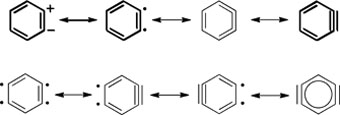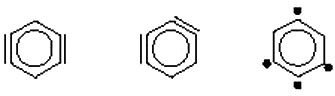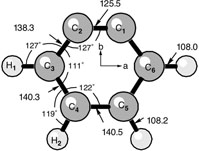

The history of o-benzyne from its early beginnings as an unobservable reactive intermediate till its present status as a very-well characterized but still theoretically challenging molecule with important applications in synthesis is reviewed. The m- and p-benzynes, tridehydrobenzenes, and benzdiynes are also known, and p-benzyne is a key intermediate in the action of a potent class of ene-diyne anti-cancer compounds.
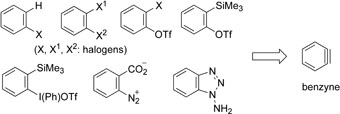
Recent progress in benzyne chemistry from synthetic aspects is reviewed. In particular, the focus is on the recently developed o-(trimethylsilyl)phenyl triflate and o-(trimethylsilyl)phenyliodonium triflate, which are used under mild conditions.
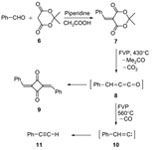
This review (1972–1999) outlines the development, and synthetic use, of the acetylene to methylenecarbene rearrangement from initial work on flash vacuum pyrolytic generation of propadienones. This was extended to the rearrangement of benzyne to cyclopentadienylidenecarbene; this is still mechanistically ambiguous, but synthetic applications are numerous..
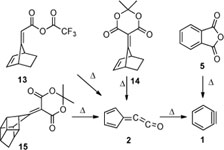
Two novel thermal routes to ortho-benzyne are reviewed. Benzyne can be made by [2 + 4] cycloaddition and has also been shown to undergo cycloreversion at high temperature. Benzyne can be prepared by solid-phase pyrolysis of phthalic anhydride on graphite or carbon nanotubes in a microwave reactor.
Matrix isolation spectroscopy in combination with quantum chemical computations has allowed a detailed investigation of several di- and tridehydrobenzenes within the past four decades. This Review summarizes recent developments with a special emphasis on the close interplay between experiment and theory in this field of reactive intermediate chemistry.
The isolation and direct observation of arynes with a higher degree of unsaturation than benzyne, such as benzdiynes, has been a challenge to organic chemists. In 1997, the first direct observation of a benzdiyne, 1,4-bis(trifluoromethyl)-2,3,5,6-tetradehydrobenzene, was reported. The following studies on benzdiynes elucidated its rather weak triple bonds owing to their multireference character. We outlined the progress in the generation and observation of benzdiynes on the background of benzyne chemistry. Additionally, the studies of bisarynes with extended π-systems and more unsaturated cyclic C6 are reviewed briefly.
The microwave spectrum of benzyne, first detected using a fast-flow pyrolysis apparatus, has more recently, with advances in microwave spectrometer technology, employing a new discharge nozzle chemical generation method in a Fourier transform microwave spectrometer, enabled a full isotopic substitution study and the determination of a precise molecular structure for o benzyne.
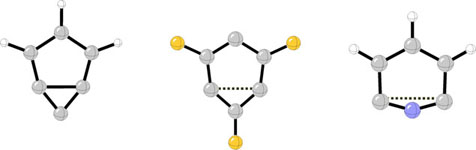
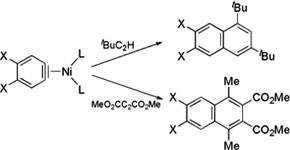
The formation and reactivity of bis(tertiary)phosphine-Group 10 metal complexes of benzyne, 2,3-naphthalyne and fluoroarynes, of general formula [M(η2-aryne)(PR3)2], are reviewed, with emphasis on the nickel compounds. The compounds are best represented as metallacyclopropabenzenes. The chemistry of the nickel compounds is dominated by the insertion of unsaturated molecules, sometimes sequential and with considerable regioselectivity, into the nickel-aryne bond, giving a variety of polycyclic aromatic compounds after reductive elimination of the nickel-carbon σ-bonds.
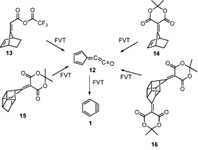
Flash vacuum thermolysis of several precursors generates cyclopentadienylideneketene 2, which at higher temperatures eliminates CO to yield benzyne 1. The collisional activation and neutralization-reionization mass spectra (CAMS and NRMS) of 1 and 2 are reported. The CAMS and NRMS of benzyne from all the precursors are identical, and the CAMS support the ring-opened structure of the C6H4•+ ions.
Flash vacuum thermolysis of compounds 13, 14, 15, and 16 generates cyclopentadienylideneketene 2, which at higher temperatures eliminates CO to yield benzyne 1. The photoelectron spectra of 1 and 2 are reported, and some previous photoelectron spectroscopic assignments are corrected. IR, MS, and PE spectroscopic investigations of 1 and 2 are correlated.
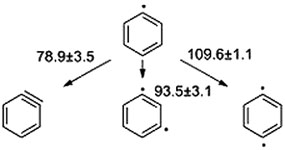
Fifty years of thermochemical studies of the benzynes have resulted in an extensive range of experimentally known thermochemical properties. The types of thermochemical parameters discussed in this work include enthalpies of formation of the benzynes, and the energetics for their dissociation and their formation by neutral and ionic pathways.
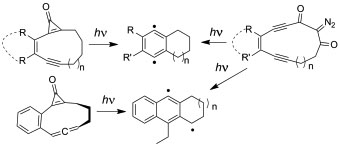
The development of ‘photoswitchable’ enediynes is discussed in this account. These compounds are stable in the dark but undergo facile spontaneous cyclization at ambient temperatures after photochemical activation, producing p, or/and α,3-didehydrotoluene derivatives. Rapid cycloaromatization of photogenerated enediynes allows the spatial and temporal control of the diradical generation.
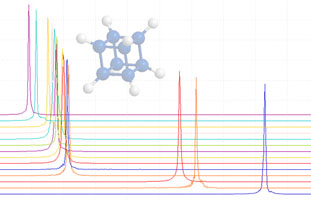
Cubane can be considered an ideal internal standard for reactions observed by NMR, due to an almost complete benign reactivity and uniquely reliable 1H and 13C NMR resonances, in wide variety of deuterated solvents.
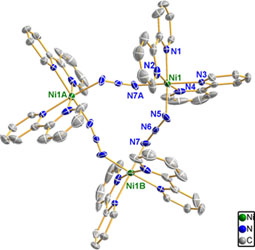
Two ideal triangular Ni3 compounds [Ni3(μ1,3-N3)3(2,2′-bpy)3]X3 3H2O (X = ClO4- (1) and BF4- (2); 2,2′-bpy = 2,2′-bipyridine) have, for the first time, been structurally and magnetically characterized.
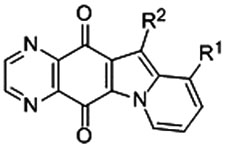
A series of novel indolizinoquinoxaline-5,12-dione derivatives were synthesized. Their ability to inhibit the growth to four human cancer cell lines and DNA topoisomerase IB inhibitory activity was investigated. The results suggested that the indolizinoquinoxalinedione structure might be a potential pharmacophore in anti-cancer drug design.
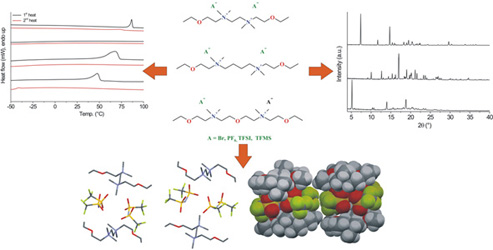
New dicationic quaternary ammonium salts containing an ethoxy ethyl group either in a side chain and/or as spacer of the diammonium cation, and having bromide, hexafluorophosphate, bis(trifluoromethanesulfonyl)imide, or trifluoromethanesulfonate as an anion, have been synthesized and characterized in the solid and liquid state using various structural and thermoanalytical methods.
Keep up-to-date with articles that have just published Online Early. This peer-reviewed and edited content is available well before being allocated to an issue.