

Australian Journal of Chemistry
Volume 65 Number 5 2012
RESEARCH FRONT: Physical and Biophysical Chemistry
CH12213BIOPHYSCHEM2011: A Joint Meeting of the Australian Society for Biophysics and the RACI Physical Chemistry Division

This Research Front of the Australian Journal of Chemistry is aligned with the BIOPHYSCHEM2011 meeting, a joint conference of the Australian Society for Biophysics and the Physical Chemistry Division of the RACI, which was held at the University of Wollongong from 3 to 6 December 2011. Research across the physical chemistry and biophysics disciplines is strong and lively in Australia and the multidisciplinary nature of these studies is a feature, with links connecting basic biological science and applications to physical chemistry processes to nanotechnological applications, and vice versa.
CH12028Reduced Bimolecular Recombination in Conjugated Polymer Donor/Fullerene Acceptor Bulk Heterojunction Solar Cells
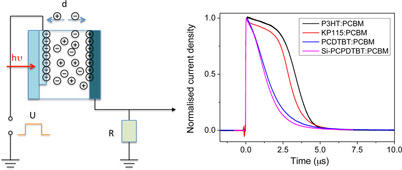
Time-of-flight photoconductivity measurements revealed significant reduction in bimolecular recombination compared to diffusion-controlled Langevin recombination in bulk heterojunction solar cells based on P3HT:PCBM and a new silole-based copolymer KP115:PCBM. This highly desirable property enables coating of relatively thick active layers without significant drop in solar cell performance. The origin of reduced recombination is presently unclear and previous models are inadequate to fully describe it.
CH12026Molecular Mechanisms of K+ Selectivity in Na/K Pump
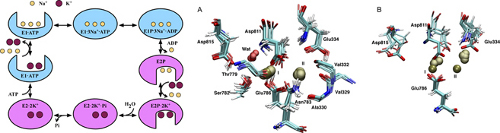
A combined computational and experimental study demonstrated that the protonation states of key acidic residues in the binding sites have both structural and energetic impacts on the function of the Na/K pump at the E2•Pi state.
CH12007 The Bromide–Carbon Monoxide Gas Phase Complex: Anion Photoelectron Spectroscopy and Ab Initio Calculations
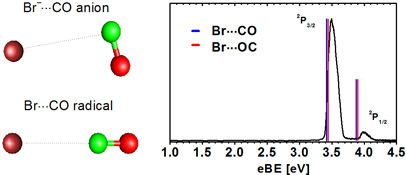
Photoelectron spectroscopy and ab initio calculations are used to interrogate the bromide–carbon monoxide gas phase complex, Br-···CO. A new minimum was found for the neutral complex, namely a linear Br···OC form. The electron affinity of the Br···CO complex is 3.50 ± 0.05 eV.
CH12029Coarse-Grained Simulations of the Effects of Chain Length, Solvent Quality, and Chemical Defects on the Solution-Phase Morphology of MEH-PPV Conjugated Polymers
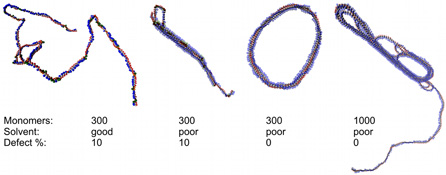
MEH-PPV forms a variety of mesoscale structures depending on chain length, solvent quality, and chemical defect concentration.
CH12015 Copper Modulation of Amyloid Beta 42 Interactions with Model Membranes
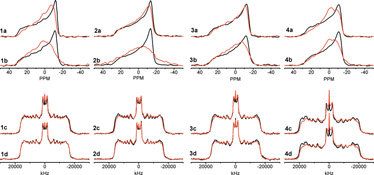
There is growing evidence that interactions between the amyloid-beta peptide Aβ(1-42) and neuronal cell membranes and copper are involved in Alzheimer’s disease (AD) pathogenesis. Our data support the finding that ternary interactions between Cu2+, lipids, and Aβ(1-42) may have significance in AD, and illustrate the importance of using appropriate lipid membrane composition.
CH12117Photochemical Upconversion Enhanced Solar Cells: Effect of a Back Reflector
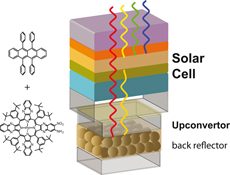
Photochemical upconversion is applied to solar cells in the presence of a backscatter to double the efficacy of the device.
CH12019Theoretical Study of the Oxidation Mechanism of Hematoxylin in Aqueous Solution
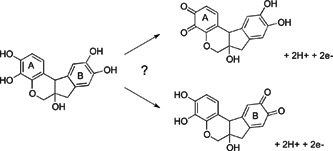
Hematoxylin undergoes oxidation via an ErErCiEr mechanism in which ring B is oxidized first.
CH12081Reduction of Copper(II) to Copper(I) in the Copper-Curcumin Complex Induces Decomposition of Curcumin

The addition of Cu(ii) to a solution of curcumin in acetonitrile enables the initial complexation of Cu(ii); a subsequent internal reduction of Cu(ii) to Cu(i) oxidises curcumin to a curcumin radical, leading to decomposition of curcumin.
CH12103Processing 15-nm Nanodiamonds Containing Nitrogen-vacancy Centres for Single-molecule FRET
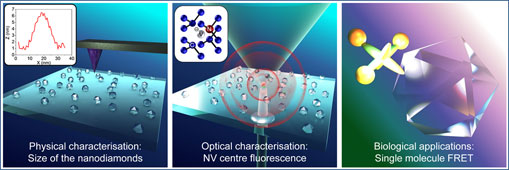
Fluorescent nanodiamonds are attractive for biological applications because of their biocompatibility and stable photoluminescence. Chemical and air oxidation treatments were used to produce small (~15 nm) nanodiamonds containing a single fluorescent centre. These were both physically and optically characterised and then used as a donor for single-molecule Förster resonance energy transfer.
CH12047Characterisation of Calmodulin Structural Transitions by Ion Mobility Mass Spectrometry
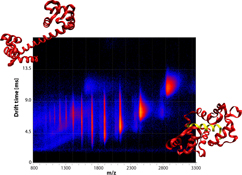
Ion mobility-mass spectrometry (IM-MS) provides a biophysical approach well suited for structural analysis of proteins and their complexes with conformational heterogeneity. Here we have utilised negative mode IM-MS to investigate structural transitions of calmodulin upon Ca2+ and target peptide binding. Of particular importance is the ability to detect conformations of calmodulin-peptide complexes without a full complement of calcium.
CH12053Frequency-based Quantum Computers from a Chemist's Perspective

Rational design criteria for molecules useful as frequency-based quantum registers are developed. These criteria are designed to minimize inter-qubit couplings and so make quantum gates much easier to implement, allowing molecular design to provide pathways for the construction of large registers.
CH12006Electronic Structure Underlying Colour Differences Between Diarylmethane Dyes and their Azomethine Analogues

We use an information-theoretic, extrathermodynamic approach to analyse the changes in the electronic structure between analogous methine and azomethine dyes.
CH12072DMF/H2O Volume-Ratio-Controlled Assembly of 2D and 3D Ln-MOFs with 5-(Pyridin-4-yl)isophthalic Acid Ligand
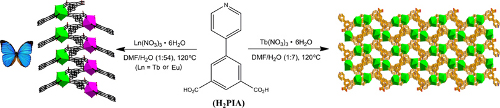
Three new Ln-MOFs, [Tb(HPIA)(PIA)(H2O)2]n·0.5nH2O (1), [Eu(HPIA)(PIA)(H2O)2]n·0.5nH2O (2), and [Tb2(PIA)3(H2O)4]n·3nH2O (3) (H2PIA = 5-(pyridin-4-yl)isophthalic acid), have been obtained by DMF/H2O volume-ratio-controlled assembly and structurally characterised. The thermal and photoluminescence properties of complexes 1-3 in the solid state have also been investigated.
CH12010Oxygenated Terpenoids from the Australian Sponges Coscinoderma matthewsi and Dysidea sp., and the Nudibranch Chromodoris albopunctata
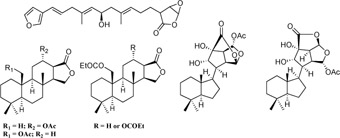
The isolation and structure elucidation of seven new oxygenated terpenoids and eight known terpene metabolites from marine invertebrates collected at the Inner Gneerings Reef, South East Queensland, is discussed. Investigation of the sponge Coscinoderma matthewsi yielded an epoxylactone derivative (1) of the known furanoterpene tetradehydrofurospongin-1 (2). A chemical investigation of the dissected nudibranch Chromodoris albopunctata provided the new oxygenated diterpenes 12α-acetoxyspongian-16-one (10), 20-acetoxyspongian-16-one (12), 20-oxyspongian-16-one propionate (13) and 12α,20-dioxyspongian-16-one dipropionate (14), while two new chromodorolides D (17) and E (18) were isolated from a Dysidea sp.
CH11471Peptide Nucleic Acid Monomers: A Convenient and Efficient Synthetic Approach to Fmoc/Boc Monomers
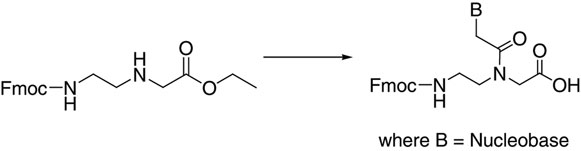
A straightforward, practical and cost-effective method for the synthesis of Fmoc/Boc-protected peptide nucleic acid (PNA) monomers from N-(2-(Fmoc)aminoethyl)glycinate ethyl ester is described. The Fmoc/Boc strategy was developed in order to eliminate the solubility issues, in particular that of the cytosine monomer, that often occur during the solid-phase synthesis of PNA.
CH12013Synthesis and Characterization of a Novel Biodegradable Amphiphilic Dendritic Polyether-ester
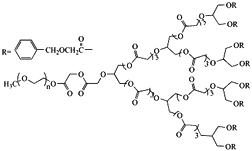
A novel biodegradable amphiphilic dendritic polyether-ester whose building blocks (glycerol, glycolic acid oligomer and methoxy poly(ethylene glycol)) are known to be biodegradable or biocompatible is described. This biodendritic macromolecule is of interest for fundamental physiochemical studies and as a new tailored material for applications in drug delivery and tissue engineering.
CH12122A Solid State Study of Keto-enol Tautomerismin Three Naphthaledene Schiff Bases
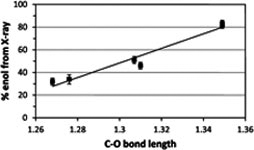
Three naphthaledene Schiff bases were analysed by variable temperature X-ray crystallography and solid state electronic spectra. The crystal structures showed no significant changes despite the compounds changing colour with temperature. The major contribution to the colour change is the broadening of the absorption band and not the change in enol-keto composition.