
The study of the logic implications of the behaviour of molecular systems stimulates the ingenuity of researchers by introducing new concepts in chemistry, and could lead to applications in fields ranging from medicine to materials science. This Research Front provides a taste of this exciting and rapidly growing research area.
How can the young field of molecular logic grow up sensibly? Six general answers to this question are offered. These range from seeing everyday chemical phenomena from a Boolean perspective to demonstrating logic applications in small spaces.
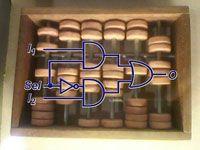
Molecular logic has made many advances in the last years. This Review discusses some milestones, but also gives a critical account of the status quo and possible directions. The picture shows an ancient calculator and the electronic symbolization of a 2:1 multiplexer, which was recently mimicked at the molecular level.
Sulfur-doped nanocrystalline cadmium sulfide exhibits very peculiar photoelectrochemical characteristics. Depending on the photoelectrode potential and the incident light wavelength, both cathodic and anodic photocurrents can be observed. This phenomenon was used to build optoelectronic demultiplexer.
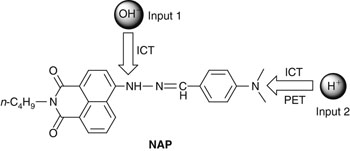
A unimolecular system functioning as a combinatorial logic circuit for a half-subtractor based on a naphthalimide derivative is reported. Chemical inputs (OH– and H+) can significantly change the absorption and fluorescence characteristics through modulating ICT and PET process, as a result of protonation/deprotonation of the molecule. An XOR gate is obtained following the absorbance variations at 485 nm and an INHIBIT gate is induced when the output signal is monitored at 535 nm in the fluorescence spectra. Large differences in output signals allow unequivocal assignment of logic-0 and logic-1 of both logic gates, which may function in parallel to implement the half-subtractor.
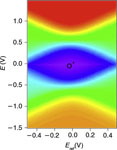
Stability region of an electrochemical diamond as reflected by the concentration in a single redox species computed as a function of the applied and reference voltage at 300 K. These diamonds are the basis for the implementation of logic binary gates and a finite state set-reset machine.
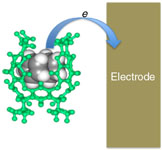
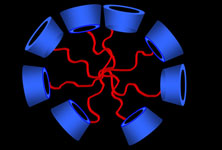
The non-covalent encapsulation of redox active centers may or may not affect the kinetics of heterogeneous electron transfer between the corresponding center and the electrode surface. This Review summarizes recent results in this area showing that a wide range of experimental findings is possible.
This Review summarizes synthetic avenues to synthetic polymers with cyclodextrins as building blocks. The synthesis of linear polymers with cyclodextrin pendant or terminal groups as well as star polymers with cyclodextrin moieties and their use in different applications is highlighted.
The syntheses of some substituted bicyclic lactams are reported employing the Schmidt reaction of ketones and the Beckmann rearrangement of the corresponding ketoximes. The mechanisms are discussed, some limitations of the mechanisms identified, and alternative mechanisms proposed. Application to the synthesis of some chloro bicyclic lactams is reported.
The convergent synthesis of a chimeric oligonucleotide tetramer and hexamer (see figure) by the phosphoramidite approach using a 2 + 2 and 3 + 3 strategy is reported. This method provides an efficient and economical way to scale-up the synthesis of high-purity oligonucleotides for clinical trials and commercial uses.
Water-exchange mechanisms of [Zn(H2O)4L]2+·2H2O (L = NH3, NH2CH3, NH(CH3)2, and N(CH3)3) have been studied by density functional theory calculations (B3LYP/6-311+G**) and provide theoretical evidence that the mechanism follows an associative (A) reaction path to form a six-coordinate intermediate [Zn(H2O)5L]2+·H2O.
Novel organoruthenium phenylcarbamate complex salts have been prepared in high yield and purity through a simple one-pot reaction between [Cp*Ru]+ and phenylisocyanate in refluxing alcohol solutions. Cytotoxic evaluation of these complexes reveals these salts to be potent antitumour agents against a range of cancerous cell lines, while displaying only minimal toxicity towards a normal human fibroblast cell line.
Two new inorganic-organic hybrid materials containing [Fe(bipy)3]n+ (bipy = 2,2'-bipyridyl; n = 2 or 3) units and Keggin-type polyoxotungstate anions, [Fe(bpy)3]3[ZnW12O39(OH)Fe(bipy)2(H2O)]2 and [Fe(bipy)3]2[CoW12O40] were obtained by hydrothermal synthesis. Both have been characterized by elemental analysis, FT-IR spectroscopy, 1H-NMR spectrometry and single crystal X-ray crystallography. The former salt features [FeII(bipy)2(OH2)]2+ units covalently bound to the anion [ZnW12O39(OH)]5– via a W=O-Fe bridge, whereas the latter salt contains discrete [CoW12O40]6– anions.
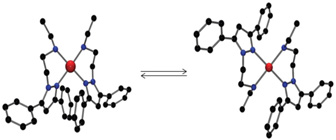
Isomerization studies in coordination chemistry are of high importance owing to the close correlation between the structure of the compounds (cis or trans isomer) and their activity, mostly for medical applications. The study of cis–trans isomerization of [Pd(NN')2](BF4)2 by NMR spectroscopy and theoretical studies is presented, including the synthesis and characterization of PdIIand PtII complexes with two new N-alkylamino-3,5-diphenylpyrazole ligands. The presence of one alkyl chain group instead of two at the amine moiety is expected to affect the ability of the ligand to coordinate the metal centre.
Adsorption of (cationic) Methylene Blue dye from aqueous solution onto titanate nanotubes is favourable, whereas (anionic) Eriochrome Black T shows weak adsorption, demonstrating the importance of electrostatic interactions.
Novel liquid-crystalline ligands were constructed by three-ring-containing mesogens linked through ester and azomethine groups with a terminal hydroxy group, from two simple dihydroxy benzenes. The thermal and liquid crystalline properties were studied and compared with methyl-terminated model mesogenic compounds. The appearance of enantiotropic phases indicated high molecular polarizability of the mesogenic core, which was investigated by differential scanning calorimetry and hot-stage optical polarizing microscope.
Two manganese(II)-dihydroxyterephthalate complexes were obtained under solvothermal conditions: [Mn(H2dhtp)(H2O)2]n (1) and [Mn2(dhtp)(H2O)2]n (2) (H4dhtp = 2,5-dihydroxyterephthalate). The 3D framework of complex 1 is constructed by H2dhtp ligands joined to 1D carboxylate-bridged Mn(II) chains, which features a (4,4)-connected PtS net. Complex 2 contains a novel inorganic honeycomb Mn(II)–O layer, which is further connected to a rare 3D (4,8)-connected flu net by dhtp ligands.
Anatase nanoparticles were prepared by calcination of low sodium titanate nanotubes. Photo-activity for the bleaching of methyl orange is compared for both UV-A and simulated sunlight. More photo-oxidation occurred in simulated sunlight suggesting that the dye is absorbing visible light and transferring this energy to the TiO2.
Nice and clean: a series of azobenzenealkanethiol compounds with the structure p-RC6H4N=NC6H4(CH2)nSH (n = 3, 4) was synthesized using a divergent strategy. In contrast to many predecessors, these molecules do not contain a heteroatom between the alkane chain and the azobenzene unit. However, this somewhat complicates the synthesis, but also makes the film-forming properties of this class of molecules much more predictable.
Easily accessible and stable palladium complexes 2a–2b were found to be highly active catalysts for the Suzuki coupling of aryl bromides with phenylboronic acid in aqueous media at room temperature under air, giving the coupled products in good to excellent yields with catalyst loadings as low as 0.01–0.05 mol-%.
The anomalous (reverse) effect of meta-substituents on δCO of benzoic acids originate exclusively through the substituent-induced changes in the total occupancy of all natural pz orbitals and is transmitted through a 5.5:–2.5:1 combination of localized π-polarization, extended π-polarization, and resonance-induced π-polarization mechanisms.
A new colorimetric and fluorescent receptor for sensing of Hg2+ ions was developed. It can exclusively distinguish Hg2+ from other metal cations by different colour changes. It also exhibits a pronounced Hg2+ ion-induced fluorescence enhancement and fluorescence colour change from dark blue to blue-pink.
A series of compounds have been prepared by one-pot three-component reactions and fully characterized. A preliminary study reveals that such compounds show strong second harmonic generation responses and ferroelectric properties.
Keep up-to-date with articles that have just published Online Early. This peer-reviewed and edited content is available well before being allocated to an issue.