
Australian Journal of Chemistry
Volume 64 Number 12 2011
CH11231 One-Pot Pathway: Fabricating Ordered Hollow Silica Spheres Using Sodium Silicate as the Precursor
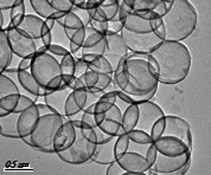
The fabrication of hollow silica with uniform morphology by the sodium silicate route is one of the fastest growing areas of materials research. However, a literature survey shows that the size distribution of particles obtained from sodium silicate is relatively wide. This manuscript reports the fabrication of highly monodisperse hollow silica by the sodium silicate pathway.
CH11315 Antitumor Activities and Structure–Activity Relationship of Phosphotriester Derivatives of Homocamptothecin Based on a Semisynthetic Route
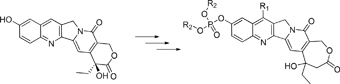
Based on a new semisynthetic route, a series of phosphotriester 7-alkylhomocamptothecin derivatives are designed and synthesized. Cytotoxic activity assays show that compounds 12a and 14c have more potent activities than irinotecan, and compound 14c shows potent tumour inhibitory activity in a Colo205 xenograft model.
CH11179 A Density Functional Theory Investigation of the Bimetallic Clusters Nb2Rh and NbRh2 and the Complexes They Form with CO
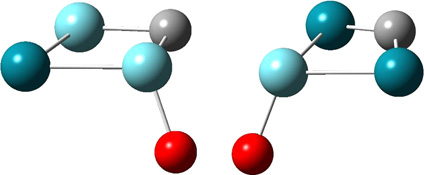
The interaction of CO with the bimetallic clusters NbRh2 and Nb2Rh has been investigated using density functional theory calculations. Many associatively and dissociatively bound minima of the reaction products Nb2Rh–CO and NbRh2–CO were identified, with the global minima being dissociative for both structures. This indicates that both the NbRh2 and Nb2Rh clusters thermodynamically dissociate CO.
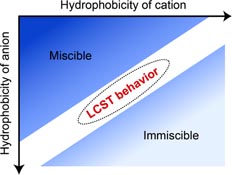
CH11278 Material design of ionic liquids to show temperature-sensitive LCST-type phase transition after mixing with water
CH11217 RuCl3·3H2O Catalyzed Tandem Reaction of Alkynylbromides with 2-Aminothiophenols in Water: A Convenient Synthesis of 2-Benzoylbenzothiazoles

RuCl3 ·3H2O catalyzed tandem reaction of alkynyl bromides with 2-aminothiophenols mediated by water represents an efficient and environmentally benign synthesis of 2-benzoylbenzothiazoles. In addition, the Ru(iii) catalyst could be readily recovered and efficiently reused together with water up to three times.
CH11291 Synthesis, Structural, and Insulin-Enhancing Studies of Oxovanadium(IV) Complexes

A series of oxovanadium(iv) complexes with Schiff bases derived from substituted salicylaldehyde and diamine have been prepared and characterized. The insulin mimetic study reveals that the oxovanadium(iv) complexes elicited a progressive reduction in plasma glucose over 6 h in streptozotocin-induced rats.
CH11285 Sodium Fluoride at the Air/Water Interface
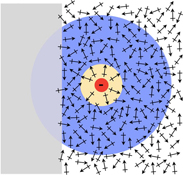
Fluoride ion is adsorbed at the hydroxide-charged air/water interface slightly more strongly than the other halide anions.
CH11325 Synthesis of Stabilized Phosphinidenoid Complexes Using Weakly Coordinating Cations
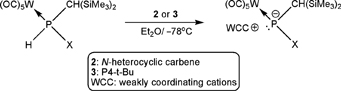
The formation of phosphinidenoid complex salts having weakly coordinating cations (WCCs) is reported via treatment of P-functional phosphane complexes with N,N’-di-tert-butyl imidazol-2-ylidene or a P4-t-Bu phosphazene base. The thermal stability of phosphinidenoid complex salts is dependent upon the P–X substituents and the nature of the WCC.
CH11162Packing Effect on the Transfer Integrals and Mobility in α,α′-bis(dithieno[3,2-b:2′,3′-d]thiophene) (BDT) and its Heteroatom-Substituted Analogues
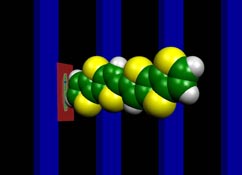
The calculated mobility showed that BDT is a hole transfer material, which is in good agreement with experimental investigations. The hole mobility of BHBDT is 7 times while electron mobility is 20 times higher than the BDT in space group C2/c. Generally mobility increases in BDT and its analogues by changing the packing from space group C2/c to P1 or .
.
CH11256 Metal Binding by Water-Soluble Polychelates and Implications for Agriculture
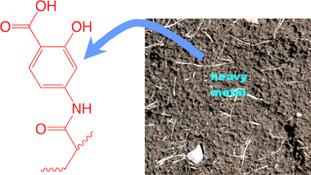
A variant of an acrylamide polymer used for soil conditioning and water treatment is synthesized which can also be used to remediate heavy metals and for delivering micronutrients.
CH11312 PolyPEGylation of Protein using Semitelechelic and Mid-functional Poly(PEGMA)s synthesized by RAFT polymerization
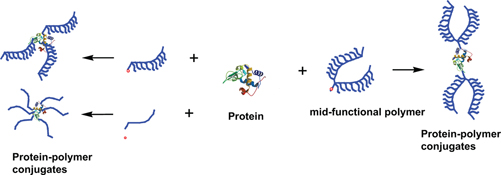
A series of well-defined semitelechelic and mid-functionalized poly(poly(ethylene glycol) methyl ether methacrylate)s (poly(PEGMA)s) were synthesized through reversible addition-fragmentation chain transfer (RAFT) polymerization using thiazolidine-2-thione-functionalized chain transfer agents (CTAs). The thiazolidine-2-thione functionality located at the end of or at the middle of the polymer chains can react with amine residues on protein surfaces, forming protein-polymer conjugates via amide linkages. The protein conjugations from the mid-functionalized polymer remained much more protein bioactive compared to their semitelechelic counterpart with similar molecular weights, indicating that the steric hindrance of the mid-functionalized poly(PEGMA)s leads to the better selective conjugation to the protein. This synthetic methodology is suitable for universal proteins, seeking a balance between the protein bioactivity and the protein protection by the covalent linkage with polymers, and exhibits promising potential for pharmaceutical protein conjugation.
CH10288 Comparative Study of the Adsorption of Aromatic Pollutants onto TiO2 (100) Surface via Molecular Simulation
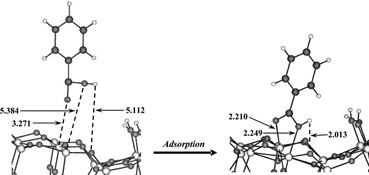
Computational results confirm that the organic molecules that are adsorbed onto the TiO2 surface via a charge-transfer mechanism are oriented either in parallel or perpendicular conformations relative to the surface depending on the functional groups of the aromatic substrates.
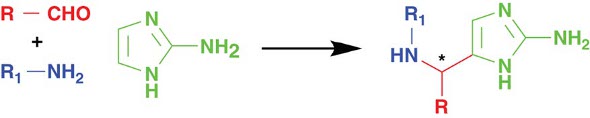
CH11358 Three-Component Mannich-like Reaction of 2-Aminoimidazole
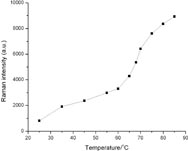
CH11180 Surface-Enhanced Raman Scattering of the Bariandite Oxide Layer on a Vanadium Dioxide Crystal
CH11236 Efficient Synthesis of Ellagic Acid Salts Using Distillable Ionic Liquids
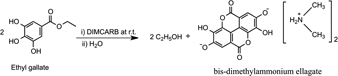
Ellagic acid is a potentially important compound in cancer therapies, but its application has been restricted by its limited availability. This paper describes a novel direct synthesis of ellagic acid salt from ethyl gallate, which involves an unusual aryl–aryl oxidative coupling reaction, using N,N-dimethylammonium N’,N’-dimethylcarbamate, a distillable ionic liquid, as solvent.
CH11267 A Mass-Sensitive Approach for the Detection of Anaesthetic Xenon
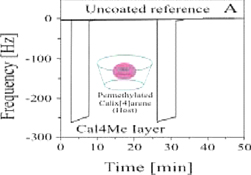
Gravimetric sensors have been designed for the detection of the noble gas xenon. Calixarene hosts as well as a polymer material have been applied as sensitive coatings. Sensitivity and selectivity studies reveal that permethylated calix[4]arene furnishes pronounced results with appreciable response time and reproducibility.