Australian Journal of Chemistry
Volume 65 Number 12 2012
RESEARCH FRONT: 12th Eurasia Conference on Chemical Sciences (EuAsC2S-12)

A foreword highlighting the 12th Eurasia Conference on Chemical Sciences, EuAsC2S-12, held at Corfu, Greece.
CH12354Iron-Catalyzed Enantioselective Reactions Through the Use of Chiral Bipyridine-Containing Ligands
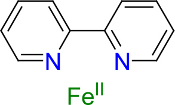
Recent examples highlighted the use of iron salts in combination with chiral bipyridine-containing ligands for highly enantioselective reactions. Very high enantioselectivities were obtained for various organic transformations, such as oxidation, Mukaiyama aldol and epoxide-opening reactions. These examples represent new entries in the field of green chemistry and sustainable development.
CH12294Photocatalytic Hydrogen Evolution Using 9-Phenyl-10-methyl-acridinium Ion Derivatives as Efficient Electron Mediators and Ru-Based Catalysts
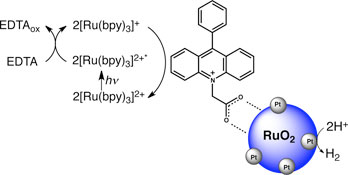
A photocatalytic hydrogen-evolution system using a highly efficient electron mediator, 9-phenyl-10-methylacridinium ion (Ph–Acr+–Me), has been reported for the first time. The hydrogen-evolution rate from the reaction system was more than 10 times faster than that from the reaction system using a conventional electron mediator of methyl viologen.
CH12303Simulation of Ir(III) in Aqueous Solution: The Most Inert Ion Hydrate
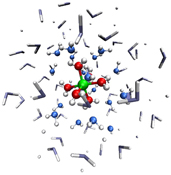
Ir(iii) is the most inert aqua-ion known. The first shell water molecules have an estimated mean ligand residence time of ~300 years. This study shows the results of an ab initio quantum mechanical charge field (QMCF) molecular dynamics simulation at Hartree-Fock level, that classify the Ir-OH2 force constant as the strongest ion-OH2 bond known to date.
CH12368CuII Complexes of Isomeric Ligands Derived from 2-Pyridine-carboxaldehyde and m- or p-Xylylenediamine: An Intermolecularly ?-Stacked Dinuclear Species and a Trinuclear Circular Helicate that Encapsulates a Chloride Ion
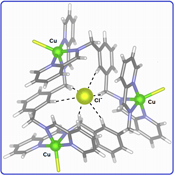
CuII complexes of isomeric ligands that incorporate two separated α-diimine coordination domains have been synthesised and their X-ray crystal structures and variable temperature magnetic properties determined. One complex is an intermolecularly (triple) π-stacked dinuclear species while the second is a rare trinuclear circular helicate that encapsulates a chloride ion.
CH12321Direct One-Pot Cobalt(II) Phthalocyanine Catalyzed Synthesis of N-Substituted Isoindolinones

A series of N-substituted isoindolinones has been synthesized by one-pot reductive amination-intramolecular amidation of 2-carboxybenzaldehyde using Ph2SiH2 as reducing agent in ethanol. High chemoselectivity with excellent yield was obtained in most of the studied substrates.
CH12378Oxo-Centred Trimetallic Clusters Supported by Electron-Withdrawing Carboxylates: Highly Inert Character in Ligand Exchange Kinetics of the Dichloroacetate-Bridged Complex [Ru3(µ3-O)(µ-CHCl2COO)6(pyridine)3]
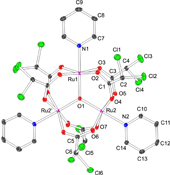
Two new oxo-centred triruthenium clusters supported by electron-withdrawing dichloroacetate ligands have been synthesised and structurally determined by X-ray diffraction. The strong inductive effect of the carboxylate was observed for the pyridine exchange kinetic rate, yielding the most inert character among compounds of this class.
CH12424Solvent-Dependent Access to Two Different Ni4II Core Topologies from the First Use of Pyridine-2,6-dimethanol in Nickel(II) Cluster Chemistry
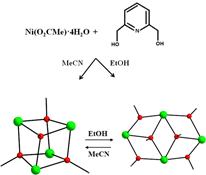
The first use of pyridine-2,6-dimethanol in NiII cluster chemistry has afforded two new tetranuclear complexes through a simple change in the nature of the reaction solvent. Both complexes possess an S = 0 spin ground state, albeit with differences in the strength of the magnetic exchange interactions, as a result of their different metal topology (cubane vs. defective dicubane).
CH12442Detection of Advanced Glycation End-Products (AGEs) During Dry-State Storage of ?-Lactoglobulin/Lactose
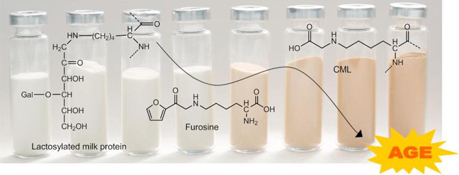
Formation of advanced glycation end products (AGEs) in dry-state storage of a milk protein is analysed by use of an immunochemical method, which correlates with traditional analysis of chemical markers formed during heat processing of foods.
CH12448Structural and In Vitro Biological Studies of Organotin(IV) Precursors; Selective Inhibitory Activity Against Human Breast Cancer Cells, Positive to Estrogen Receptors
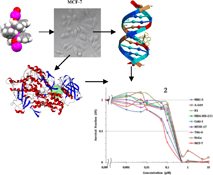
The organotin compounds [Ph3SnCl] (1), [Ph3SnOH]n (2), and [(Ph2Sn)4Cl2O2(OH)2] (3) were evaluated for their binding properties towards lipoxygenase (LOX) and calf thymus-DNA and the results are compared with their in vitro cytotoxicity against a panel of cancer cell lines. Compounds 1 and 2 showed selective cytotoxic activity against carcinoma cells, especially against MCF-7 (human breast adenocarcinoma) cells.
CH12353Ion-Pair Recognition by Metal–Salophen and Metal–Salen Complexes
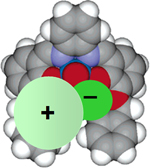
This short review shows the high versatility of salen and salophen ligands and of the corresponding metal complexes to behave as ditopic receptors for ion pairs. The possibility to modulate their structure within wide limits provides new opportunities for their application in the field of membrane transport, salt solubilization, salt extraction, and sensing.
CH12366Progress in Microwave-Aided Chemical Synthesis
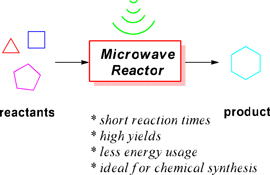
In this short review, we present recent applications of microwave-aided chemical synthesis in organic, medicinal, and natural product synthetic endeavours.
CH12327Mass Spectrometry of Cyclopentadienylideneketene: Differentiation of Isomeric Ion Structures by Means of Ion/Molecule Reactions
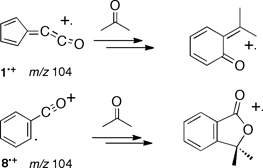
The isomeric radical cations 1+. and 8+. derived from cyclopentadienylideneketene and phthalic anhydride, respectively, are differentiated by ion/molecule reactions with acetone.
CH12270Synthesis, Structure, and Properties of a Chiral Zinc(II) Metal-Organic Framework Featuring Linear Trinuclear Secondary Building Blocks
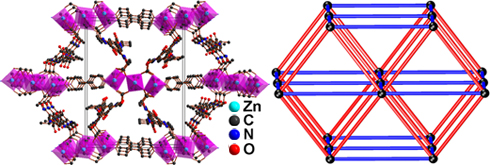
We report here a chiral metal-organic framework built from a semi-flexible linker of trimesoyltri(L-alanine), which features eight-connected linear trinuclear nodes and triangular prism-like one-dimensional channels. The dehydrated title compound shows remarkable adsorption selectivity on CO2 and water vapour over N2 gas.
CH12115Synthesis of Diphenyl Carbonate from Carbon Dioxide, Phenol, and Carbon Tetrachloride Catalysed by ZnCl2 Using Trifluoromethanesulfonic Acid as Functional Co-Catalyst

Diphenyl carbonate has been successfully synthesised from carbon dioxide, phenol, and carbon tetrachloride catalysed by ZnCl2 with the addition of co-catalyst. The catalytic activity of ZnCl2 is significantly improved by trifluoromethanesulfonic acid (CF3SO3H).
CH12325Synthesis, Structure, Physical Properties, and Displacement Current Measurement of an n-Type Organic Semiconductor: 2:3,5:6-Bis(1,1-dicyanoethylene-2,2-dithiolate)-quinone
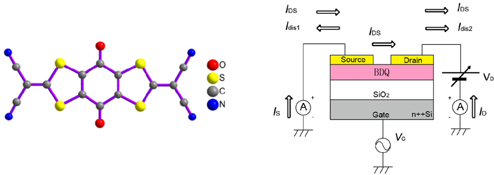
An n-type organic semiconductor 2:3,5:6-bis(1,1-dicyanoethylene-2,2-dithiolate)- quinone (BDQ) has been successfully synthesised and characterised. BDQ is a planar molecule with strong face-to-face π-π stacking (3.40 Å) and S···S interactions (3.66 Å) between neighbouring molecules. The displacement current measurement of BDQ-based devices is also demonstrated and discussed.
CH12358Probing for the Pharmacophore of the Cytotoxic Neoclerodane Salvileucalin B
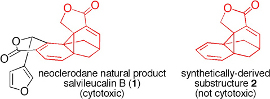
A pentacyclic compound, 2, embodying key features of the core of the neoclerodane salvileucalin B (1) has been prepared, using a rhodium-catalysed intramolecular Büchner reaction as the key step, but found to lack the cytotoxic properties of the natural product.
CH12350Cu(OAc)2-Mediated Cross-Coupling Reaction of Benzophenone N,N,N-Trimethylhydrazonium Salts and Aryl Boronic Acids
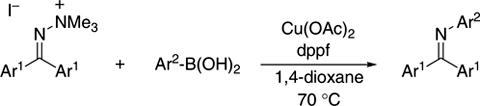
In this paper, Cu(OAc)2-mediated coupling of benzophenone N,N,N-trimethylhydrazonium salts and aryl boronic acids is described. The coupling products, N-aryl imines would be formed via N(sp2)–N(sp3) bond cleavage in the hydrazonium salts with a copper complex.