
119 CRYOPRESERVATION OF BIOPSIED BOVINE EMBRYOS PRODUCED IN VITRO USING ARABINOGALACTAN AND 1.5 M ETHYLENE GLYCOL
B. Shangguan A , N. Yang A , R. Vanderwal A and M.D. Darrow AAbbotsford Veterinary Clinic, Ltd., Abbotsford, British Columbia, Canada. email: b_shangguan@hotmail.com
Reproduction, Fertility and Development 16(2) 182-182 https://doi.org/10.1071/RDv16n1Ab119
Submitted: 1 August 2003 Accepted: 1 October 2003 Published: 2 January 2004
Abstract
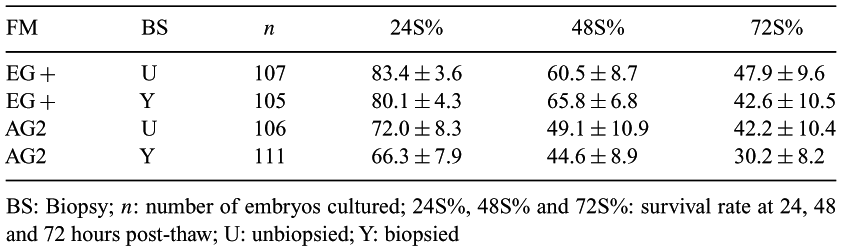
Arabinogalactan (AG) in combination with 1.5 M ethylene glycol (EG) has been used successfully in cryopreserving biopsied in vivo bovine embryos (Darrow, 2002 Theriogenology 57(1), 531). This study was undertaken to investigate the efficiency of AG addition in a freezing medium (FM) to cryopreserve biopsied bovine embryos produced in vitro (IVP). Blastocysts of grade 1 were collected at Days 7 and 8 post-insemination. After biopsy with a small blade, embryos were transferred to CR1aa medium and cultured for 2 hours (h) before being frozen. In experiment 1, a group of unbiopsied embryos were handled in a manner similar to that used for the biopsied embryos. Embryos were frozen using either 1.5 M EG + 0.1 M sucrose (EG+) (AB Technology, Pullman, WA, USA) or a FM containing 1.5 M EG and different concentrations of AG (AG1, 2 and 3, courtesy of AB Technology). Embryos remained in FM for 10 (exp.1), 5 (exp.2), 5 and 10 (exp.3) or 5, 10, and 20 (exp.4) minutes before being loaded into a freezer and cooled down to −35°C at 0.3°C/min. Frozen embryos were thawed (35°C, 20 seconds) and cultured in CR1aa at 38.5°C for 3 days. Embryo survival rates (S%) were recorded at 24, 48 and 72 h post-thawing. Data were compared with t-test or ANOVA procedures using SigmaStat 3.0. Results from exp.1 (Table) indicate that biopsied and unbiopsied embryos survived well in EG+ or AG2. While the biopsy procedure did not affect the post-thaw S% of embryos in either FM, no significant differences were observed between embryos frozen with EG+ and AG2 (P = 0.055). Reducing or increasing AG concentration in FM by 2-fold (AG1 and 3, respectively) did not significantly affect the post-thaw S% at 24 h (EG+, 80.0%, n = 133; AG1, 83.3%, n = 135; AG2, 71.4%, n = 137 and AG3, 75.0%, n = 135; P = 0.217, exp.2). However, shortened exposure from 10 to 5 minutes to AG2 resulted in an improvement in S% at 24 h, from 35.7% (n = 80) to 61.4% (n = 82, P < 0.05; exp.3). When AG1 (= 0.5 × AG2) was used in the FM the S% at 24 h after different exposure times was not significant (5 minutes, 77.8%, n = 179; 10 and 20 minutes, 66.7%, n = 179 and 183; P = 0.472, exp.4). This study demonstrates that addition of AG to the FM effectively sustains the viability of biopsied IVP embryos during freezing and any potential harmful impact of AG on embryo survival can be minimized by reducing AG concentration or the time of embryo exposure to AG prior to freezing. Further studies are needed to determine optimal AG concentration. Currently, field trials are underway to evaluate the ability of AG medium to promote pregnancies from frozen, biopsied IVP embryos.
|