
25 COLD STORAGE OF TISSUES AS SOURCE FOR DONOR CELLS DOES NOT REDUCE THE IN VITRO DEVELOPMENT OF BOVINE EMBRYOS FOLLOWING NUCLEAR TRANSFER
S. Arat A , H. Bagis A , F. Ergin A , H. Sagirkaya B , H.O. Mercan A and A. Dinnyes CA Research Institute for Genetic Engineering and Biotechnology, TUBITAK, Kocaeli, Turkey. email: sezen@rigeb.gov.tr;
B Department of Artificial Insemination and Reproduction, Uludag University, Bursa, Turkey;
C Research Group for Applied Animal Genetics and Biotechnology, Hungarian Academy of Sciences, Gödöllö, Hungary.
Reproduction, Fertility and Development 16(2) 135-135 https://doi.org/10.1071/RDv16n1Ab25
Submitted: 1 August 2003 Accepted: 1 October 2003 Published: 2 January 2004
Abstract
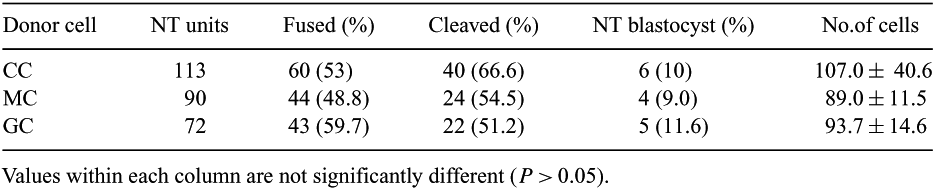
So far, most calves have been cloned from live adult cows or fresh fetal samples. There are few reports on using cells from a dead mammal for nuclear transfer (NT). This study was conducted to investigate whether different kind of viable cells could be obtained from tissues stored in cold for different duration and whether these cells could be used for NT. Bovine oocytes isolated from slaughterhouse ovaries were matured in TCM199 supplemented with 10% fetal calf serum (FCS), 50 μg mL−1 sodium pyruvate, 1% v:v penicillin-streptomycin (10.000 U mL−1 penicillin G, 10.000 μg mL−1 streptomycin), 10 ng mL−1 EGF, 0.5 μg mL−1 FSH, and 5 μg mL−1 LH. First cell line (CC) was established from articular cartilage of the leg of a slaughtered cow stored at 0°C in a cold storage room for 48 h. Second cell line (MC) was established from leg muscle of a cow carcass stored at 0°C for 24 h. Tissues from articular cartilage and muscle were cut into small pieces. Tissue explants were cultured in DMEM-F12 supplemented with 10% FBS at 37°C in 5% CO2 in air. Bovine granulosa cells (GC) were isolated from ovarian follicles and used for NT as control cells. Prior to NT, all somatic cells were allowed to grow to confluency (G1/G0) in DMEM-F12 supplemented with 10% FBS. Cumulus cells were removed by vortexing with hyaluronidase at 18 h after the start of maturation. Matured oocytes labeled with DNA fluorochrome Hoechst 33342 were enucleated under UV to ensure full removal of the chromatin. A single cell was inserted into the perivitelline space of the enucleated oocyte. Oocyte-cell couples were fused by a DC pulse of 133V/500 μm for 25 μs. After fusion, NT units were activated using a combination of calcium ionophore (5 μM), cytochalasin D (2.5 μg mL−1), and cycloheximide (10 μg mL−1), and cultured for 7 days. Differences among groups were analyzed by one-way ANOVA after arcsin square transformation. The results are summarized in Table 1. The results suggest that viable cells can be obtained from articular cartilage and muscle of a cow carcass stored at cold temperature for 24 and 48 h and these cells have ability to generate NT blastocysts at rates similar to that of the controls. This study was supported by a grant from TUBITAK, Turkey (VHAG-1908-102V048). F Ergin is a volunteer young researcher.
|