
4 CHROMOSOMAL STABILITY OF AFRICAN WILD CAT (FELIS SILVESTRIS LIBICA) SOMATIC CELLS AND CLONED EMBRYOS
A.M. Giraldo A B , M.C. Gomez A B , B.L. Dresser B C , R.F. Harris B , A.L. King B and C.E. Pope BA Department of Animal Science, Louisiana State University, Baton Rouge, LA, USA. email: agirall@lsu.edu
B Audubon Center for Research of Endagered Species, NewOrleans, LA, USA
C Department of Biological Science, University of New Orleans, New Orleans, LA, USA.
Reproduction, Fertility and Development 16(2) 124-125 https://doi.org/10.1071/RDv16n1Ab4
Submitted: 1 August 2003 Accepted: 1 October 2003 Published: 2 January 2004
Abstract
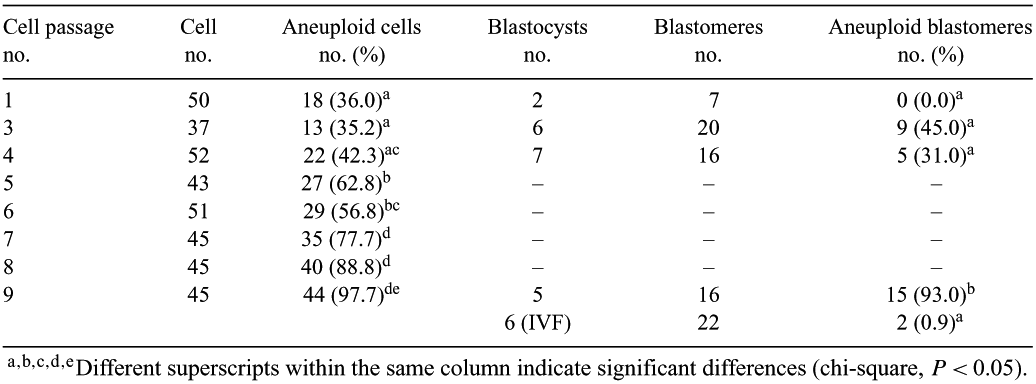
Nuclear transfer (NT) procedures are generally inefficient and chromosomal abnormalities have been suggested as one causative factor. Embryos derived by somatic cell NT show a high incidence of aneuploidy, which seems to be reflective of the donor cell line with high chromosomal abnormalities (Bureau et al., 2003, Theriogenology 59, 239). Also, aneuploidies in some cell lines increase progressively with the number of passages (Denning et al., 2001, Cloning 3, 221–231). Therefore, the aim of the present study was to analyze the chromosomal stability of donor cells at different passages as well as that of reconstructed embryos derived from these cells. A primary culture of African wild cat (AWC) fibroblast cells was established from a skin sample and cultured until cells stopped dividing at passage 9. Chromosome numbers were determined in cells using a karyotyping technique (Iwasaki et al., 1992 J Exp Zool 261, 79–85) at passages 1 and 3 through 9. At passages 1, 3, 4 and 9, NT of AWC fibroblast cells into domestic cat cytoplasts was done (Gomez et al., 2003, Biol Reprod 69, 1032–1041). Reconstructed blastocysts were treated with colcemid (0.28 μg mL−1) and fixed for karyotyping to evaluate chromosome numbers in the blastomeres. Blastomere metaphases were often highly contracted or overlapping, so that only 1 to 7 sets of metaphase chromosomes per embryo were spread sufficiently to allow determination of ploidy. No attempt to produce NT embryos using cells at passages 5 through 8 was done because the percentages of aneuploidies of these passages were not significantly different (P > 0.05). Data were analyzed by chi-square test (P < 0.05). As shown in the Table, the percentage of aneuploidy in the somatic cells increased progressively with duration of culture. Furthermore, the percentage of chromosomal abnormalities in reconstructed embryos was similar to that of the cells from which they were derived. Accordingly, for future NT, we propose to use donor cells at early passages when the percentage of cells with chromosomal abnormalities is still relatively low. Research was funded partially by the John & Shirley Davies Foundation.
|