
157 HOLSTEIN-CHINESE YELLOW HYBRID RECIPIENT OOCYTES RECOVERED BY OVUM PICKUP CAN IMPROVE THE DEVELOPMENT OF CLONED BOVINE EMBRYOS
X.Y. Yang A , J.G. Zhao A , H.W. Li A , H. Li A , H.F. Liu A , Y.T. Zeng A and S.Z. Huang AAInstitute of Medical Genetics, Shanghai Jiao Tong University, Shanghai, China. Email: ytzeng@stn.sh.cn
Reproduction, Fertility and Development 17(2) 229-229 https://doi.org/10.1071/RDv17n2Ab157
Submitted: 1 August 2004 Accepted: 1 October 2004 Published: 1 January 2005
Abstract
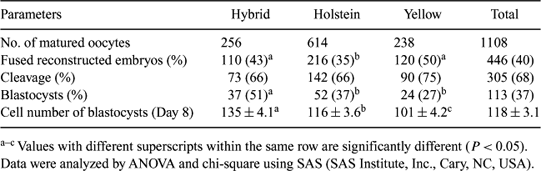
We used the subspecies hybrid F1 oocytes (Holstein/Chinese Yellow cattle) recovered by ovum pickup (OPU) as recipient cytoplasts to improve the development of bovine cloned embryos. Ten Holstein cattle, four Chinese Yellow cattle, and four hybrid F1 bovines were subjected to OPU once a week. In total, 44, 110, and 42 OPU sessions were respectively performed for hybrid cattle, Holstein cattle and Chinese Yellow cattle. The mean numbers of punctured follicles for hybrid and Yellow cattle were higher than for Holstein cattle (11.4 ± 0.5 and 11.7 ± 0.5 vs. 10.1 ± 0.7, mean ± SE), but the recovery rate for Holstein cattle was higher than that for hybrid and Yellow cattle (76.2% vs. 70.3% and 66.6%); therefore, recovered oocytes per session were similar in hybrid, Holstein, and Yellow cattle (8.0 ± 0.5, 7.7 ± 0.4 and 7.8 ± 0.5, respectively). No difference was shown in the quality of the recovered oocytes among the three breeds. The three kinds of recipient oocytes had a maturation rate of 72–73% (256/353, 614/847, and 238/327, respectively). Matured oocytes were used as recipients without selection, and same batch cumulus cells collected from Holstein cow were used as donor cells. The nuclear transfer procedure was essentially as described by Park et al. (2004 Mol. Reprod. Dev. 69, 365–374). Cleavage rate of reconstructed embryos was similar in the hybrid, Holstein, and Yellow groups (66%, 66%, and 75%, respectively). However, the blastocyst rate from the cleavage embryos (51% vs. 37% and 27%), cell number of each blastocyst on Day 8 (135 ± 4.1 vs. 116 ± 3.6, and 101 ± 4.2), and the percentage of Grade A blastocysts (54% vs. 42% and 29%) in the hybrid group were higher than in the Holstein and Yellow groups. The proportion of blastocyst production on Day 7 was greater in the hybrid group than in the Holstein and Yellow groups (89% vs. 71% and 63%). The blastocyst rate from morula in the hybrid group (84%, 37/44) was significantly higher than in the Holstein group (63%, 52/83) and the Yellow group (59%, 24/43). Taken together, these results strongly show that hybrid recipient oocytes can improve the development of cloned bovine embryos. It is suggested that the genetic heterogeneity of the hybrid recipient cytoplasm would lead to more possibilities of reprogramming and embryo development.
|
This work was supported by the Chinese “863” High-Tech Plan Program (Grant No. 2002AA206201).