
39 BOVINE SOMATIC CELL NUCLEAR TRANSFER USING CUMULUS–OOCYTE COMPLEXES COLLECTED FROM THE IDENTICAL INDIVIDUAL BY OVUM PICKUP
K. Hasegawa A , S. Takahashi B , S. Akagi B , K. Takeda B , K. Imai C , M. Shimizu B , T. Okazaki A , S. Abe A and Y. Izaike DA Shimane Prefectural Livestock Technology Center, Izumo, Shimane, Japan
B National Institute of Livestock and Grassland Science, Tsukuba, Ibaraki, Japan
C National Livestock Breeding Center, Nishishirakawa, Fukushima, Japan
D Iwate University, Morioka, Iwate, Japan
Reproduction, Fertility and Development 19(1) 138-138 https://doi.org/10.1071/RDv19n1Ab39
Submitted: 12 October 2006 Accepted: 12 October 2006 Published: 12 December 2006
Abstract
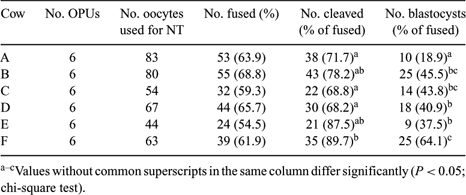
We previously produced a cloned calf by nuclear transfer (NT) using cumulus cells removed from cumulus–oocyte complexes (COCs) after IVM. If both cumulus cells and oocytes are obtained identically and individually, and can be used simultaneously for NT, the production of cloned cows will be more expedient. And the cloned offspring produced from them will not exhibit the heteroplasmic mixed mtDNAs of donor cells and recipient oocytes. In this study, we examined the developmental potential of NT embryos using cumulus–oocyte complexes (COCs) collected from cows individually by ovum pickup (OPU). The cumulus cells were removed from COCs after IVM. The cumulus cells and cumulus-free MII oocytes derived from the same cow were used as donor nuclei and recipient oocytes, respectively. NT was performed as previously described (Akagi et al. 2003 Clon Stem Cells 5, 101–108). In Experiment 1, we examined the in vitro development of NT embryos using COCs collected by OPU. The aspiration of the follicles was performed once a week consecutively for 6 weeks in 6 cows (Cows A, B, C, D, E, and F) without hormone stimulation. In Experiment 2, we examined fetal development after the transfer of NT embryos. A Japanese black cow (Cow G) was used for OPU. On Day 7, 13 NT blastocysts were transferred to 7 recipient cows. The mtDNA genotypes of the donor cow and the cloned calf were analyzed by PCR-mediated single-strand conformation polymorphism analysis as previously described (Takeda et al. 2003 Mol. Reprod. Dev. 64, 429–437). The results of Experiment 1 are summarized in Table 1. Fusion rates did not differ among individual cows. However, the developmental rates of NT embryos at the blastocyst stage varied widely among individual cows, with a range of 19 to 64%. In Experiment 2, 2 of 7 recipient cows became pregnant on Day 30. One pregnant cow aborted on Day 60, and another cow calved a healthy calf. The mtDNA genotype of the cloned calf was confirmed to be identical with that of the donor cow. These results indicate that COCs from an identical individual can be used as donor nuclei and recipient oocytes for NT in order to produce female clones with the same mtDNA as that of the donor cow.
|