
272 INTRACELLULAR NITRIC OXIDE LEVEL OF PORCINE OOCYTES IS NEGATIVELY CORRELATED WITH OOCYTE MATURATION RATE AND CUMULUS EXPANSION INDEX IN A CHEMICALLY DEFINED MEDIUM
T. Uozumi A and H. Funahashi AOkayama University, Okayama, Japan
Reproduction, Fertility and Development 23(1) 234-234 https://doi.org/10.1071/RDv23n1Ab272
Published: 7 December 2010
Abstract
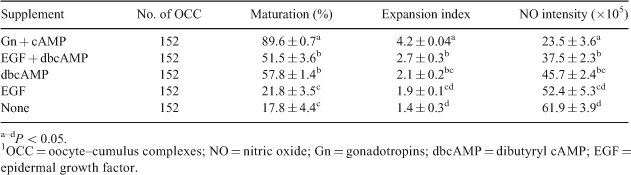
Nitric oxide (NO) has been known to inhibit nuclear maturation in cumulus–enclosed oocytes in rodents. The objective of this study was to examine if meiotic stimulators, such as dibutyryl cAMP and epidermal growth factor (EGF), influence intracellular NO level of oocytes and if the level is correlated with oocyte maturation rate and cumulus expansion in a chemically defined medium. Oocyte–cumulus complexes (OCC) were aspirated from mid-size follicles (3–6 mm in diameter) of prepuberal porcine ovaries. The OCC were cultured in modified porcine oocyte medium with various supplements – gonadotropins plus dibutyryl cAMP (Gn + cAMP), EGF plus dibutyryl cAMP (EGF + cAMP), dibutyryl cAMP alone (cAMP), EGF alone (EGF), and non-supplements (none) – for a first 20-h period and then in fresh porcine oocyte medium (without those supplements) for another 24 h in an atmosphere of 5% CO2 in air at 39°C. Following in vitro maturation culture, OCC were assessed for the degree of cumulus expansion (scored from 0 as cumulus free to 5 as full expansion) and then additionally cultured with DAF2-DA, an indicator of NO, for an additional 1-h period in the same condition. The oocytes were denuded with 0.1% hyaluronidase, and the intensity of fluorescence was measured. The oocytes were also fixed, stained with acetic orcein, and observed for meiotic stage. Statistical analysis was performed by ANOVA with a Bonferroni-Dunn post hoc test (significance, P < 0.05). Maturation rates and cumulus expansion indexes were significantly affected by various supplement conditions (Table 1). The intensity of fluorescence showing intracellular NO level was also different among experimental groups (Table 1). A negative correlation was found between intracellular NO intensity and maturation rate (r2 = 0.71) or cumulus expansion index (r2 = 0.70). From these results, we conclude that there is a synergistic effect of cAMP and EGF on cumulus expansion and oocyte maturation and the reduction of oocyte NO levels in a chemically defined medium. Furthermore, a reduction of oocyte NO level seems to be included in the induction of cumulus expansion and oocyte maturation.
|