
Can bare ground cover server as a surrogate for plant biodiversity in grazed tropical woodlands?
Juliana McCosker A D , John Rolfe B and Rod Fensham CA Environmental Protection Agency, PO Box 906 Emerald, Qld 4720, Australia.
B Central Queensland University, Rockhampton, Qld 4701, Australia.
C Queensland Herbarium, Environmental Protection Agency, Mt Coot-tha Road Toowong, Qld 4066, Australia.
D Corresponding author. Email: juliana.mccosker@epa.qld.gov.au
The Rangeland Journal 31(1) 103-109 https://doi.org/10.1071/RJ08041
Submitted: 9 September 2008 Accepted: 17 February 2009 Published: 26 March 2009
Abstract
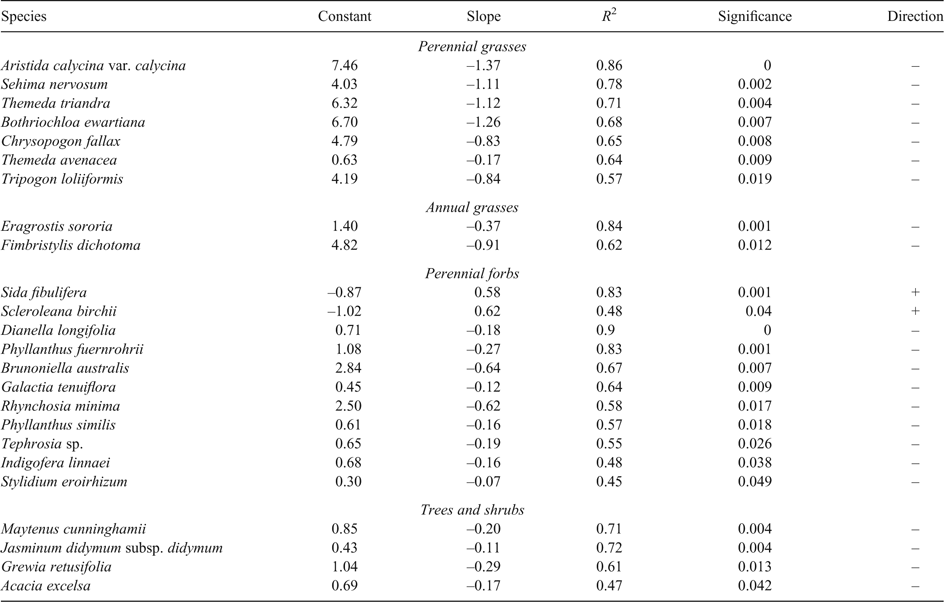
A bare ground index derived by remote sensing would provide a rapid methodology for assessing the biodiversity condition of an ecosystem, providing that ground cover is a satisfactory correlate with key biodiversity attributes. The relationship between plant species richness and the abundance of individual species was examined in relation to ground cover within silver-leaved ironbark (Eucalyptus melanophloia F. Muell.) woodlands in the Desert Uplands bioregion of north-eastern Australia. There was significant correlation between the bare ground index and ground cover and biomass measurements. Twenty-four species, including the perennial grasses Sehima nervosum (Rottler) Stapf, Themeda triandra Forssk. and Bothriocloa ewartiana (Domin) C.E. Hubb., were significantly and negatively correlated with bare ground. Scleroleana birchii (F. Muell.) Domin and Sida fibulifera Lindl.displayed significant positive relationships with increasing bare ground, and where abundant indicate heavy grazing in this land type. The study suggests that satellite-derived data does provide a meaningful methodology for assessing vegetation condition although it is strongly associated with seasonal conditions, but is only useful in relation to the regional average for a land type. The findings suggest that plant diversity is maintained at a relatively high level throughout most of these woodlands in the Desert Uplands.
Additional keywords: bare ground index, biodiversity condition, grazing, plant composition, silver-leaved ironbark.
Acknowledgements
We would like to thank the following people who assisted with fieldwork: Joe Halloran, John Augusteyn, Samantha Evans, Cameron James, Karen Aitchison and Tim Murphy. Many thanks to all the property owners who allowed us access to the sites. Thank you also to two anonymous reviewers and Dr A.J. Pressland for useful comments that helped to improve this manuscript.
Fairfax R. J., Fensham R. J.
(2000) The effect of exotic pasture development on floristic diversity in central Queensland, Australia. Biological Conservation 94, 11–21.
| Crossref | GoogleScholarGoogle Scholar |

Fensham R. J., Skull S. D.
(1999) Before cattle: a comparative floristic study of Eucalyptus savanna grazed by macropods and cattle in North Queensland, Australia. Biotropica 31, 37–47.
Gibbons P., Freudenberg D.
(2006) An overview of methods used to assess vegetation condition at the scale of the site. Ecological Management & Restoration 7, S10–S17.
| Crossref | GoogleScholarGoogle Scholar |
Jackson J.
(2005) Is there a relationship between species richness and buffel grass (Cenchrus ciliaris). Austral Ecology 30, 505–517.
| Crossref | GoogleScholarGoogle Scholar |
Landsberg J., Crowley G.
(2004) Monitoring rangeland biodiversity: plants as indicators. Austral Ecology 29, 59–77.
| Crossref | GoogleScholarGoogle Scholar |
Landsberg J.,
James C. D.,
Morton S. R.,
Muller W. J., Stol J.
(2003) Abundance and composition of plant species along grazing gradients in Australian rangelands. Journal of Applied Ecology 40, 1008–1024.
| Crossref | GoogleScholarGoogle Scholar |
Ludwig J. A.,
Bastin G. N.,
Wallace J. F., McVicar T. R.
(2007) Assessing landscape health by scaling with remote sensing: when is it not enough? Landscape Ecology 22, 163–169.
| Crossref | GoogleScholarGoogle Scholar |
Lunt I. D.,
Eldridge D. J.,
Morgan J. W., Witt B.
(2007) A framework to predict the effects of livestock grazing and grazing exclusion on conservation values in natural ecosystems in Australia. Australian Journal of Botany 55, 401–415.
| Crossref | GoogleScholarGoogle Scholar |
MacLeod N. D., McIvor J. G.
(2006) Reconciling economic and ecological conflicts in the use of grazing lands. Ecological Economics 56, 386–401.
| Crossref | GoogleScholarGoogle Scholar |
McIntyre S., Filet P. G.
(1997) Choosing appropriate taxonomic units for ecological survey and experimentation: the response of Aristida to management and landscape factors as an example. The Rangeland Journal 19, 26–39.
| Crossref | GoogleScholarGoogle Scholar |
McIvor J. G.
(2007) Pasture management in semi-arid tropical woodlands: dynamics of perennial grasses. The Rangeland Journal 29, 87–100.
| Crossref | GoogleScholarGoogle Scholar |
Pickup G.,
Bastin G. N., Chewing V. H.
(1994) Remote sensing-based condition assessment for non-equilibrium rangelands under large-scale commercial grazing. Ecological Applications 4, 497–517.
| Crossref | GoogleScholarGoogle Scholar |
Pringle H. J. R., Landsberg J.
(2004) Predicting the distribution of livestock grazing pressure in rangelands. Austral Ecology 29, 31–39.
| Crossref | GoogleScholarGoogle Scholar |
Vesk P. A., Westoby M.
(2001) Predicting plant species responses to grazing. Journal of Applied Ecology 38, 897–909.
| Crossref | GoogleScholarGoogle Scholar |
Wallace J.,
Behn G., Furby S.
(2006) Vegetation condition assessment and monitoring from sequences of satellite imagery. Ecological Management & Restoration 7, S31–S36.
| Crossref | GoogleScholarGoogle Scholar |
Ward D. P., Kutt A. S.
(2009) Rangeland biodiversity assessment using finescale on-ground survey, time series of remotely sensed ground cover and climate data: an Australian Savanna case study. Landscape Ecology 24, 495–507.
| Crossref |
Appendix 1. Significant relationships with bare ground are listed
For 25 species with no significant relationships are listed with their frequency in parenthesis. Perennial grasses: Aristida jerichoensis (282), Sporobolus carolii (14), Eragrostis lacunaria (169), Eriachne mucronata (217), Chloris ventricosa (17), Eragrostis spartinoides (10), Heteropogon contortus (60), Digitaria brownii (171), Eulalia aurea (14), Enneapogon lindeyanus (85), Digitaria ammophila (38), Chloris divaricata (13), Panicum effusum (268), Cymbopogon bombycinus (14), Cymbopogon refractus (7), Schizachyrium fragile (26), Enneapogon virens (329), Triodia pungens (393), Tragus australianus (10), Paraneurachne meulleri (16), Cenchrus ciliaris (106), Perennial forbs: Scleroleana muricata (70), Scleroleana convexula (28), Sida rohlenae (139), Cynodon dactylon (10), Hibiscus burtonii (74), Sida atherophora (115), Senna artemisioides subsp. filifolia (14), Abutilon sp. (38), Phyllanthus sp. (13), Indigofera linifolia (84), Desmodium varians (8), Hybanthus enneaspermus (21), Spermacoce brachystemma (9), Tephrosia leptoclada (7), Wultheria indica (16), Chaemasyce drummondii (33), Calotis xanthosioidea (33), Boerhavia pubescens (88), Alternanthera nana (30), Cheilanthes sieberi subsp. sieberi (13), Peripleura hispidula (17), Rostellularia adscendens (14), Gossypium australe (6), Corchorus aestuans (82), Solanum ellipticum (46), Tricoryne elatoir (13), Zornia muriculata (63), Evolvulus alsinoides subsp. decumdens (209), Annual grasses: Aristida holathera (147), Perotis rara (7), Dactyloctenium radulans (23), Annual forbs: Gomphrena celosioides (6), Portulaca oleracea (12), Portulaca pilosa (41), Oldenlandia mitrasacmoides (45), Heliotropium tanythrix (21), Alternanthera denticulata (20), Oldenlandia corymbosa (26), Trees and shrubs: Canthium oleifolium (33), Acacia melleodora (10), Acacia tenuissima (34), Opuntia stricta (16), Carissa ovata (52), Acacia coriacea subsp. sericophylla (107), Stylosanthes scabra (66), Petalostigma pubescens (15)
|