 |
 |
 |
 |
 |
 |
 |
 |
 |
 |
 |
 |
 |
 |
 |
Cabbage gum
Corymbia confertiflora (F.Muell.) K.D.Hill & L.A.S.Johnson, Telopea 6: 428 (1995).
Eucalyptus confertiflora F.Muell., J. Linn. Soc., Bot. 3: 96 (1859). T: Northern Territory: W of Katherine, 26 Oct. 1946, S.T.Blake 17300; neo: BRI; isoneo: K, MEL, NSW.
Description
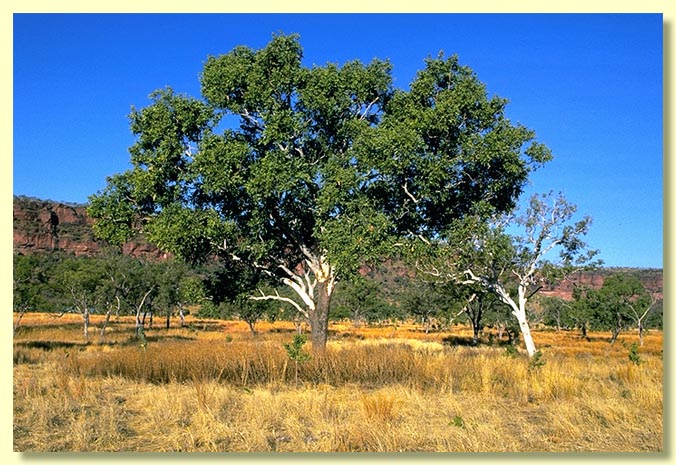
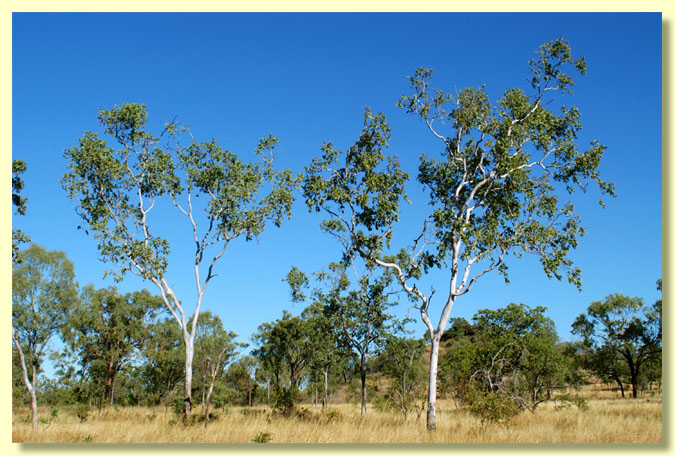
Tree 18 m tall, usually deciduous in the late dry season. Forming a lignotuber.
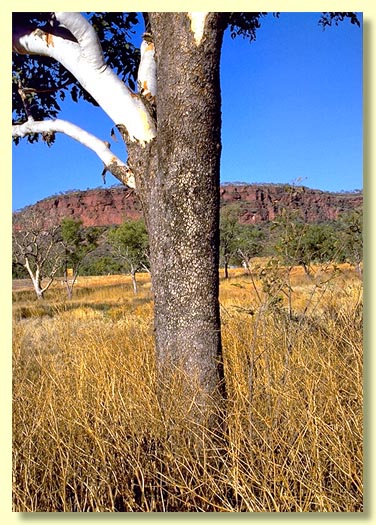
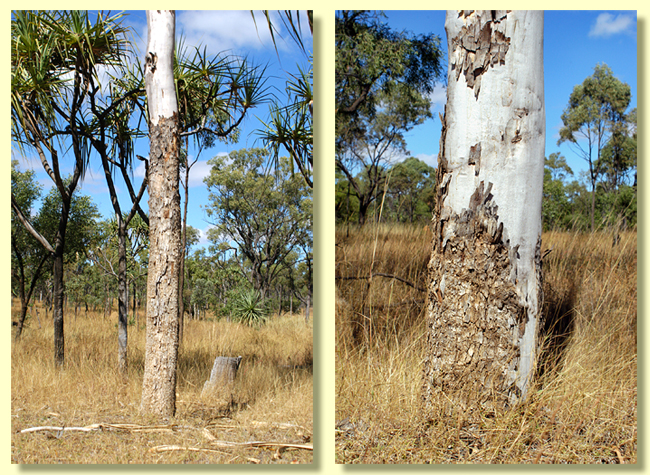
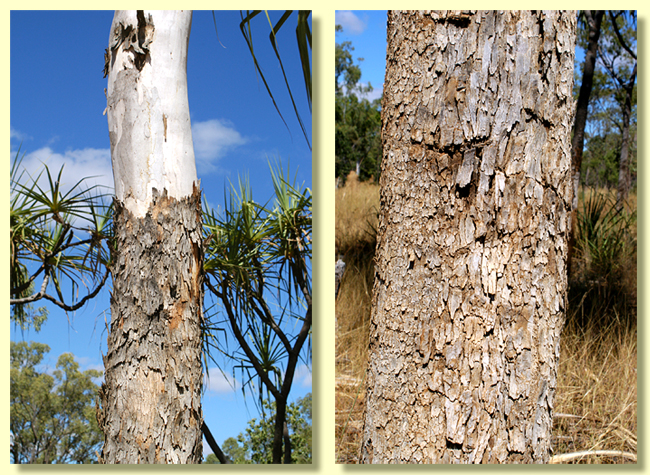
Bark rough, persistent, tessellated and blackish grey for basal 0.5–3 m of trunk, rarely the whole trunk, then abruptly becoming smooth, white to pale grey, shedding in thin flakes.
Branchlets sometimes have oil ducts visible in the pith; younger branchlets setose to scabrid with bristle-glands. In this species the bristle-glands usually lack simple hairs, but any are present then few and short.
Juvenile growth (coppice or field seedlings to 50 cm): stems rounded in cross-section, setose with bristle-glands to sparsely so, sometimes only present below the leaf axils; juvenile leaves always sessile, opposite, sub-orbicular to cordate or ovate-elliptic, 9.8–23 cm long, 4.2–17 cm wide, base usually amplexicaul or rounded, apex rounded, margin entire, green, dull, setose with bristle-glands.
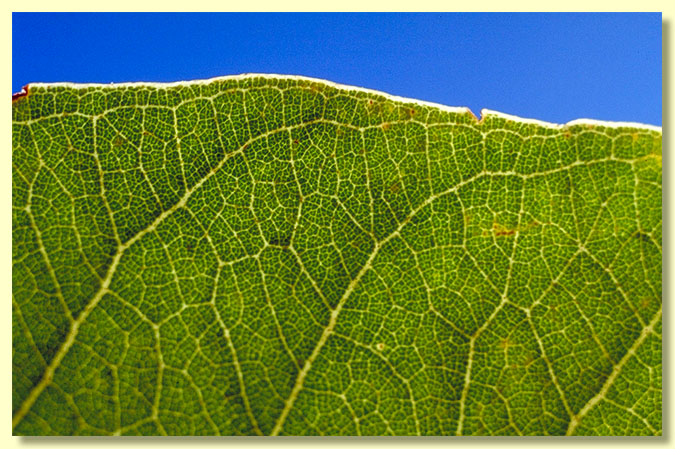
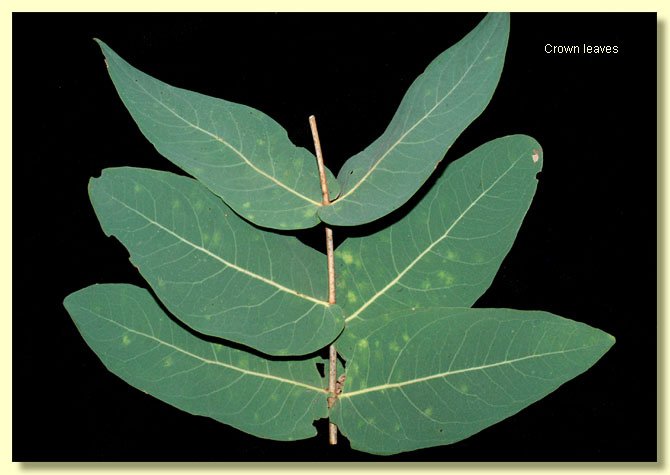
Crown of intermediate to adult leaves, opposite or sometimes ± sub-opposite, sessile or shortly petiolate, petioles 0–0.3(0.5) cm long; blade cordate to broadly elliptic or lanceolate to ovate, 5–16(21) cm long, (1.8)2.5–10.3 cm wide, ± undulate, base amplexicaul to lobed or rounded, margin entire or distantly sub-crenulate, apex rounded or broadly pointed, concolorous, dull, green, setose with bristle-glands that usually lack or have few short simple hairs, side-veins at greater than 45° to midrib, reticulation dense to very dense, intramarginal vein present, oil glands obscure. The new season’s leaf growth is often reddish purple at first.
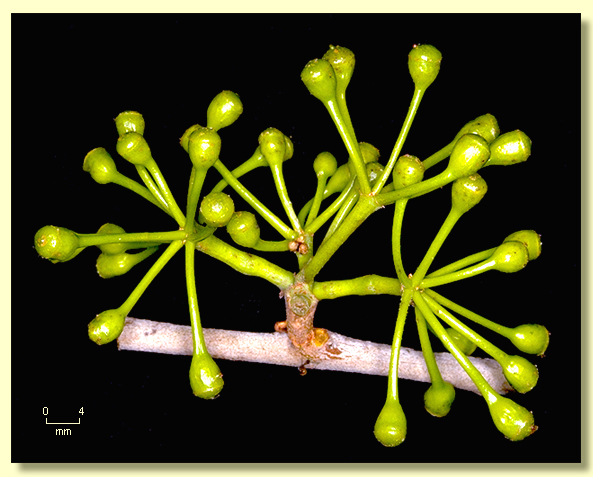
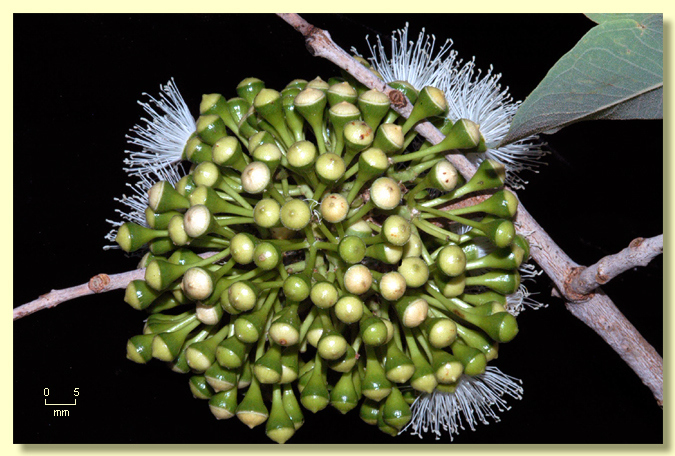
Inflorescences born on leafless sections of branchlets below new season’s leaf growth, axillary compound and greatly condensed, the rhachis consisting of a basal internode ca 0.1–1 cm long, a second internode absent or if present 0.1–0.7 cm long, further internodes sometimes present and always short (< 0.2 cm); peduncles of variable length within a single inflorescence, 0–1.7 cm long; buds in umbels of 7 or possibly more than 7 (often difficult to tell especially if peduncles are short or absent), strongly pedicellate (pedicels 0.7–3 cm long). Mature buds pyriform (0.4–0.7 cm long, 0.4–0.5 cm wide), smooth, scar present (outer operculum shed early), operculum shallowly rounded, sometimes apiculate, stamens inflexed, all fertile, anthers oblong, dorsifixed, versatile, dehiscing by longitudinal slits, style long and straight, stigma tapered, locules 3, the ovules not arranged in distinct vertical rows on the placentae but sometimes appearing to be in ± 5 rows. Flowers creamy white.
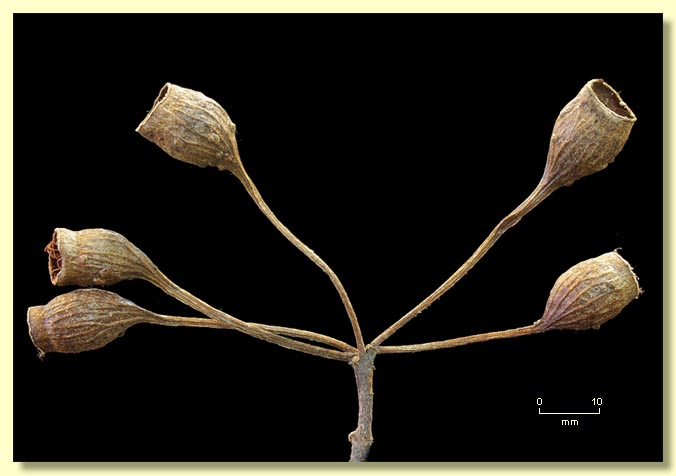
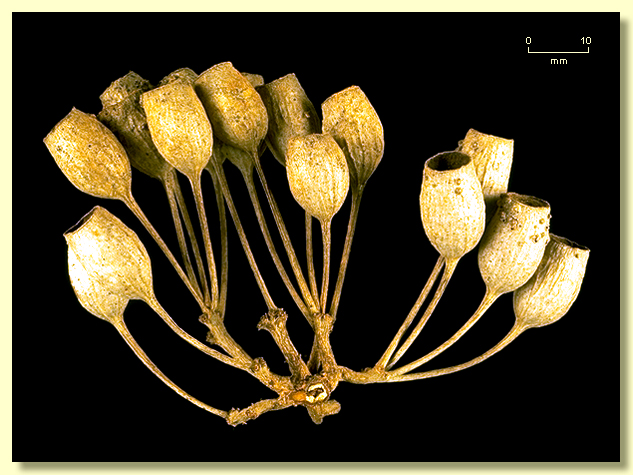
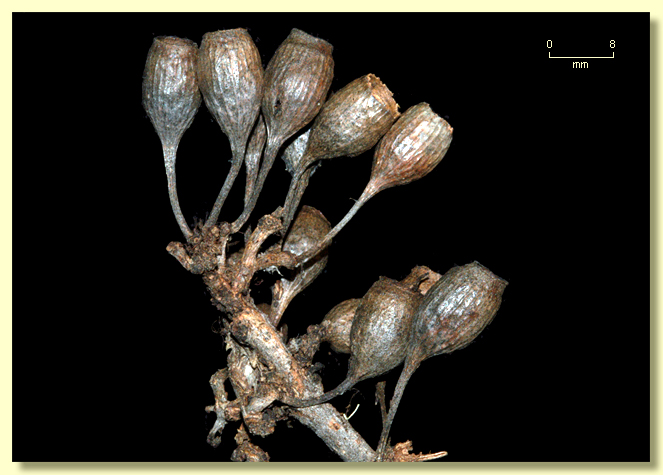
Fruit pedicellate (pedicels 1–3.5 cm long), cylindrical to barrel-shape to campanulate, 0.7–1.5 cm long, 0.6–1.2 cm wide, thin-walled, disc descending vertically, valves 3, enclosed.
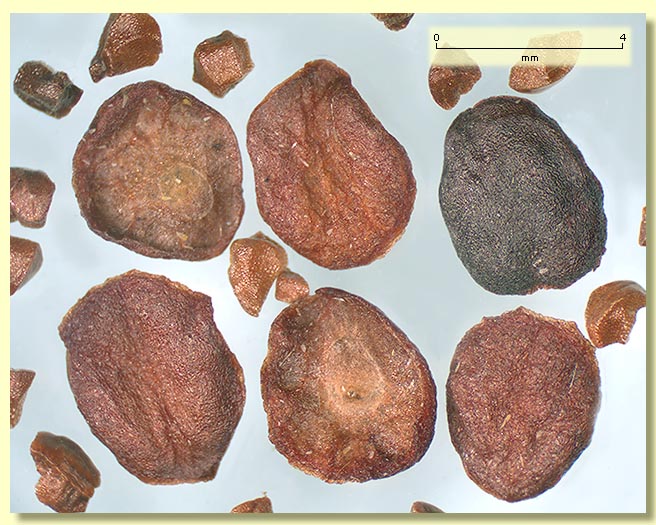
Seeds brown, 3–5 mm long, saucer-shaped, smooth, hilum ventral.
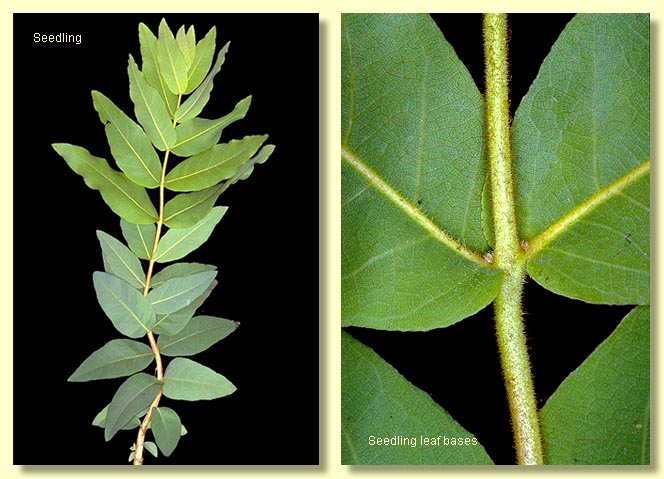
Cultivated seedling (measured at ca node 10): cotyledons large, ± orbicular; stems rounded in cross-section, setose with long bristle-glands; leaves sessile, opposite for at least 12+ nodes, ovate to elliptic, 4.8–11 cm long, 1.2–5.7 cm wide, base amplexicaul to rounded, apex pointed, dull, green, setose with bristle-glands on both sides.
Notes
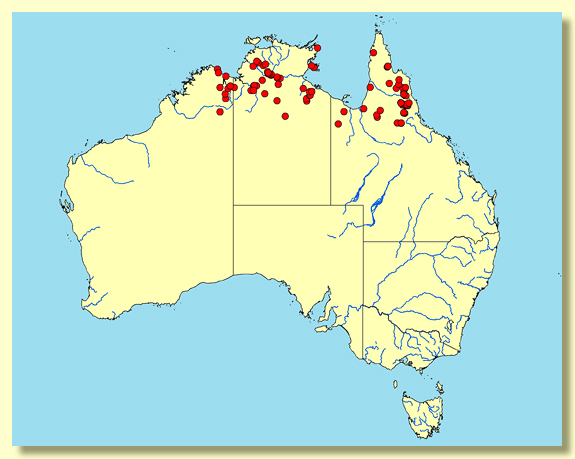
A ghost gum tree widespread in monsoonal northern Australia east from Turkey Creek, Karunjie, Kununurra and Wyndham in the Kimberley region of Western Australia through the southern Top End of the Northern Territory, from Daly Waters and Pine Creek to south-eastern Arnhem Land, extending through the sub-coastal country around the Gulf of Carpentaria to near Townsville in Queensland and north to the Kennedy River. Corymbia confertiflora has a clearly tessellated stocking of rough bark, opposite, broad, dull, green, setose crown leaves that are sessile to very shortly petiolate with the base lobed and often stem-clasping. The leaves are usually deciduous in the mid to late dry season and the cream flowers develop in dense clusters on last year’s branchlets before or whilst the new crown leaves are forming. New crown leaves may be at first pinkish in colour then becoming green. The setae on youngest branchlets and leaves are rarely adorned by simple hairs except in the Kimberley area where there is often one or two simple hairs on most setae.
Corymbia confertiflora is closely related to three other species - C. disjuncta, C. pauciseta and C. dendromerinx. These species, together with a fifth taxon described by Hill & Johnson (1995) as Corymbia karelgica but not recognized in EUCLID, form a group which, prior to 1995, were all included under the name Eucalyptus confertiflora. The division of this taxon into several species was made in an attempt to resolve the wide variation in petiole length, leaf shape and size, leaf vestiture type and density, and pedicel length seen across the range which covers all of monsoonal northern Australia. Some specimens, especially where variable in leaf shape within the one tree crown may be impossible to determine satisfactorily to species level without resorting to geography and perhaps not even then.
As circumscribed here Corymbia confertiflora is distinguished from C. disjuncta by the much shorter petioles (petioles always present and usually > 1 cm long in the latter species). In the Kimberley region C. confertiflora is distinguished from C. dendromerinx by the longer pedicels of the buds (pedicels 0.6–1.2 cm in the latter) and by the nature and abundance of the setae on the crown leaves - in C. confertiflora the setae are moderately abundant but rarely adorned with simple hairs whilst in C. dendromerinx the setae are distributed densely on the leaf surface and appear much branched because each seta bears several simple hairs.
In the Northern Territory Corymbia confertiflora is distinguished from C. polysciada by the broader setose leaves, with leaves being lanceolate, petiolate and glabrous in the latter species. Both species have a stocking of rough bark. C. grandifolia differs from C. confertiflora by its smooth trunk, glossy green leaves and more robust buds and fruit. In lowland north-eastern Arnhem Land and the coastal area bordering the Arafura Sea another species of ghost gum related to C. confertiflora is found - C. pauciseta - differing in having glabrous or virtually glabrous crown leaves.
In Queensland Corymbia confertiflora differs from the partly rough-barked ghost gum C. tessellaris and smooth-barked C. dallachiana in the setose crown leaves (glabrous, lanceolate, petiolate in both these species) and also has much longer pedicels than either.
In Queensland in the area north-west and west of Mareeba Corymbia confertiflora hybridizes with another ghost gum species, probably C. tessellaris, the result being trees with basal rough tessellated bark, smooth upper trunk and branches, a crown predominantly of opposite to sub-opposite, dull green, slightly setose to ± glabrous, lanceolate-elliptic leaves on distinct but short (0.2–0.7cm) petioles, and with the small compound axillary inflorescences with expanded rhachis internodes. These hybdrid trees were descibed by Hill & Johnson (1995) as Corymbia chillagoensis. This hybrid is not frequent in the wild and can be difficult to find and is not included in EUCLID.
MORE ABOUT CORYMBIA
MORE ABOUT GHOST GUMS
Flowering Time
Flowering has been recorded in July, August, September and October.
Origin of Name
Corymbia confertiflora: from Latin confertus, crowded and florus, flower.