 |
 |
 |
 |
 |
 |
 |
 |
 |
 |
 |
 |
Pilbara ghost gum
Corymbia ferriticola (Brooker & Edgecombe) K.D.Hill & L.A.S.Johnson, Telopea 6: 446 (1995).
Eucalyptus ferriticola Brooker & Edgecombe, Nuytsia, 5: 373 (1986). T: Western Australia: Wittenoom Gorge, 30 Oct. 1983, M.I.H.Brooker 8314 & W.B. Edgecombe; holo: PERTH; iso: CANB, K, MEL, NSW. 
Corymbia ferriticola subsp. sitiens L.A.S.Johnson & K.D.Hill, Telopea 6: 447 (1995). T: Western Australia: 49.9 km S from the northern end of the Alfred and Marie Range, between range and Lake Gruszka, M.I.H. Brooker 10704, 14 Apr. 1991; holo: NSW; iso: CANB, DNA, PERTH.
Description
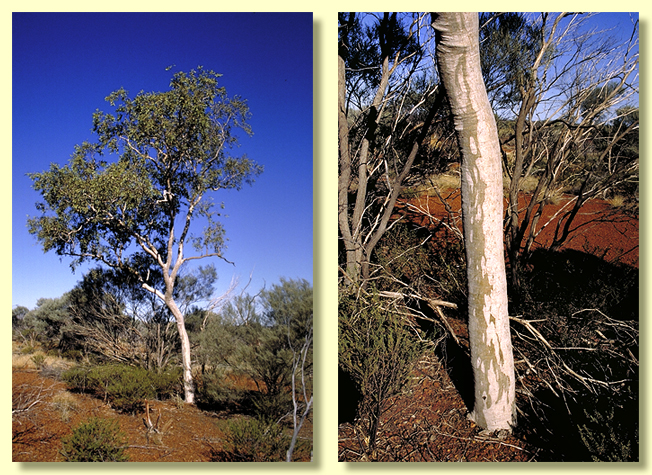
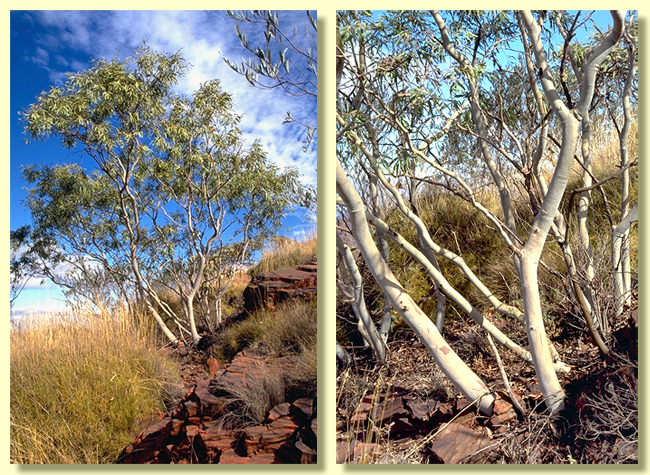
Mallee or Tree to 15 m tall, but often much shorter. Forming a lignotuber.
Bark usually smooth over the entire trunk, powdery, white to pink, weathering light brown to grey, sometimes with a small stocking of rough grey tessellated bark at the base.
Branchlets lacking oil glands in the pith; smooth.
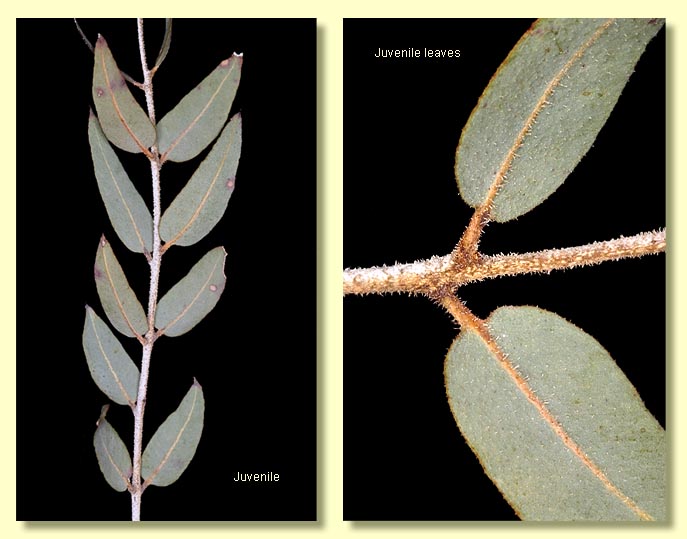
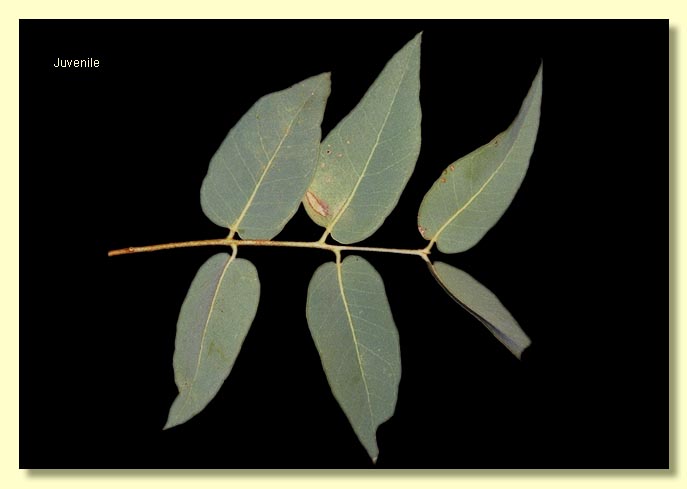
Juvenile growth (coppice or field seedlings to 50 cm): stems rounded in cross-section, setose but becoming smooth with age; juvenile leaves opposite to sub-opposite and shortly petiolate, cordate to ovate to broadly lanceolate, 3.5–8 cm long, 1.3–3.7 cm wide, base lobed to rounded, dull grey-green.
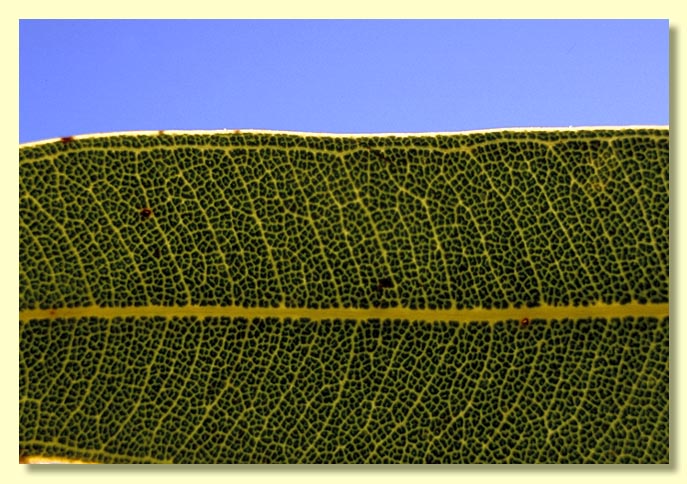
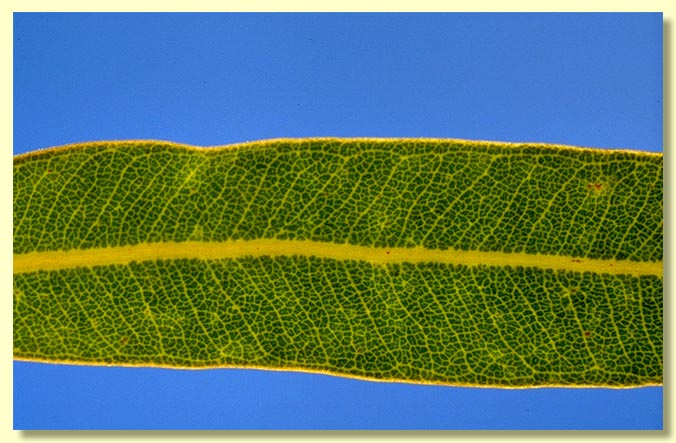
Adult leaves alternate, petiole 0.3–1.2 cm long; blade lanceolate, sometimes undulate, 4–10 cm long, 0.6–2.2 cm wide, base usually tapering to petiole, occasionally rounded, concolorous, dull to slightly glossy, grey-green to green, penniveined, densely to very densely reticulate, intramarginal vein present, oil glands abundant and island, but obscure.
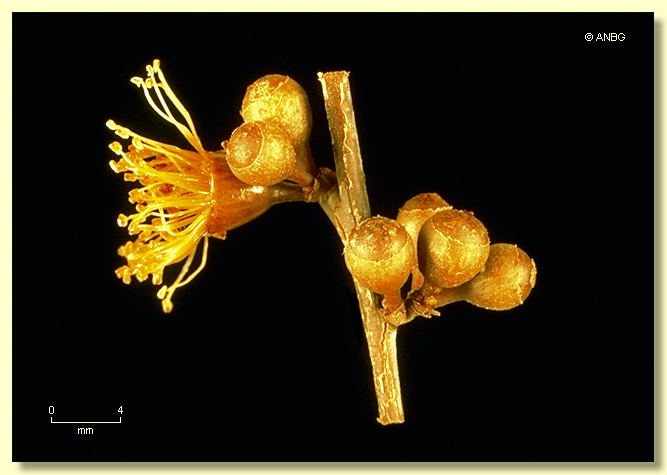
Inflorescences condensed axillary panicles, peduncles short, 0–0.2 cm long; buds 7 per umbel, pedicels 0.2–0.5 cm long. Mature buds pyriform, 0.4–0.5 cm long, 0.3–0.4 cm wide, smooth (not scurfy), scar present, operculum flattened, stamens inflexed, anthers oblong, versatile, dorsifixed, dehiscing by longitudinal slits (non-confluent), style long, stigma tapered, locules usually 4, the ovules not arranged in distinct vertical rows on the placentae. Flowers whitish.
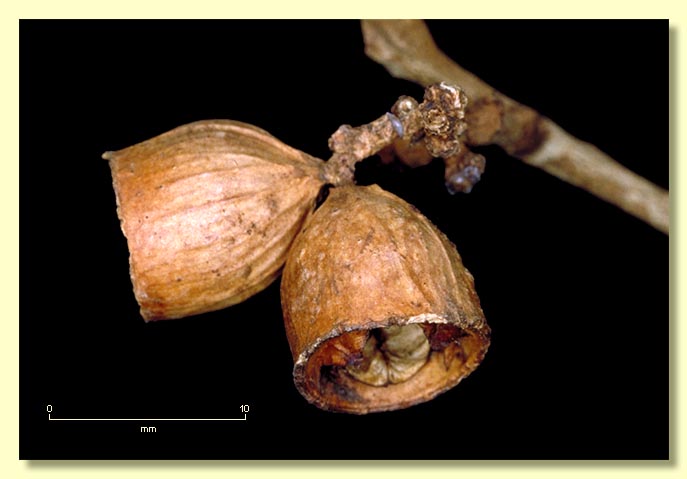
Fruit pedicellate (pedicels 0.1–0.5 cm long), truncate ovoid to more or less cylindrical, sometimes campanulate, 0.6–1 cm long, 0.4–0.9 cm wide, thin-walled, disc vertically descending, valves 4, enclosed.
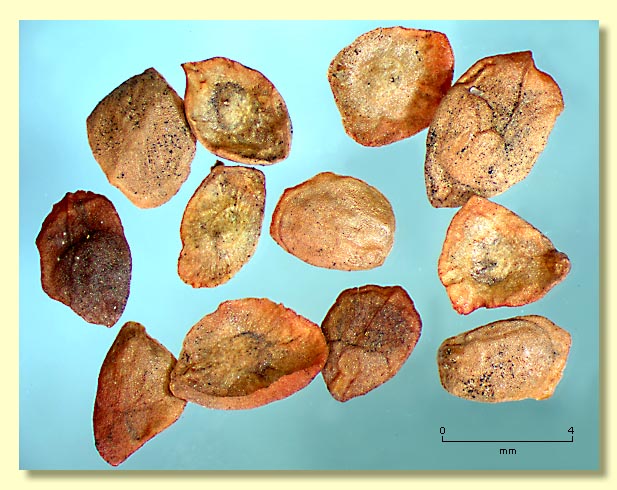
Seed brown, round and flattened (saucer-shaped), usually with a small membranous flange around the edge, 3–5 mm long, surface smooth, sometimes slightly lacunose, hilum ventral.
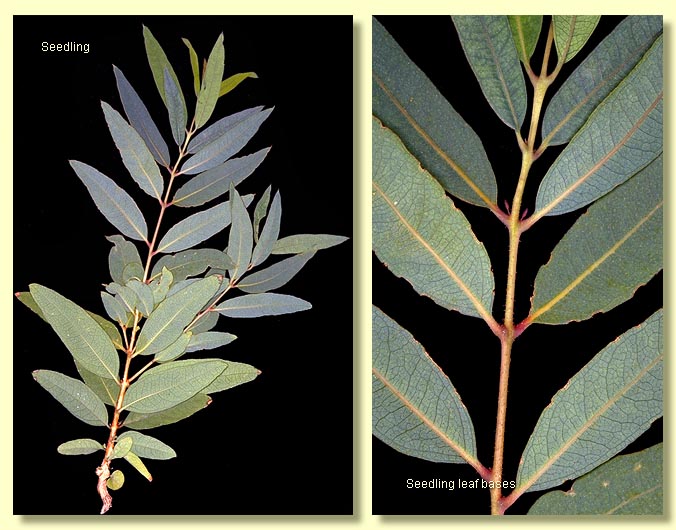
Cultivated seedling (measured at node 10): stems round in cross-section, setose throughout, leaves shortly petiolate, opposite, ovate, 4–11.5 cm long, 2.2–5 cm wide, dull yellow-green, apex acute, base rounded to tapering to the petiole, rarely lobed, usually setose on the under surface until at least node 17.
Notes
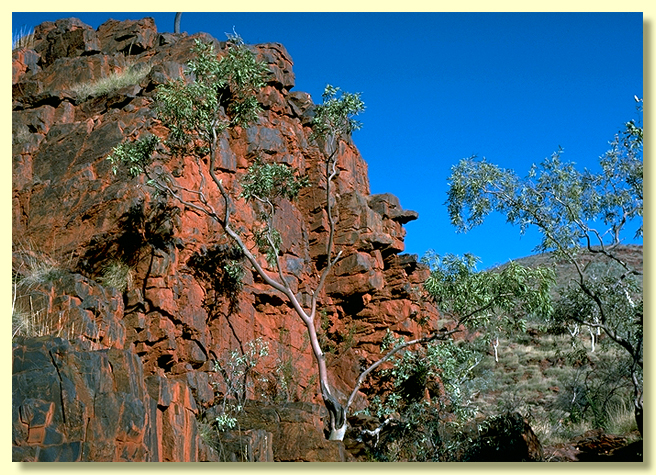
A mallee
or small straggly tree
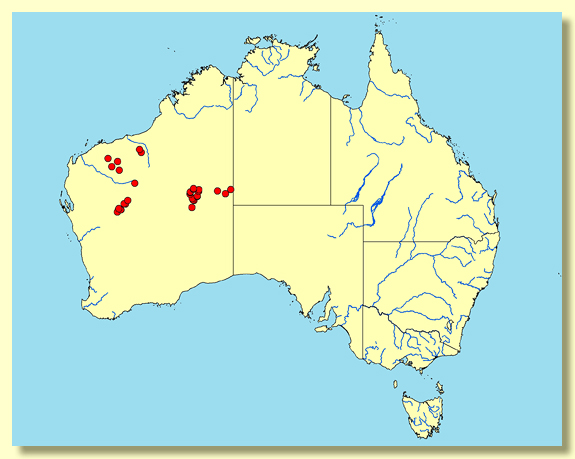
with the main distribution in the ironstone hills of the Pilbara region in
Western Australia, but with sporadic occurrences further south towards Mount
Augustus and Meekatharra and east to the Gibson Desert on Mount Beadell and
near Lake Gruszka, and the north-eastern fringe of the Great Victoria Desert.
Corymbia ferriticola has smooth bark,
often pink-brown to pale grey, but finally white and powdery.
The juvenile
leaves are ovate
and scabrid.
The adult
leaves are grey-green to green, glabrous
and lanceolate.
Corymbia ferriticola is a distinctive species
within its natural range, differing from the other common ghost gum species,
C. candida, in having a crown
of alternate
leaves that are glabrous
(smooth) with a tapering leaf base, never lobed, whilst C.
candida has opposite leaves with lobed to rounded often stem-clasping
leaf bases, and may be glabrous
or quite scabrid.
Both species
have thin-walled fruit
like all ghost gums. Within this zone there are three other white, smooth-barked
eucalypts - E. camaldulensis var. obtusa along rivers, E.
victrix in a variety
of habitats and E. leucophylla
subsp. leucophylla on ironstone hills - all easily distinguished
from the ghost gums by the small fruit
with prominently exserted valves.
Corymbia ferriticola subsp. sitiens, from remote stony to
rocky country between Carnegie and the Alfred and Marie Range in Western Australia,
was distinguished from subsp. ferriticola by having slightly narrower
and thicker-textured adult leaves and narrower intermediate leaves. Collections
are few and documentation of juvenile and intermediate growth phases poor.
Consequently subsp. sitiens is not recognized as differing significantly
by the authors of EUCLID.
MORE ABOUT CORYMBIA
MORE ABOUT GHOST GUMS
Flowering Time
Flowering has beeen recorded in December and January.
Origin of Name
Corymbia ferriticola: Latin ferriti, of iron andcola, dweller, referring to the dominant ironstone hills where the species occurs.