 |
 |
 |
 |
 |
 |
 |
 |
 |
 |
 |
 |
Corymbia serendipita (Brooker & Kleinig) A.R.Bean, Austrobaileya 6: 345 (2003).
Eucalyptus serendipita Brooker & Kleinig, Field Guide to Eucalypts volume 3, p. 371, (1994). T: Queensland: hills between Robertson and Gilbert Rivers, south-west of Forsayth [18°46'S, 143°20'E], 6 Nov. 1992, M.I.H.Brooker 11380 & D.A.Kleinig; holo: CANB; iso: BRI, MEL, NSW. 
Corymbia arnhemensis subsp. monticola K.D.Hill & L.A.S.Johnson, Telopea 6: 273 (1995). T: Queensland: Chudleigh Park Station, south Gregory Range, on track to upper Stawell River, 29 July 1990, K.D.Hill 3733 & L.Stanberg; holo: NSW; iso BRI, CANB.
Description
Tree to 12 m tall. Forming a lignotuber.
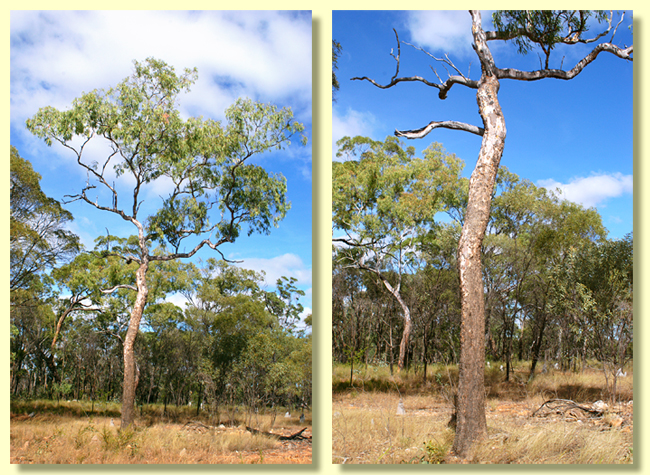
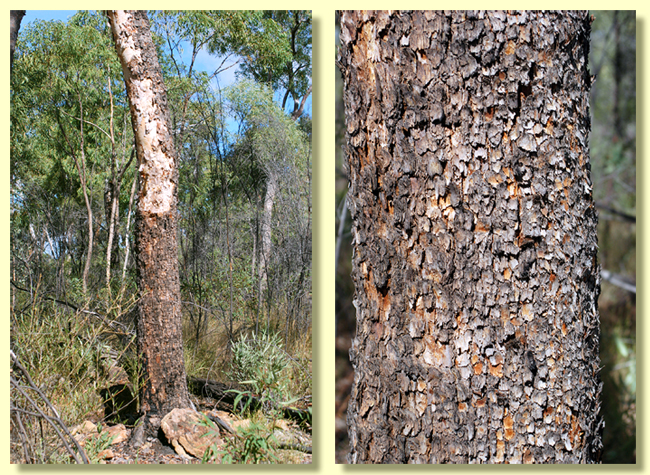
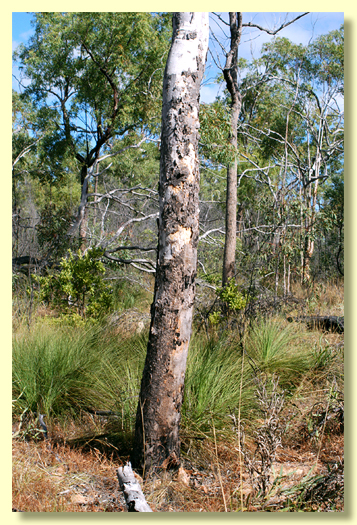
Bark rough over part or most of trunk, thin, red-brown to orange to greyish, flaky-tessellated, becoming smooth above, powdery, white to cream to whitish grey.
Branchlets smooth; long oil ducts sometimes present in the pith.
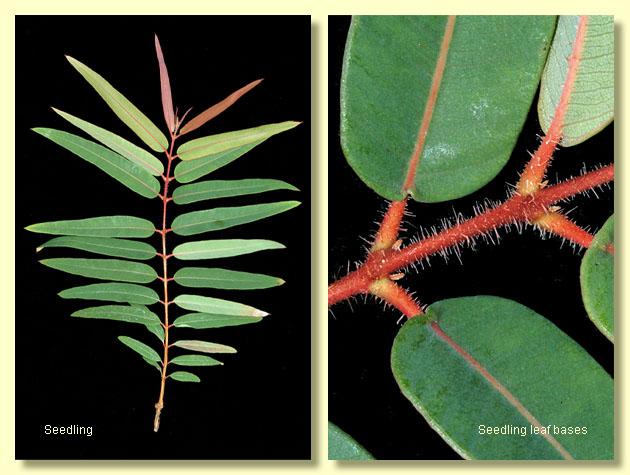
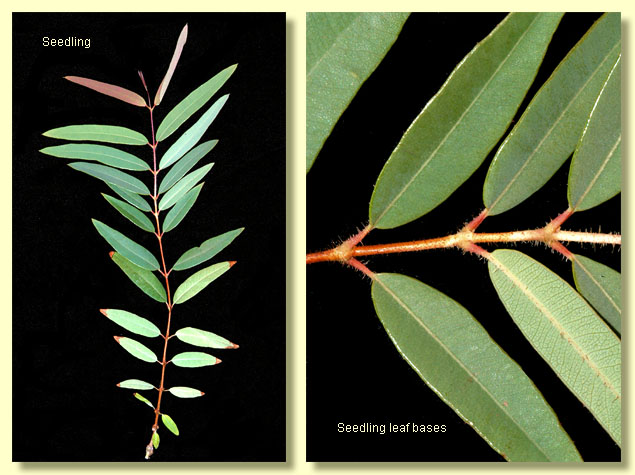
Juvenile growth (coppice or field seedlings to 50 cm): stems rounded in cross-section, sparsely setose to scabrid in the lower part becoming smooth after ca 7 nodes; juvenile leaves shortly petiolate, opposite, lanceolate, 6–12 cm long, 1.2–1.8(2.5) cm wide, base tapering, apex pointed, green, discolorous, lower leaves to ca node 5 scabrid with bristle-glands on underside only, upper leaves glabrous; lower leaves also have white simple, microscopic hairs on underside.
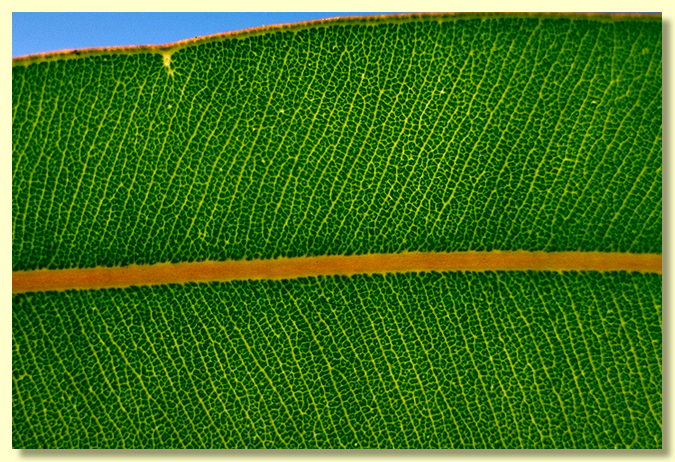
Adult leaves opposite, subopposite or alternate, petioles 1–2.5 cm long; blade lanceolate or falcate, 7.5–18 cm long, 0.8–1.7(2.2) cm wide, base tapering to petiole, margin entire, apex pointed, discolorous, dull, light green to grey-green, smooth, side-veins at greater than 45° to midrib (penniveined), reticulation dense to very dense, intramarginal vein present but very close to margin and more clearly visible from underside of leaf, oil glands scattered, small and ± island.
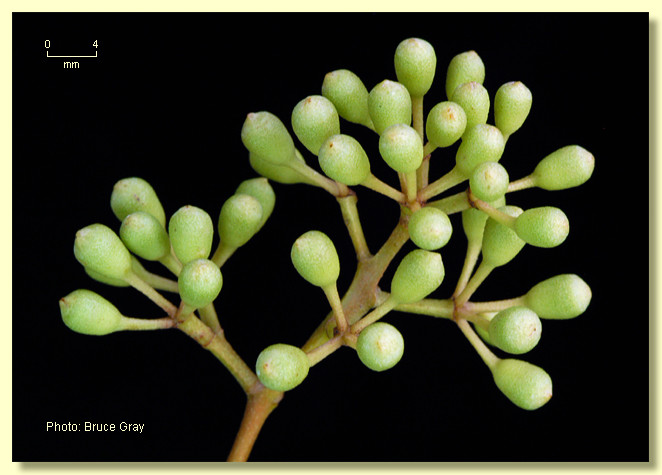
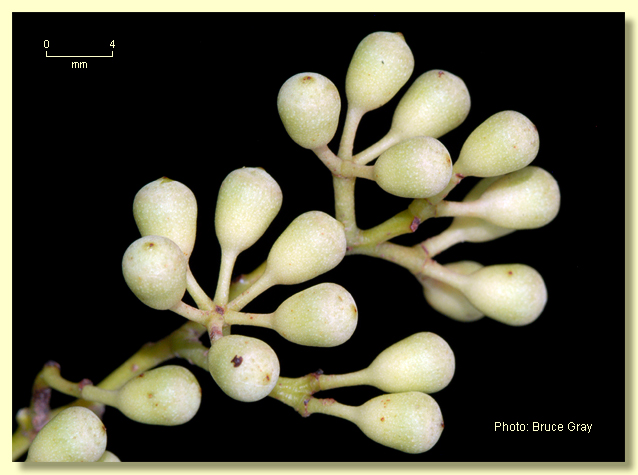
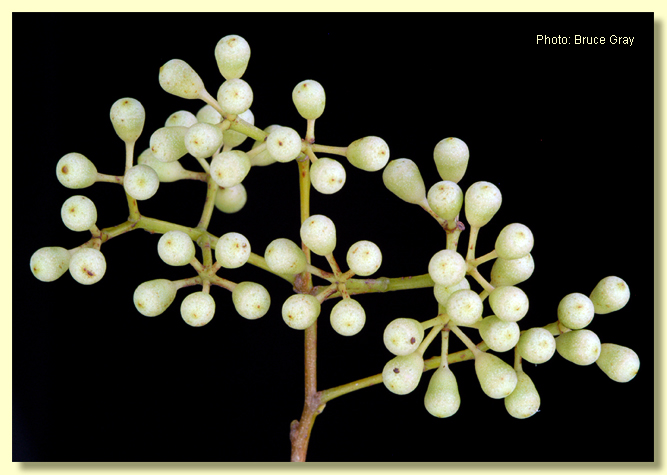
Inflorescences terminal, peduncles slender and slightly angular, 0.2–1.6 cm long; buds 7 per umbel, pedicels 0.1–1.1 cm long. Mature buds obovoid or pyriform, ca 0.5 cm long, ca 0.4 cm wide, smooth and shiny, scar absent (both opercula shed together at flowering), operculum shallowly rounded and apiculate or not so, stamens inflexed, all fertile, anthers oblong, dorsifixed, versatile, dehiscing by longitudinal slits, style as long, straight, stigma blunt and with a fringe of short papillae, locules 3 or 4, the placentae each with ca 5 vertical ovule rows or the rows indistinct. Flowers not seen.
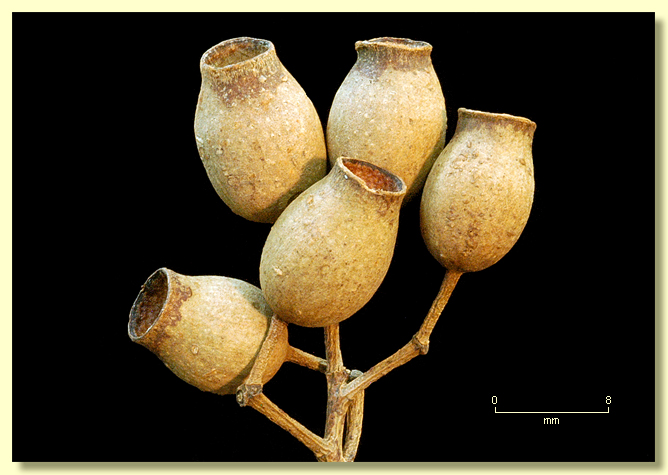
Fruit pedicellate (pedicels 0.1–1.1 cm long), urceolate with a short neck that is slightly flared at the rim, 1–1.5 cm long, (0.7)0.8–1 cm wide, smooth, disc descending vertically, valves 3 or 4, enclosed.
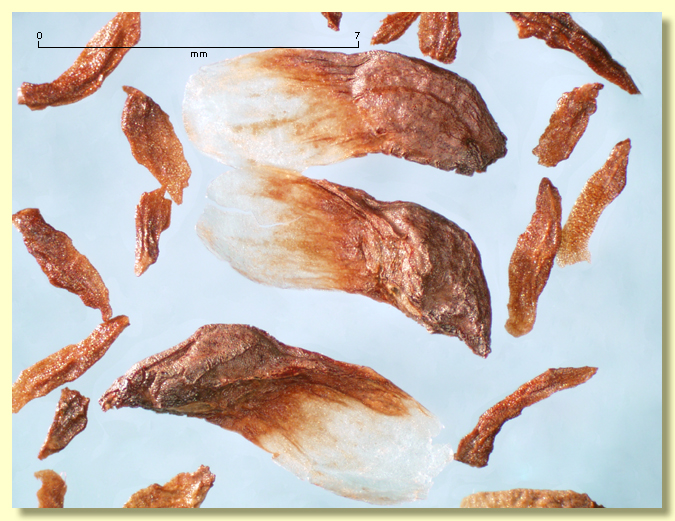
Seeds brown, 6–9 mm long, ellipsoidal with terminal wing, hilum ventral.
Cultivated seedling (measured at ca node 10): cotyledons large, reniform; stems rounded in cross-section, densely setose below ca node 9–12, above this sparsely setose to ca node 18 or becoming glabrous; leaves always petiolate, narrowly elliptic-lanceolate to linear, 4.7–10.5 cm long, 0.8–1.8 cm wide, base rounded or tapering, some leaves with peltate bases at nodes 7–12, dull, green, discolorous, upper surface glabrous after node 7–8, underside remaining sparsely setose especially on main veins. Microscopic white simple hairs are present on the underside of the upper seedling leaves, sometimes not well developed and more resembling papillae.
Notes
A bloodwood tree
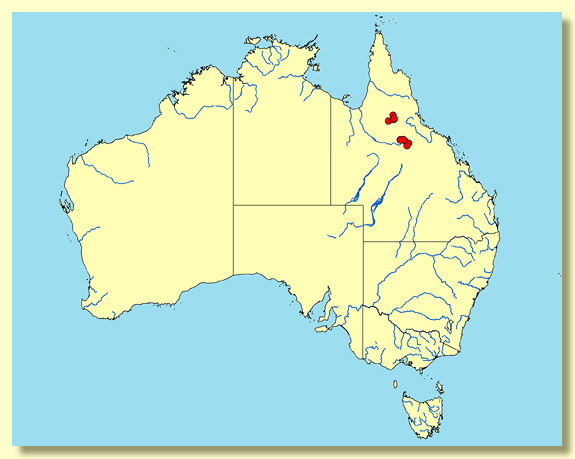
endemic
to north Queensland where it is restricted to the Newcastle and Gregory Ranges
between Georgetown, Einasleigh and Forsayth, extending south to
the White Mountains (Porcupine Gorge area and Torrens Creek). It occurs
on dissected sandstone hills and plateaus in skeletal sandy soil. Corymbia
serendipita has thinly persistent
tessellated
bark
over part or all of the trunk with the upper trunk and branches
shedding to smooth, white and often powdery
bark,
a dull greenish crown
with leaves darker above and paler underneath, and small shiny buds
in terminal
inflorescences.
The urn-shaped fruit
are never more than 1 cm wide and 1.4 cm long and seeds
are winged.
Juvenile growth
is scabrid
initially but soon becomes smooth, with upper juvenile
to intermediate
leaves both glabrous
and broad.
Within its natural range Corymbia serendipita grows with C.
ligans which differs in being fully rough-barked including the
branches and has more elongated fruit, but
has similar discolorous
adult
leaves and smooth to slightly scurfy
small buds.
It also grows with Corymbia trachyphloia,
which is also fully rough-barked and has thinner-walled, small fruit and
wingless seeds.
Corymbia serendipita is likely to be confused with C. stockeri
subsp. stockeri
but the latter has rough bark
extending to the smaller branches, often has whitish buds
due to the thin rubbery cuticle, and broader juvenile
leaves.
Eucalyptus serendipita Brooker & Kleinig was reduced to subspecific
rank as C. arnhemensis subsp. monticola by Hill & Johnson
(1995) but was restored to specific rank as C. serendipita by Queensland
botanist Tony Bean (2002). Corymbia serendipita differs from the
Northern Territory endemic C. arnhemensis by the latter having juvenile
leaves which are lobed to round at the base and the adult leaves lacking conspicuous
oil glands.
MORE ABOUT CORYMBIA
MORE ABOUT RED BLOODWOODS
Flowering Time
Flowering has been recorded in February.
Origin of Name
Corymbia serendipita: English, serendipity, the faculty of making happy and unexpected discoveries by accident.