
Desert Channels

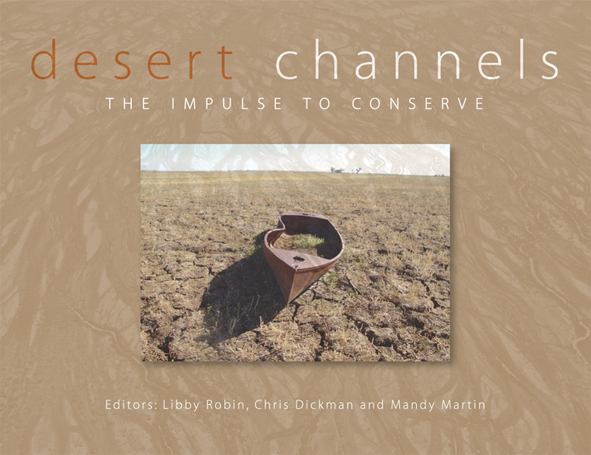
The Impulse to Conserve
Edited by: Libby Robin, Chris Dickman, Mandy Martin


Combines art, science and history to explore the distinctive Desert Channels country of south-western Queensland.
Desert Channels is a book that combines art, science and history to explore the ‘impulse to conserve’ in the distinctive Desert Channels country of south-western Queensland. The region is the source of Australia’s major inland-flowing desert rivers. Some of Australia’s most interesting new conservation initiatives are in this region, including partnerships between private landholders, non-government conservation organisations that buy and manage land (including Bush Heritage Australia and the Australian Wildlife Conservancy) and community-based natural resource management groups such as Desert Channels Queensland. + Full description
Conservation biology in this place has a distinguished scientific history, and includes two decades of ecological work by scientific editor Chris Dickman. Chris is one of Australia’s leading terrestrial ecologists and mammalogists. He is an outstanding writer and is passionate about communicating the scientific basis for concern about biodiversity in this region to the broadest possible audience.
Libby Robin, historian and award-winning writer, has co-ordinated the writings of the 46 contributors whose voices collectively portray the Desert Channels in all its facets. The emphasis of the book is on partnerships that conserve landscapes and communities together. Short textboxes add local and technical commentary where relevant. Art and science combine with history and local knowledge to richly inform the writing and visual understanding of the country.
Conservation here is portrayed in four dimensions: place, landscape, biodiversity and livelihood. These four parts each carry four chapters. The ‘4x4’ structure was conceived by acclaimed artist, Mandy Martin, who has produced suites of artworks over three seasons in this format with commentaries, which make the interludes between parts. Martin’s work offers an aesthetic framework of place, which shapes how we see the region.
Desert Channels explores the impulse to protect the varied biodiversity of the region, and its Aboriginal, pastoral and prehistoric heritage, including some of Australia’s most important dinosaur sites. The work of Alice Duncan-Kemp, the region’s most significant literary figure, is highlighted. Even the sounds of the landscape are not forgotten: the book's webpage has an audio interview by Alaskan radio journalist Richard Nelson talking to ecologist Steve Morton at Ocean Bore in the Simpson Desert country. The twitter of zebra finches accompanies the interview.
Conservation can be accomplished in various ways and Desert Channels combines many distinguished voices. The impulse to conserve is shared by local landholders, conservation enthusiasts (from the community and from national and international organisations), Indigenous owners, professional biologists, artists and historians.
- Short descriptionNews
This title is no longer available in print format.
CSIRO Publishing would like to thank RAPAD whose generous financial support made the publication of this work possible.
Reviews
"Continuity in writing style, being one of personal observation and reflection more than simply documentation of facts, is also successfully achieved throughout, making for very easy reading across the different topics."
Graeme Armstrong, Austral Ecology, Vol 37 (e39) 2012
"My quick flick-through rapidly turned to captivation, with blocks of text describing everything from pituri and mulgaras to infamous 4WD mishaps and defining historical events. The imagery is artistic, reflecting the mixture of subjects.
...I was enthralled and repeatedly I felt the urge to hop in the car and head for the desert channels."
Tyrone Lavery, Wildlife Australia Magazine, Winter 2011, pp. 44
"To appreciate the uniqueness of Desert Channels, one needs to go no further than the impressive list of the forty-two contributors: gathered here are not only historians, archaeologists, and natural scientists but also conservation managers, politicians, and even artists and cattle-breeders. One really should go further, however. This beautiful book offers a diverse collection of articles, essays, stories, and images of and about the Desert Channels, an arid and sparsely-populated region in the north-eastern interior of Australia. The eclectic contributions are united in their remarkably successful attempt to speak to a wide audience and to avoid disciplinary jargon."
Environment and History Vol 17.4
"...a stunning example of the opportunities that environmental history offers for interdisciplinary collaboration and understanding the significance of a place. This superb presentation invites itself to be read at leisure, mined in depth, or simply perused for the scenery. Combined with a collection of engaging stories, its design qualities will certainly ignite the reader’s impulse to conserve..."
Ruth Morgan, LIMINA: A Journal of Historical and Cultural Studies, 2011
"...this is an impassioned multidisciplinary attempt to highlight the scientific and cultural importance of this remarkable area, as well as the complexities of trying to understand it. This is an area that clearly arouses immense enthusiasm and passion, a biodiversity hotspot which needs to be managed alongside sheep and cattle grazing, a cultural landscape for aboriginal people and an area under constant threat from mining and water extraction. Most people will never get to see this area but the book really does provide an insight into the many reasons that drive conservation and the real time problems of achieving it."
David Walton, Bulletin of the British Ecological Society 2011, 42:1
"This is how one hopes science works, with an eye on the greater good, the advancement of knowledge rather than the advancement of careers, and a passionate curiosity about the natural world in all its variety and strangeness. Desert Channels combines accessibility with serious intent, weaving a tapestry of people and place, stories and science, traditions and aspirations, art and anecdote, providing models for conservation that reflect multifaceted strategies and partnerships."
Kim Mahood, Australian Book Review, May 2011
"The sixteen essays and several sidebars in this collection are written readably and accessibly. They are reinforced by a generous selection of well-chosen photographs, some with the immediacy of good family album snaps, others chosen to focus attention on some telling detail of the natural or built environment that might otherwise escape the casual observer. These are augmented by the patiently created landscape paintings of Mandy Martin…this is a splendid book that deserves to be read by specialists and general readers alike."
Geoffrey Bolton, Historical Records of Australian Science, Vol 22 No 1, 2011
"This book will leave you amazed, humbled, and wanting more…"
Desert Channels QLD, Basin Bullet, August 2010
"The reader is left with a sense of inherent complexity but also of hope for enhanced understanding and prudent stewardship."
Australian Garden History, Vol 22, No 3, 2011
"The 46 contributors selected for the CSIRO’s Desert Channels each offer a fresh perspective. Their work – a collection of words, art and a sound recording – reveals much about this beautiful country and the people who care for it, including pastoralists, conservationists, historians, ecologists and palaeontologists.
The book is illustrated with beautiful photography, historic images and art. It will stir up memories for anyone who has spent time in the region...Those who love the region will appreciate the depth and variety of perspectives this book offers. It is well worth the effort."
Outback, October/November 2010
Details
ePDF | September 2010ISBN: 9780643097506
Publisher: CSIRO Publishing
Available from eRetailers
ePUB | September 2010
ISBN: 9780643102095
Publisher: CSIRO Publishing
Available from eRetailers
Features
View a sample from Desert Channels.- Combines visual appreciation of the region with accessible text about its intriguing natural history, its people and their histories and the various ways that people are working to conserve the land, the rivers and the creatures
- Celebrates what people in the region value about their place, and what visitors might find when they visit
- Strong writing by many prize-winning writers
- Features the artworks of Mandy Martin, one of Australia’s premier artists
- CD of Alaskan radio program Encounter, where international nature writer and broadcaster, Richard Nelson, interviews Steve Morton about Zebra Finches at Oceans Bore, Cravens Peak Reserve
Contents
PART 1: PLACEINTERLUDE I Landscape studies 2007: environmental projects and the impulse to conserve
PART 2: LANDSCAPE
INTERLUDE II Landscape studies 2008: aesthetic evaluation as an environmental tool
PART 3: BIODIVERSITY
INTERLUDE III Landscape studies 2009: painting in place
PART 4: LIVELIHOOD
INTERLUDE IV Listening to the land: Encounter documentary of zebra finches at Ocean Bore
(CD at back of book)
View the full table of contents.
Authors
Libby Robin is an environmental historian who has had a long interest in conservation initiatives in deserts. Her books include How a Continent Created a Nation, which won the NSW Premier’s Prize for Australian History (2007) and The Flight of the Emu, which won the Victorian Premier’s Literary Award for Science Writing (2003). Her most recent co-edited book is Boom and Bust: Bird Stories for a Dry Country (CSIRO Publishing 2009), which won the Whitley Medal in 2009.Chris Dickman is Professor in Terrestrial Ecology at the University of Sydney, and author of the popular book A Fragile Balance: The Extraordinary Story of Australian Marsupials (2007), which won the Whitley Medal for advancing zoological knowledge in 2008. He also won the NSW Scientist of the Year 2010 for the Plant and Animal Sciences Category and has been studying the natural history of the Desert Channels area for 20 years, and has published extensively on this.
Mandy Martin is one of Australia’s best known artists, with work in most major Australian galleries. She is a pioneering scholar in interdisciplinary environmental art projects, including the book Inflows: the Channel Country (2001), which focuses on this region. Her art is underpinned by a consuming passion for the future of the Australian landscape, particularly the desert landscapes.
Supplementary Material
The print copy of this book contains a CD-ROM with supplementary material. You can also download a zip file of this material using the link below.
Download Instructions
For PC Users
Right click on the Link and choose Save Target (Internet Explorer) or Save Link As (Firefox).
For Mac Users
Click and hold on the Link and choose Download Link to Disk (Internet Explorer) or Save this Link as (Firefox).
All Firefox Users
Please be aware that due to difficulties with Firefox you must specify which format you wish the file to be saved as. When saving your article choose your file name and add the .zip extension. e.g. Bookname.zip
Related titles


