
Why do evergreen trees dominate the Australian seasonal tropics?
D. M. J. S. Bowman A B and L. D. Prior AA Key Centre for Tropical Wildlife Management, Charles Darwin University, Darwin, NT 0909, Australia.
B Corresponding author. Email: david.bowman@cdu.edu.au
Australian Journal of Botany 53(5) 379-399 https://doi.org/10.1071/BT05022
Submitted: 4 February 2005 Accepted: 20 May 2005 Published: 11 August 2005
Abstract
The northern Australian woody vegetation is predominantly evergreen despite an intensely seasonal climate and a diversity of deciduous species in the regional flora. From a global climatic perspective the dominance of evergreen rather than deciduous trees in the Australian savannas is apparently anomalous when compared with other savannas of the world. However, this pattern is not unexpected in light of existing theory that emphasises photosynthetic return relative to cost of investment between deciduous and evergreen species. (a) Climatically, monsoonal Australia is more extreme in terms of rainfall seasonality and variability and high air temperatures than most other parts of the seasonally dry tropics. Existing theory predicts that extreme variability and high temperatures favour evergreen trees that can maximise the period during which leaves assimilate CO2. (b) Soil infertility is known to favour evergreens, given the physiological cost of leaf construction, and the northern Australian vegetation grows mainly on deeply weathered and infertile Tertiary regoliths. (c) These regoliths also provide stores of ground water that evergreens are able to exploit during seasonal drought, thereby maintaining near constant transpiration throughout the year. (d) Fire disturbance appears to be an important secondary factor in explaining the dominance of evergreens in the monsoon tropics, based on the fact that most deciduous tree species of the region are restricted to small fire-protected sites. (e) Evolutionary history cannot explain the predominance of evergreens, given the existence of a wide range of deciduous species, including deciduous eucalypts, in the regional tree flora.
Acknowledgments
We are grateful to Professor Patricia Werner for many helpful comments on the manuscript. We thank the Food and Agriculture Organization of the United Nations for permission to use the map reproduced as Fig. 1.
Aerts R
(1995) The advantages of being evergreen. Trends in Ecology & Evolution 10, 402–407.
| Crossref | GoogleScholarGoogle Scholar |
measured a very stable soil CO2 efflux during the dry season of 2 µmol m–2 s–1 (ground-area basis), which, with a leaf area index of ∼0.5 m2 m–2, corresponds to 4 µmol m–2 s–1 leaf area. This would require average CO2 assimilation rates of 12 µmol m–2 s–1 leaf area to replace.
Soil CO2 efflux comprises root, microbial and mesofaunal respiration (Cuevas 1995); however, microbial and mesofaunal respiration in the bulk soil during the dry season is probably minimal, so that the dry-season soil CO2 efflux would primarily represent respiration by roots and perhaps rhizosphere microbes. Assimilation rates at the end of the dry season, averaged over 24 h, are thus less than rates of CO2 efflux from the soil plus leaf maintenance costs. Eucalypts therefore cannot afford to maintain more leaves during the dry season if that means higher root respiration costs.
|
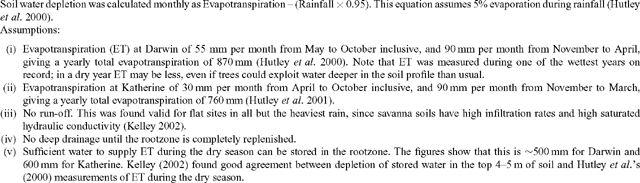
Soil water depletion was calculated monthly as Evapotranspiration – (Rainfall × 0.95). This equation assumes 5% evaporation during rainfall (Hutley et al. 2000).
Assumptions:
-
Evapotranspiration (ET) at Darwin of 55 mm per month from May to October inclusive, and 90 mm per month from November to April, giving a yearly total evapotranspiration of 870 mm (Hutley et al. 2000). Note that ET was measured during one of the wettest years on record; in a dry year ET may be less, even if trees could exploit water deeper in the soil profile than usual.
-
Evapotranspiration at Katherine of 30 mm per month from April to October inclusive, and 90 mm per month from November to March, giving a yearly total evapotranspiration of 760 mm (Hutley et al. 2001).
-
No run-off. This was found valid for flat sites in all but the heaviest rain, since savanna soils have high infiltration rates and high saturated hydraulic conductivity (Kelley 2002).
-
No deep drainage until the rootzone is completely replenished.
-
Sufficient water to supply ET during the dry season can be stored in the rootzone. The figures show that this is ∼500 mm for Darwin and 600 mm for Katherine. Kelley (2002) found good agreement between depletion of stored water in the top 4–5 m of soil and Hutley et al.’s (2000) measurements of ET during the dry season.