|
 |
home | glossary | about eucalypts | about EUCLID | browse species Eucalyptus acmenoides |
|
White mahogany |
|
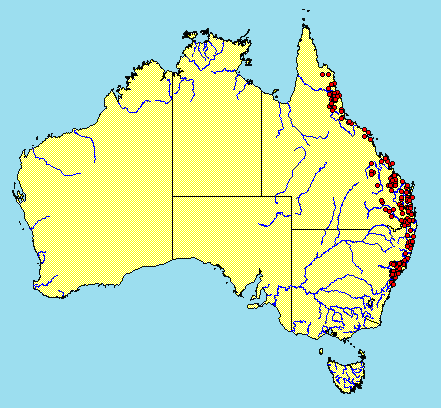
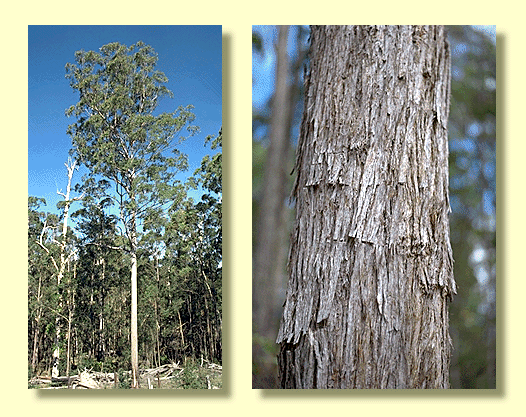
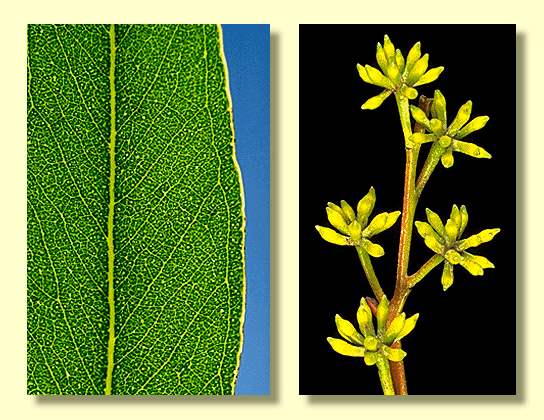
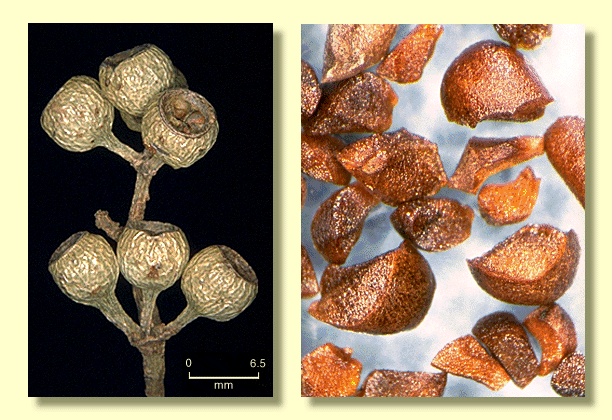
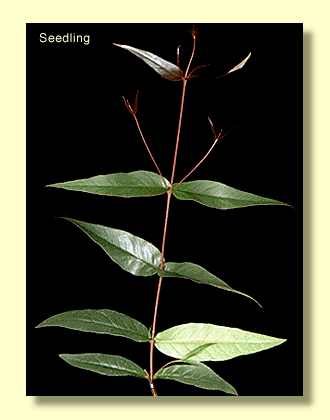
Eucalyptus acmenoides Schauer in W.G.Walpers, Repert. Bot. Syst. 2: 924 (1843) T: Castle Hill, N.S.W., 14 Jan. 1817, A.Cunningham 20; iso: K, MEL. Medium sized or tall tree to 45 m. Bark rough to small branches, fibrous, grey or grey-brown, held in flattish strips rather than like typical stringybark. Juvenile stem rounded in cross-section, smooth; juvenile leaves opposite and sessile for several to many pairs before becoming alternate and petiolate, ovate, 5.5-14 cm long, 2-7 cm wide, discolorous, glossy, green. Adult leaves alternate, petiolate, lanceolate, 7-13 cm long, 1.2-3.5 cm wide, base oblique or tapering to petiole, margin entire, discolorous, glossy, green, penniveined, moderately to densely reticulate, intramarginal vein parallel to and just within margin or well removed from it, oil glands island and intersectional. Inflorescences terminal, or axillary unbranched, peduncles 1-1.9 cm long, 11-15 flowered; buds pedicellate, ovoid to fusiform, green to yellow, scar absent, operculum conical or sometimes beaked, stamens irregularly flexed or inflexed, anthers reniform to cordate, versatile, dorsifixed, dehiscing by confluent slits, style long, locules 3-5 each with two vertical ovule rows; flowers white. Fruit pedicellate, barrel-shaped, hemispherical or cup-shaped, 0.4-0.8 cm wide, disc descending, valves 3-5, enclosed. Seed brown, 1-2.5 mm long, pyramidal or obliquely pyramidal, dorsal surface smooth, hilum terminal. NOTES Eucalyptus acmenoides (resemblance to the genus Acmena) A medium-sized to tall forest tree occurring from north of Sydney through coastal New South Wales to north of Mareeba in northern Queensland. It has fibrous bark held in flattish strips, slightly discolorous adult leaves with dense reticulation. Juvenile leaves are large, ovate and opposite for many pairs and are conspicuous in the field. It is related to three other white mahoganies (section Amentum), E. apothalassica, E. umbra and E. carnea which have concolorous leaves. It is a primitive monocalypt, recognised principally by the characters above, which may indicate some affinity with the blackbutts (section Pseudophloius) and the peppermints (section Aromatica). USES Poles, sleepers, bridge and wharf construction, stumps, plates, flooring, joists and weatherboard, honey. |
     |