|
 |
home | glossary | about eucalypts | about EUCLID | browse species Eucalyptus albens |
|
White box |
|
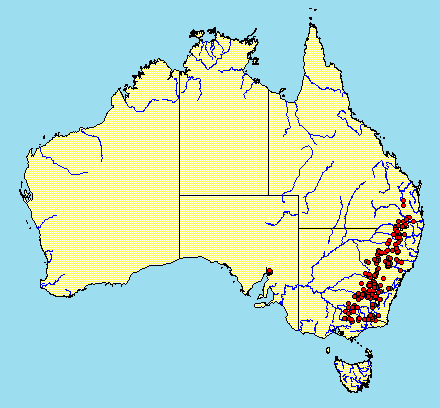
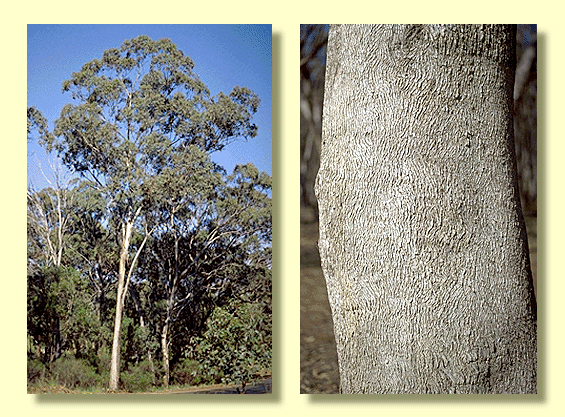
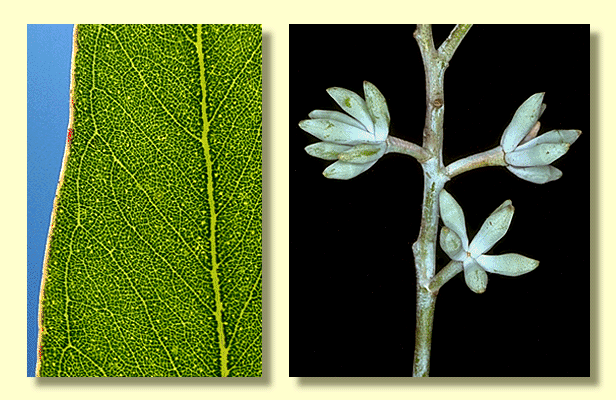
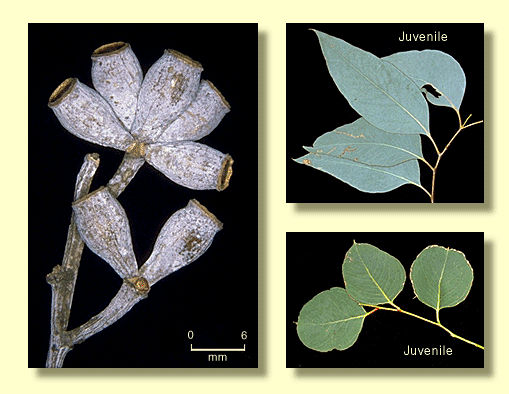
Eucalyptus albens Benth., Fl. Austral. 3: 219 (1867) E. hemiphloia var. albens (Benth.) Maiden, Forest Fl. New South Wales 1: 131 (1904). T: Macquarie R., N.S.W., Aug. 1817, A.Cunningham 198; syn: BM, K; New England, N.S.W., C.Stuart s.n.; syn: K, MEL; between Alfords and the Range, N.S.W., 17 June 1843, L.Leichhardt s.n.; syn: MEL; between Ten Mile Ck & Broken R., Vic., F.Mueller; syn: K, MEL. E. albens var. elongata Blakely, Key Eucalypts 237 (1934). T: Mt Topper State Forest, N.S.W., Oct. 1923, L.B. Peacocke s.n.; holo: NSW. Tree to 25 m tall. Bark rough on most or all of trunk and base of large branches, rarely extending to branches <8cm diam., box type, often becoming tessellated, pale grey or mottled grey and white patches, smooth bark of branches predominantly white, sometimes grey, or tinged orange, pink or salmon; branchlets usually glaucous, pith oil glands present or absent. Juvenile stem rounded or square in cross-section, glaucous or non-glaucous; juvenile leaves alternate, petiolate, orbicular, deltoid or ovate, 5-10.5 cm long, 5-10 cm wide, margin entire, blue-green, grey-green, or blue-grey or glaucous. Adult leaves alternate, petiolate, lanceolate to ovate, 7-16.5 cm long, 1.7-4.3 cm wide, base tapering to petiole, margin entire, concolorous, dull, blue-green, grey-green, blue-grey to glaucous, weakly penniveined, densely to very densely reticulate, intramarginal vein parallel to and just within margin or well removed from it, oil glands mostly intersectional or obscure. Inflorescences terminal panicles or axillary unbranched, peduncles 0.8-1.8 cm long, 7-flowered; buds pedicellate or sessile, fusiform, often slightly curved, glaucous or sometimes green, slightly angled, scar absent, operculum conical, stamens irregularly flexed, anthers cuboid, adnate to filament, dehiscing by broad lateral pores, style long, locules 3 or 4(5) each with 4 vertical ovule rows; flowers white. Fruit pedicellate or sessile, cylindrical, urceolate or barrel-shaped, 0.5-1 cm wide, often slightly angled longitudinally, glaucous or non-glaucous, disc descending, valves 3 or 4(5), enclosed. Seed blackish, brown or grey, 1-2 mm long, irregularly ovoid or depressed-ovoid, sometimes pointed at one end, lacunose or not, dorsal surface smooth or shallowly pitted, hilum ventral. NOTES Eucalyptus albens (Latin albens, white, of the general appearance of the tree and the white wax on the flower buds and fruits) A small to medium-sized box tree occurring naturally on more elevated country with shallower soils than the related coastal E. moluccana and the related inland species E. microcarpa. It differs from E. moluccana by the more extensive white-patchy box bark up the trunk and the dull greyish adult leaves, and from E. microcarpa which has smaller glossy green leaves and smaller buds and fruit. E. albens occurs from south-eastern Queensland throughout the western slopes of New South Wales to eastern Victoria, with a small population near Melrose in the southern Flinders Range of South Australia. The juvenile leaves are large, grey to glaucous and pendulous. The buds are elongated and usually glaucous. USES Heavy engineering construction, poles, railway sleepers, fencing, fuel, honey. |
    |