|
 |
home | glossary | about eucalypts | about EUCLID | browse species Eucalyptus alligatrix subsp. miscella |
|
|
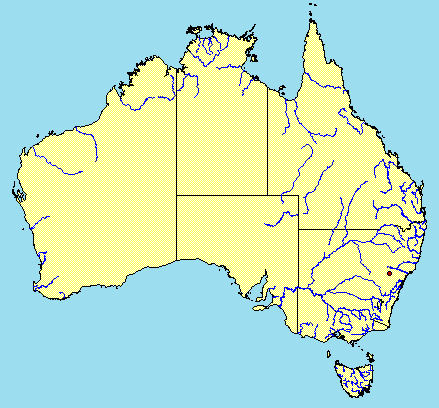
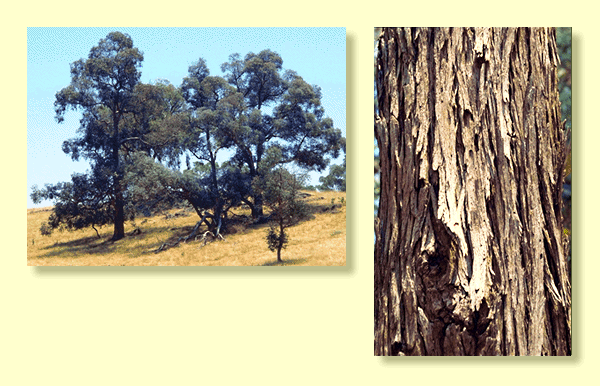
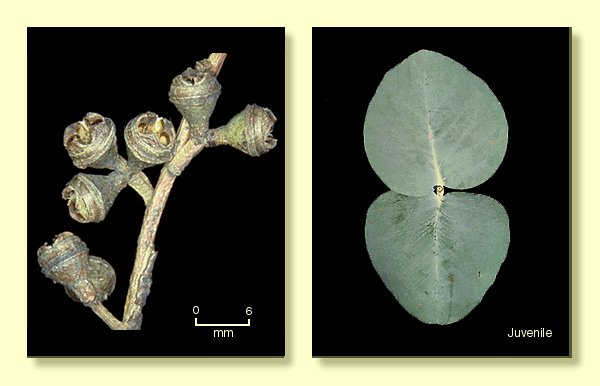
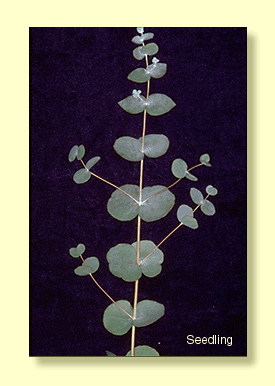
Eucalyptus alligatrix subsp. miscella Brooker, Slee & J.D.Briggs, Austral. Syst. Bot. 8: 512 (1995) T: New South Wales: "Coomber" Farm, SW of Rylstone, 24 Aug. 1992, M.I.H. Brooker 11147, holo: CANB; iso: BRI, MEL, NSW Tree to 15 m tall. Bark rough to small branches or rarely the branches <8cm diam. smooth, rough bark thick, fibrous, coarsely furrowed down trunk, grey; branchlets rarely glaucous. Juvenile stem rounded or square in cross-section, usually glaucous; juvenile leaves always opposite, sessile, orbicular to ovate, 2-4.5 cm long, 2.5-5.0 cm wide, margin entire or crenulate, green to grey-green or glaucous. Crown composed entirely of adult leaves which are alternate, petiolate, lanceolate, 8-17 cm long, 0.8-2.8 cm wide, base tapering to petiole, margin entire, concolorous, glossy, green to grey-green, penniveined, moderately to densely reticulate, intramarginal vein parallel to and just within margin, oil glands mostly island. Inflorescences axillary unbranched, peduncles 0.4-1 cm long, 3- or 7-flowered; buds pedicellate or rarely sessile, diamond-shaped, slightly glaucous or green, scar present, operculum conical, stamens inflexed, anthers cuboid or cuneate, versatile, dorsifixed, dehiscing by longitudinal slits (non-confluent), style long, locules 3 or 4, the placentae each with 4 vertical ovule rows; flowers white. Fruit pedicellate or sessile, obconical or campanulate, 0.5-0.6 cm wide, disc raised, valves 3 or 4, strongly exserted. Seed brown, 1-1.5 mm long, ovoid or depressed-ovoid, usually lacunose, dorsal surface shallowly pitted, hilum ventral. NOTES Eucalyptus alligatrix ( Latin alligatrix, she who binds together, refers to the relationship of the species to E. cinerea and E. cephalocarpa of the same taxonomic series) E. alligatrix is a small to medium-sized tree, one of a group of related rough-barked species which have round, opposite, glaucous juvenile leaves. E. alligatrix has three subspecies: subspecies alligatrix from the Eildon area of Victoria has buds are in threes and the crown usually has a mixture of narrow adult and broader intermediate leaves. subsp. limaensis (after a nearby town, Lima, in central Victoria) from further north near Swanpool in Victoria is a taller tree and has a completely adult crown with consistently narrow leaves, is three-budded and has the smallest fruit of the three subspecies. subsp. miscella (Latin miscella, mixed, refers to the 3 and 7-flowered inflorescences on the same tree) has a very restricted distribution near Rylstone, New South Wales, and is a smaller spreading woodland tree with a completely adult crown but with broader leaves than subsp. limaensis, and has buds in a mixture of threes and sevens on the same tree. |
    |