|
 |
home | glossary | about eucalypts | about EUCLID | browse species Eucalyptus amygdalina |
|
Black peppermint |
|
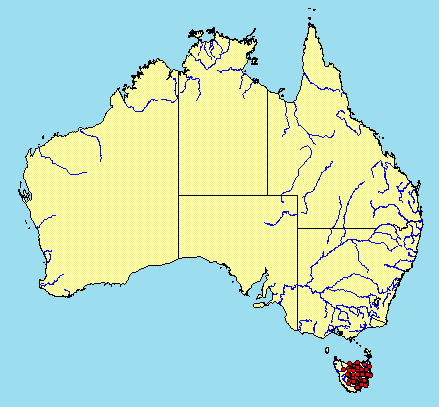
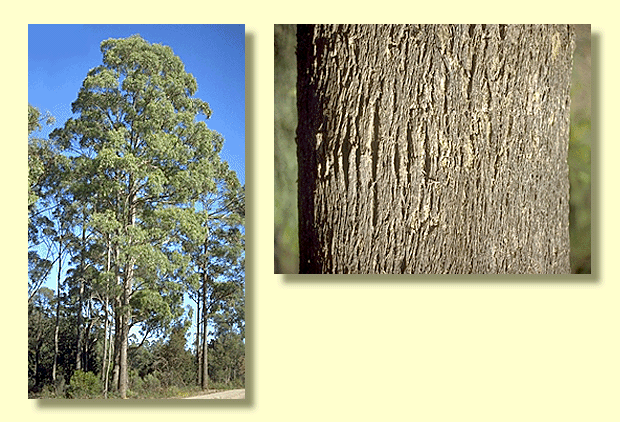
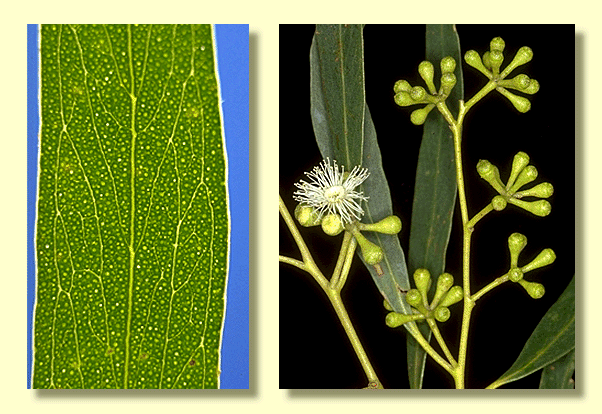
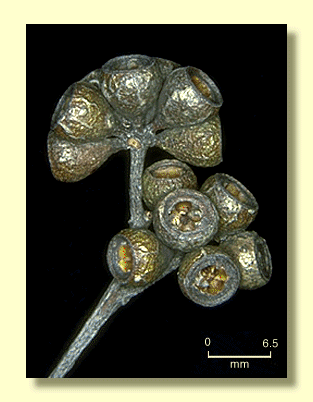
Eucalyptus amygdalina Labill., Nov. Holl. Pl. Spec. 2: 14, t. 154 (1806) T: Van Diemens Land, [Tas.], 1792, J. de Labillardière s.n.; holo: FI; iso: BM, L, W. E. glandulosa Desf., Cat. Pl. Paris. 3rd edn, 284, 408 (1829). T: cultivated in Paris, France; (FI) Tree to 30 m tall. Bark rough on part or all of trunk and to base of large branches, finely fibrous peppermint type, dark grey to grey-brown, smooth bark white to grey, or brownish, sometimes with ribbons of decorticated bark in the upper branches. Juvenile stem rounded in cross-section, warty; juvenile leaves opposite for 10-15 nodes then alternate, sessile, lanceolate to falcate, 2.8-5.5 cm long, 0.2-1.1 cm wide, margin entire, green. Adult leaves alternate, petiolate, lanceolate to linear or slightly falcate, 5.5-12 cm long, 0.4-1.2 cm wide, base tapering evenly to petiole, margin entire, concolorous, slightly glossy to dull, bluish green maturing green, venation acute to sub-parallel, reticulation sparse to absent, intramarginal parallel to and well removed from margin, oil glands few to numerous, island. Inflorescences axillary unbranched, peduncles 0.4-1 cm long, 11- 15 or more-flowered; buds pedicellate, clavate, green to yellow, smooth or slightly warty, scar absent although a depression ring may be visible at the join of operculum and hypanthium, operculum rounded to slightly apiculate, stamens inflexed or irregularly flexed, with or without staminodes, anthers reniform to cordate, versatile, dorsifixed, dehiscing by (usually) confluent slits, style short or long, locules 3 or 4, the placentae each with 2 vertical ovule rows; flowers white. Fruit pedicellate, or sessile, cup-shaped to hemispherical, 0.5-0.7 cm wide, disc raised slightly or level to descending, valves 3 or 4, near rim level to enclosed. Seed brown, 1-2 mm long, pyramidal or obliquely pyramidal to cuboid, dorsal surface smooth, hilum terminal. NOTES Eucalyptus amygdalina (Latin amygdala, almond, allusion obscure) A small to medium-sized, narrow-leaved peppermint tree endemic to Tasmania where it is widespread in the eastern half of the island. The bark is rough over the whole trunk unlike that in E. pulchella which has the narrowest leaves of all the peppermints. The bark in northern forms of E. pulchella may be rough in the lower half of the trunk. The seedling leaves of E. amygdalina are notable for the almost complete lack of oil glands. USES Light construction, joinery, fencing, gums, fuel, oils. |
    |