|
 |
home | glossary | about eucalypts | about EUCLID | browse species Eucalyptus ancophila |
|
|
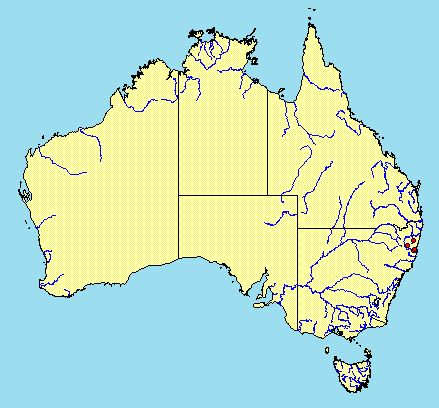
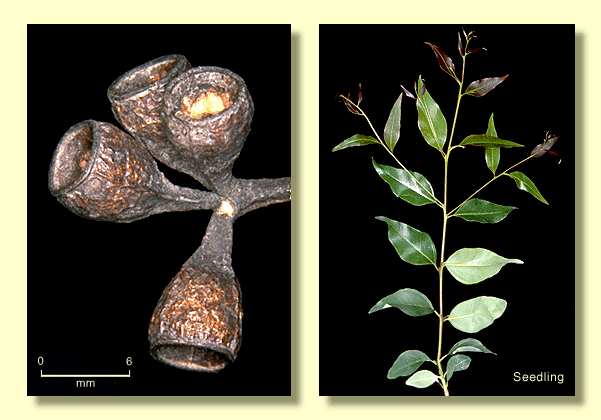
Eucalyptus ancophila L. Johnson & K. Hill, Telopea Vol. 4: 82 (1990) T: N.S.W., North Coast, 21 miles (33 km) NW of Kempsey, at western ridge of Mungay Creek, T.J. Evans NSW 222245, Feb. 1975; (NSW) Tree to 35 m tall. Grey ironbark throughout or on trunk and larger branches only, smooth bark pale grey. Juvenile stems square in cross-section; juvenile leaves petiolate, opposite for 4-7 nodes then alternate, ovate becoming lanceolate, discolorous, glossy, green. Adult leaves alternate, petiolate, lanceolate, 9-20 cm long, 1.8-4.8 cm wide, base tapering evenly to petiole, margin entire, concolorous or discolorous, more or less glossy, green, penniveined, densely to very densely reticulate, intramarginal vein parallel to and just within margin or well removed from it, oil glands few, mostly intersectional. Inflorescences terminal panicles, peduncles 0.3-1 cm long, 7-flowered; buds pedicellate, ovoid to diamond-shaped, scar present, operculum beaked to conical, stamens inflexed or irregularly flexed, with outer staminodes, anthers adnate, positioned obliquely at filament tip, cuboid, dehiscing by terminal pores, style long, locules 3 or 4, the placentae each with 4 vertical ovule rows; flowers white. Fruit pedicellate, obconical or barrel-shaped, 0.5-0.7 cm wide, disc descending, valves 3 or 4, enclosed. Seed brown, 1.4-2 mm long, ovoid or depressed-ovoid or pointed at one end, dorsal surface shallowly pitted, hilum ventral. NOTES Eucalyptus ancophila (Greek ancophila, valley lover) A medium-sized to tall forest tree known only from the Kempsey-Bellingen districts of north-coastal New South Wales. An ironbark with rough bark to the branchlets, it belongs in the group characterised by the early loss of the outer operculum, inflexed stamens and outer staminodes. It has glossy green leaves which distinguish it from E. fusiformis, non-ribbed or non-angled fruit, which distinguishes it from E. tetrapleura, and longer leaves than E. placita. |
  |