|
 |
home | glossary | about eucalypts | about EUCLID | browse species Eucalyptus andrewsii subsp. andrewsii |
|
New England blackbutt |
|
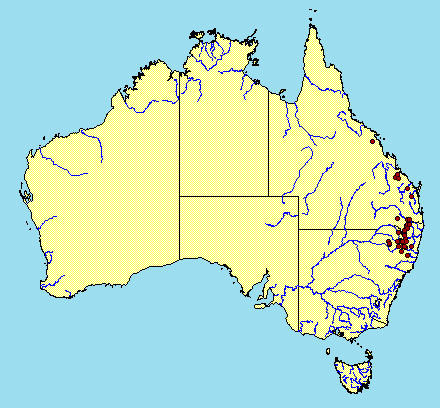
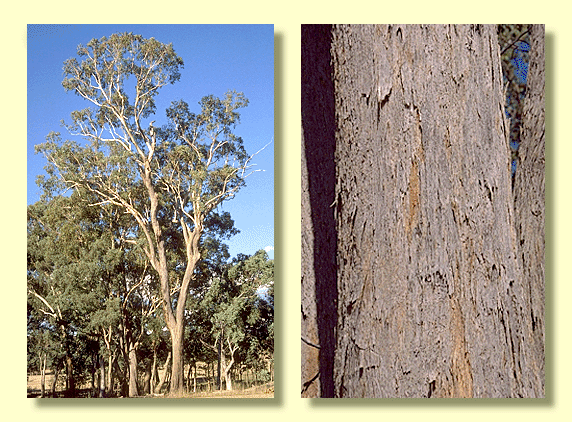
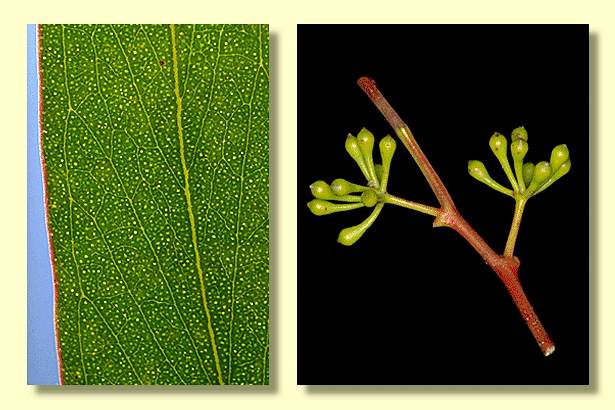
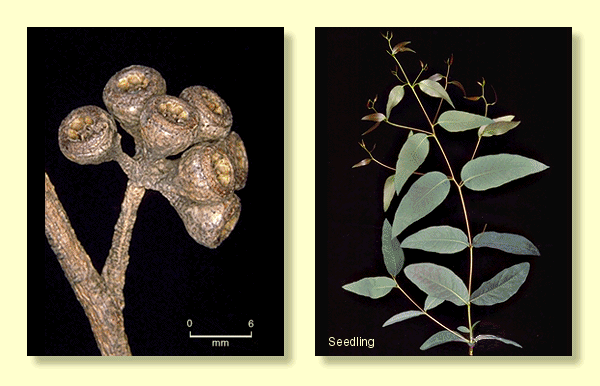
Eucalyptus andrewsii Maiden, Proc. Linn. Soc. New South Wales 2nd ser., 29: 472 (1904) subsp. andrewsii. T: Tingha, N.S.W., 16 Oct. 1903, R.H.Cambage s.n.; lecto: NSW, fide J.H.Maiden, Crit. Revis. Eucalyptus 1: 195, 205 (1905). E. haemastoma var. inophloia C.White, Queensland Agric. J. 2nd ser., 14: 70, t. 3 (1920). T: ranges near Toowoomba, Qld, C.T.White. Tree to 45 m tall. Bark rough on trunk to base of large branches, finely fibrous (like peppermints), grey or grey-brown, smooth bark whitish, branchlets sometimes glaucous. Juvenile stem rounded in cross-section; juvenile leaves opposite, shortly petiolate and elliptical for ca 6 nodes then alternate, petiolate, ovate to lanceolate, becoming falcate, 4.5-10 cm long, 2.5-4.5 cm wide, base tapering or oblique, blue-green or grey-green. Adult leaves alternate, petiolate, lanceolate to falcate, 9-17 cm long, 1-3.2 cm wide, base oblique or tapering evenly to petiole, margin entire, concolorous, glossy or dull, green or blue-green, weakly penniveined, sparsely to moderately reticulate, intramarginal vein parallel to and well removed from margin, oil glands numerous, island. Inflorescences axillary unbranched, peduncles 0.8-2 cm long, 11- 15-flowered; buds pedicellate, clavate, yellowish tinged red, scar absent, operculum conical or rounded and apiculate, stamens inflexed, a few staminodes present or all stamens perfect, anthers reniform to cordate, versatile, dorsifixed, dehiscing by confluent slits, style short, locules 3 or 4(5) each with 2 vertical ovule rows; flowers white. Fruit pedicellate, cup-shaped or hemispherical, 0.5-0.7 cm wide, disc slightly raised or level, valves 3 or 4(5), near rim level. Seed dark brown, 1-3 mm long, pyramidal or obliquely pyramidal, dorsal surface smooth, hilum terminal. NOTES A small to tall tree of blue-leaved ash group occurring from the Northern Tablelands of New South Wales north to the vicinity of Eungella west of Mackay in Queensland. It has grey peppermint-type bark and is easily recognisable in the field by the large, pendulous, alternating, broadly falcate, bluish green juvenile leaves of the regrowth particularly on roadsides. There are two subspecies: subsp. andrewsii (after E.C. Andrews, geologist and botanist) has more or less hemipherical to cupular fruit and in New South Wales occurs mainly on the western side of the northern Tableland. subsp. campanulata (Latin campanulatus, bell-shaped, of the fruit), which in New South Wales occurs more on the eastern side of the northern Tableland, has obconical to cupular fruit reminiscent of E. sieberi, a related blue-leaved ash of southern New South Wales, eastern Victoria and Tasmania. The bark of E. sieberi is, however, black and furrowed. USES General building construction. |
    |