|
 |
home | glossary | about eucalypts | about EUCLID | browse species Eucalyptus angophoroides |
|
Apple-topped box |
|
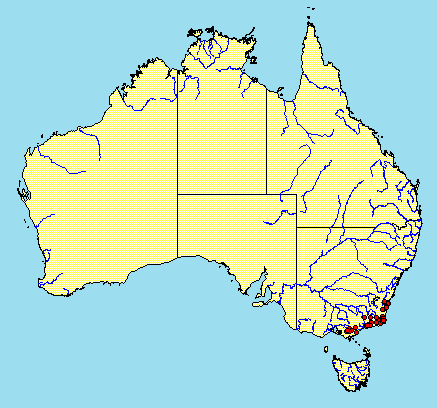
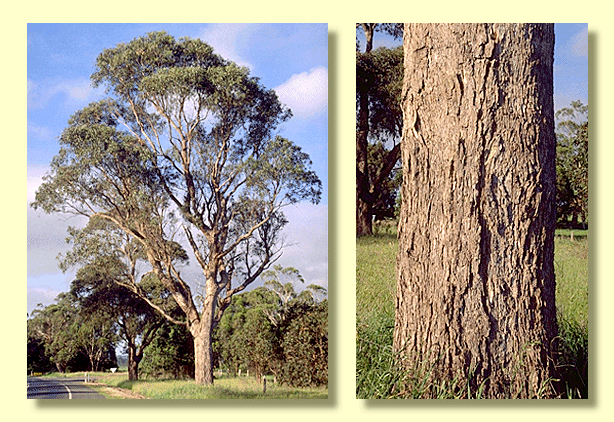
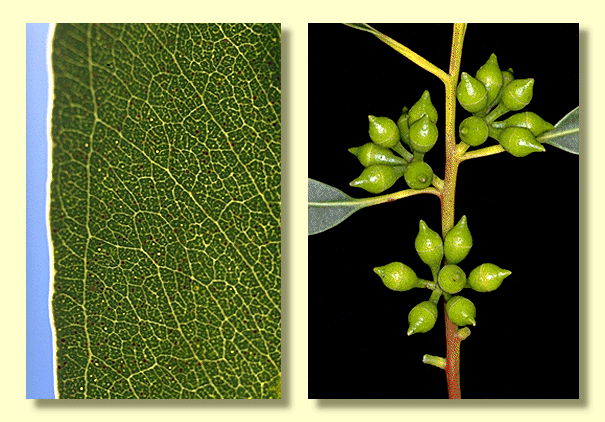
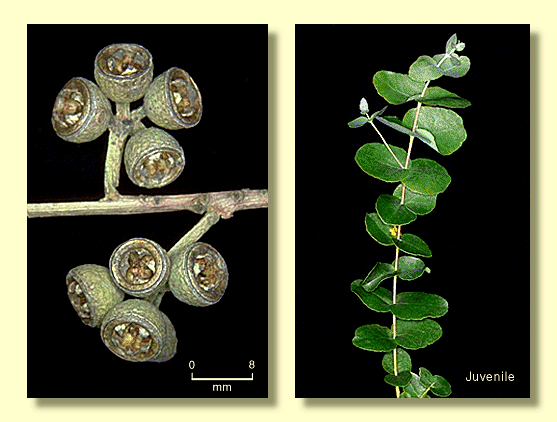
Eucalyptus angophoroides R.Baker, Proc. Linn. Soc. New South Wales 25: 676 (1901) T: Colombo, N.S.W., W.Bäuerlen s.n.; lecto: NSW, fide J.H.Maiden, Crit. Revis. Eucalyptus 5: 185 (1921). Tree to 40 m tall. Bark rough on trunk and branches, shortly and closely fibrous, often tessellated, grey, or mottled with grey and white patches, horizontal black scars sometimes present on trunk. Juvenile stem rounded or square in cross-section, green or glaucous, warty, new growing tips glaucous; juvenile leaves opposite, sessile for many pairs, becoming subopposite, shortly petiolate, orbicular to ovate or cordate, 1.7-7 cm long, 1.5-5.5 cm wide, margin crenulate, discolorous (greenish above and paler, slightly glaucous below). Adult leaves alternate, petiolate, lanceolate to falcate, 8-25 cm long, 1.4-4.3 cm wide, base sometimes oblique but usually tapering evenly to petiole, margin entire, discolorous or rarely concolorous, glossy, green, penniveined, moderately to densely reticulate, intramarginal vein parallel to and just within margin or some distance from it, oil glands numerous, small, island and intersectional. Inflorescences axillary unbranched, peduncles 0.3-1 cm long, 7-flowered; buds pedicellate, ovoid, green to yellow, scar present, operculum conical to beaked, stamens irregularly flexed, anthers cuboid or cuneate, versatile, dorsifixed, dehiscing by longitudinal slits (non-confluent), style long, locules 3 or 4, the placentae each with 4 vertical ovule rows; flowers white. Fruit pedicellate, cup-shaped or hemispherical, 0.6-0.9 cm wide, sometimes slightly angled longitudinally, disc raised or level, rarely slightly descending, valves 3 or 4, strongly exserted. Seed blackish, brown or grey, 1-2.2 mm long, ovoid or depressed-ovoid, usually lacunose, dorsal surface shallowly pitted, hilum ventral. NOTES Eucalyptus angophoroides (resembling the genus Angophora, allusion obscure) A small to medium-sized apple box tree of south-eastern coastal New South Wales and Victoria from the Strzelecki Range eastwards. It has typical box-type bark but is unrelated to the true box species. E. angophoroides has green juvenile leaves, slightly discolorous adult leaves and four valves to the fruit which distinguish it from the related tableland species, E. bridgesiana, which has glaucous juvenile leaves, concolorous adult leaves and usually three valves to the fruit. The third species of the group is E. dunnii, a tall tree of the far Northern Tablelands of New South Wales with mostly smooth bark. A fourth species of the group, E. malacoxylon, retricted to the Moonbi area north of Tamworth, can be easily distinguished from the others by the presence of a prominent median flange where the operculum joins the hypanthium and usually has coarser glaucous buds and fruit. |
    |