|
 |
home | glossary | about eucalypts | about EUCLID | browse species Eucalyptus angulosa |
|
Ridge-fruited mallee |
|
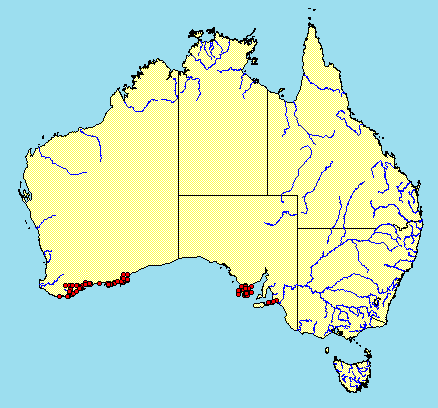
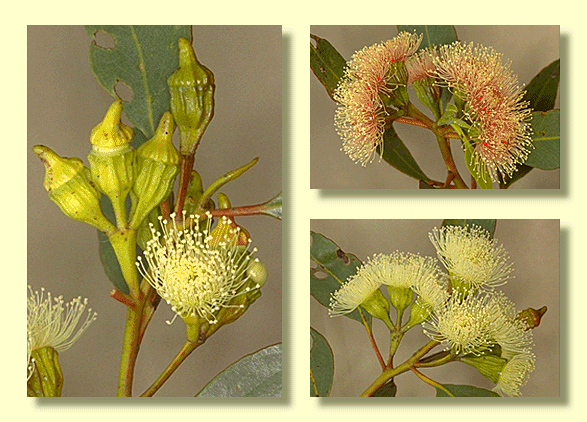
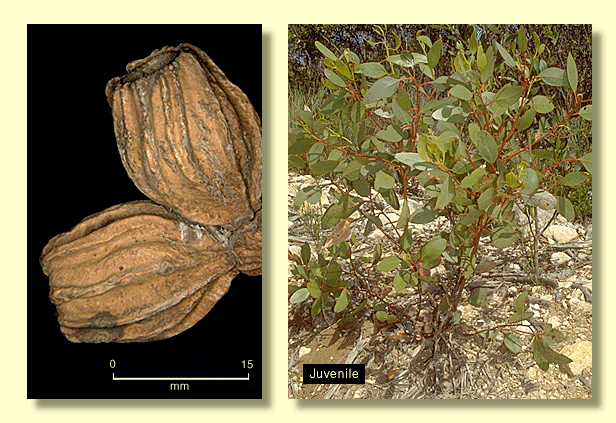
Eucalyptus angulosa Schauer in W.C.Walpers, Repert. Bot. Syst. 2: 925 (1843). E. incrassata var. angulosa (Schauer) Benth., Fl. Austral. 3: 231 (1867). T: Australia, collector unknown. E. cuspidata Turcz., Bull. Soc. Imp. Naturalistes Moscou 22: 21 (1849). T: Swan R. Colony, W.A., J.Drummond 4: 75; iso: BM, CGE, FI, K, PERTH, W. Mallee to 5 m tall. Bark smooth throughout with some grey, loose, rough bark accumulating at base of stems, smooth bark grey, grey-brown, white or pinkish with ribbons of decorticated bark in the upper branches, pith of branchlets with or without oil glands. Juvenile stem rounded or square in cross-section; juvenile leaves alternate, petiolate, ovate, 5-9 cm long, 2.5-4 cm wide, margin entire, green. Adult leaves alternate, petiolate, lanceolate to broadly lanceolate, 6-17 cm long, 1.7-4.2 cm wide, base tapering evenly to petiole, margin entire, concolorous, glossy, green, penniveined, moderately to very densely reticulate, the veinlets erose, intramarginal vein well removed from margin, oil glands numerous, intersectional. Inflorescences axillary unbranched, peduncles 1.5-2.5 cm long, 3 or 7-flowered; buds pedicellate, oblong to ovoid to pyriform, green to yellow, with coarse longitudinal ribs, scar present, operculum conical and beaked, stamens inflexed, anthers cuboid to rounded, versatile, dorsifixed, dehiscing by longitudinal slits (non-confluent), style long, locules 3 or 4, the placentae each with 6 or 8 vertical ovule rows; flowers white (rarely pink). Fruit pedicellate, cup-shaped, cylindrical, hemispherical or urceolate, 1-2 cm wide, coarsely ribbed longitudinally, disc descending, valves 3 or 4, enclosed. Seed black or grey, 3-4 mm long, irregularly pyramidal to D-shaped, with ventral ridges, sometimes slightly lacunose, dorsal surface shallowly pitted, often with a narrow marginal flange, hilum ventral. NOTES Eucalyptus angulosa (Latin angulosus, angled, refers to the ribbed fruit) Small to tall mallee with smooth bark and large, glossy, thick leaves. Buds are in 3s or 7s, sessile or pedicellate, usually ribbed. Seeds are black, flanged around edges, smooth on dorsal side, with sharp angles ascending to the hilum on the ventral side. E. angulosa usually lacks glands in the pith unlike related species. It occurs from south coastal Western Australia east to Eyre Peninsula and Fleurieu Peninsula but not Kangaroo Island. It is the coastal relative of E. incrassata and is coarser in all features. USES Honey. |
   |