|
 |
home | glossary | about eucalypts | about EUCLID | browse species Eucalyptus archeri |
|
Alpine cider gum |
|
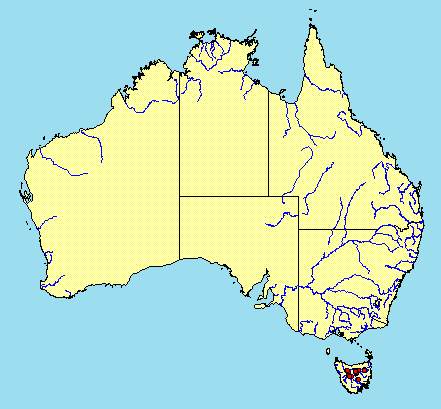
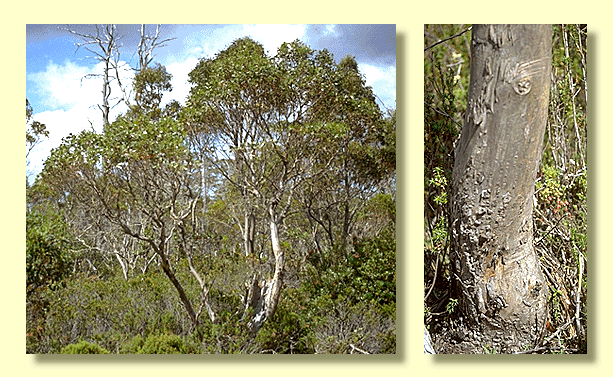
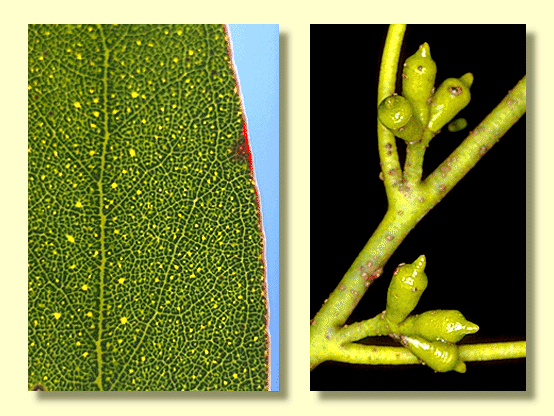
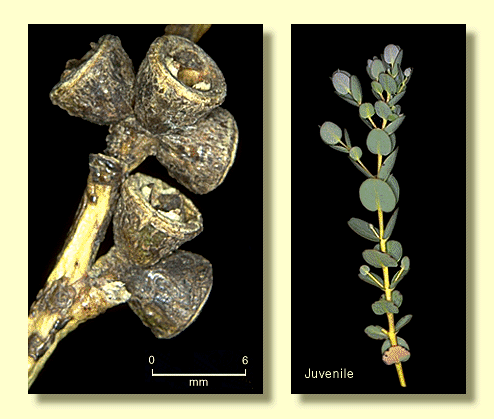
Eucalyptus archeri Maiden & Blakely, Crit. Revis. Eucalyptus 8: 58 (1929). T: Western Mts, Tas., Jan. 1848, W.H.Archer; holo: NSW; iso: CANB. Small tree or mallee to 12 m tall. Bark smooth, grey-green, grey, pinkish, white or brown, sometimes with horizontal black scars. Juvenile stem rounded or square in cross-section, warty or smooth; juvenile leaves opposite, sessile and orbicular for at least 25 nodes, becoming alternate, petiolate, broadly orbicular to ovate, 1.3-3.9 cm long, 0.9-3.2 cm wide, margin crenulate or entire, green or grey-green (only tip growth and newly expanded juvenile leaves glaucous). Adult leaves alternate, petiolate, lanceolate to elliptical, 4-9 cm long, 0.9-3 cm wide, flat (rarely undulate), base tapering evenly to petiole, margin entire, concolorous or slightly discolorous, glossy, green to grey-green, weakly penniveined, densely to very densely reticulate, intramarginal vein parallel to and well removed from margin, oil glands scattered, intersectional. Inflorescences axillary unbranched, peduncles 0.1-0.7 cm long, 3-flowered; buds shortly pedicellate or sessile (often only central bud pedicellate), oblong to ovoid to clavate, green, usually slightly angular, scar present, operculum conical, rounded or slightly beaked, stamens inflexed, anthers cuboid to oblong, versatile, dorsifixed, dehiscing by longitudinal slits (non-confluent), style short or long, locules 3 or 4, the placentae each with 4 vertical ovule rows (sometimes with an incomplete fifth row); flowers white. Fruit sessile to shortly pedicellate, cylindrical, barrel-shaped, obconical or hemispherical, 0.5-0.8 cm wide, disc descending, valves 3 or 4, near rim level or enclosed. Seed dark brown or blackish, 1.2-2 mm long, ovoid or depressed-ovoid, often pointed at one end, usually lacunose, dorsal surface smooth or shallowly pitted, hilum ventral. NOTES Eucalyptus archeri (after the collector of the type material) A small tree endemic to Tasmania, it is distinguished from the related E. gunnii which has glaucous buds and fruits. From other 3-budded species it is distinguished by the cupular fruit. |
    |