|
 |
home | glossary | about eucalypts | about EUCLID | browse species Eucalyptus arenacea |
|
Desert stringybark |
|
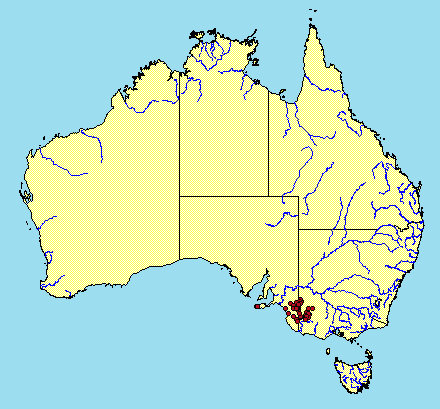
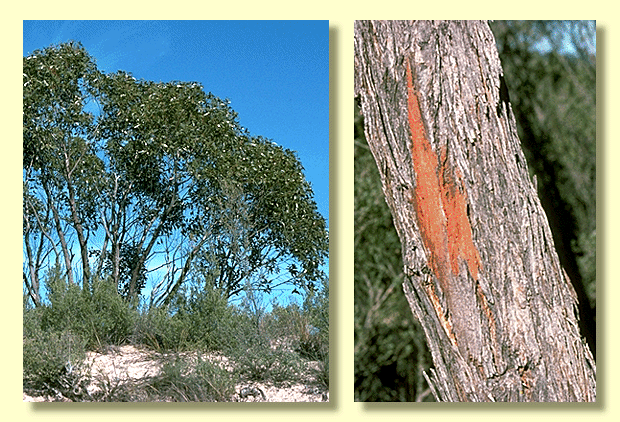
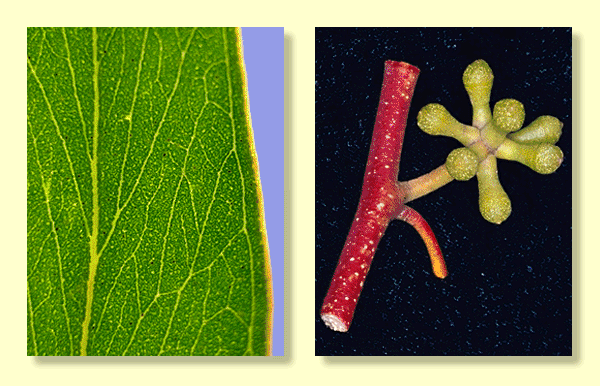
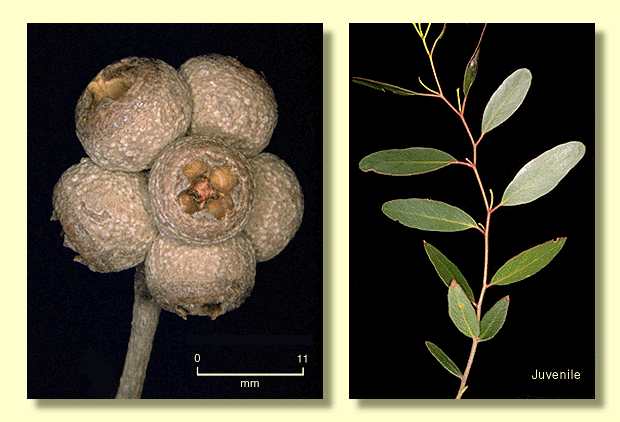
Eucalyptus arenacea Marginson & P.Ladiges, Austral. Syst. Bot. 1: 163 (1988). T: Big Desert, Victoria, 24 km N of Yanac on road toMurrayville, 4 July 1981, J.C. Marginson 224: holo: MEL; iso: MELU,CANB,NSW,AD. Mallee or small tree to 10 m tall. Bark rough to small branches in trees, stringy, grey or brown; in mallees shortly fibrous to flaky on stems with branches smooth. Juvenile stem rounded in cross-section, scabrid at first, becoming smooth; juvenile leaves opposite and sessile for a few pairs, scabrid above and below, becoming alternate, petiolate, ovate, 4.5-8.5 cm long, 3-4 cm wide, margin entire, smooth, green and glossy. Adult leaves alternate, petiolate, broadly lanceolate to lanceolate to falcate, 7-12 cm long, 1.5-4 cm wide, base oblique or tapering to petiole, margin entire, concolorous, glossy, green, weakly penniveined, sparsely reticulate, intramarginal vein parallel to and well removed from margin, oil glands island or obscure. Inflorescences axillary unbranched, peduncles 0.7-1.8 cm long, 9- 15-flowered; buds pedicellate, clavate to ovoid, green to yellow, smooth or scurfy, scar absent, operculum conical to rounded, stamens irregularly flexed, anthers reniform to cordate, versatile, dorsifixed, dehiscing by (usually) confluent slits, style long, locules 3 or 4, the placentae each with 2 vertical ovule rows; flowers white. Fruit sessile or shortly pedicellate, hemispherical or truncate-globose, 0.7-1 cm wide, disc raised or level, valves 3 or 4, slightly exserted or near rim level. Seed brown to reddish brown, 1.8-3 mm long, pyramidal or obliquely pyramidal, dorsal surface smooth or very slightly pitted, hilum terminal. NOTES Eucalyptus arenacea (Latin arenaceus, sandy, of the habitat) A mallee stringybark common in the upper south-east of South Australia and the Little Desert and Big Desert of western Victoria. Occurrence on Kangaroo Island is doubtful and the mallees attributed to it may be better classified as E. baxteri. It is related to E. baxteri from which it differs in the lower stature, smoother buds and fruit and by the flatter disc of the fruit. It grows on very poor soils including white sands. |
    |