|
 |
home | glossary | about eucalypts | about EUCLID | browse species Eucalyptus aromaphloia subsp. aromaphloia |
|
Creswick apple-box, Scented bark, Scent bark |
|
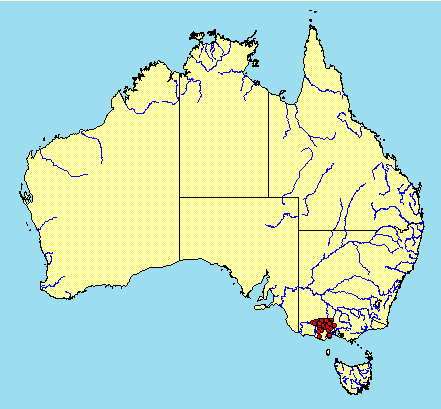
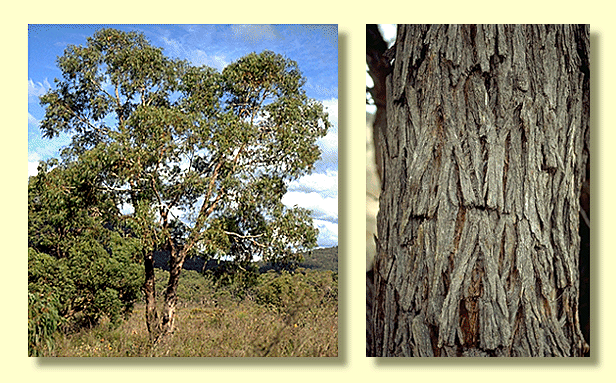
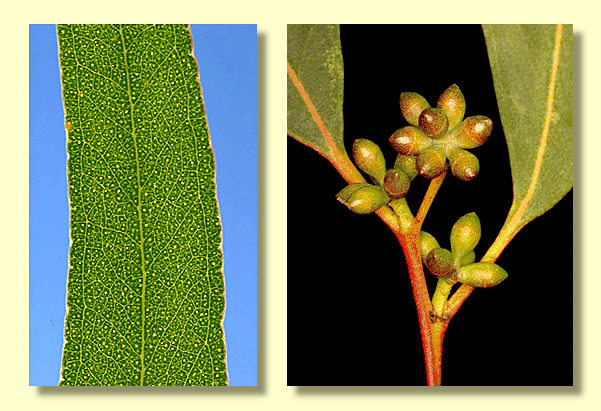
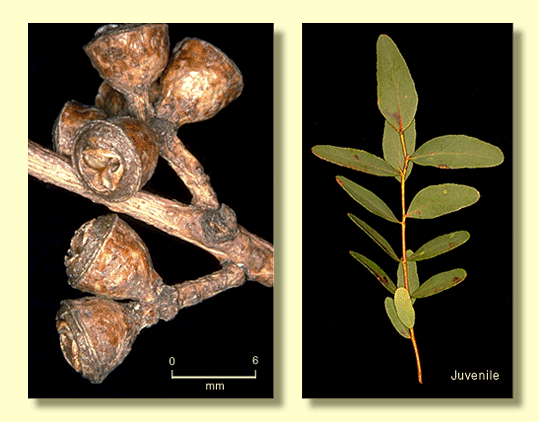
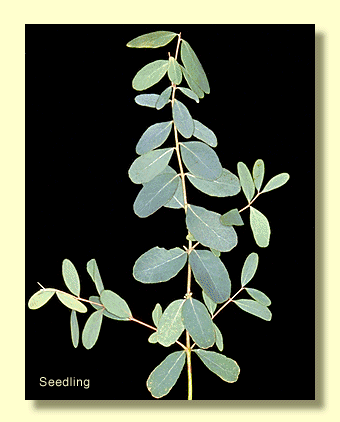
Eucalyptus aromaphloia Pryor & J.H.Willis, Victorian Naturalist 71: 125 (1954) subsp. aromaphloia. T: 113 mile post, Great Western Hwy (between Buangor and Mt Langi-Ghiran), Vic., 20 Aug. 1954, L.D.Pryor & J.H.Willis, s.n.; holo: MEL; iso: BRI, K, NSW. Tree to 18 m tall. Bark rough to small branches, thick, furrowed longitudinally, dark grey to blackish, densely fibrous, sometimes with horizontal black scars, smooth branchlets salmon coloured. Juvenile stem rounded in cross-section, slightly warty or smooth; juvenile leaves usually shortly petiolate, opposite for several pairs then becoming alternate, elliptical to oblong at first, eventually more ovate then falcate (the duration of juvenile phases is very variable), 3-7.8 cm long, 0.9-3.5 cm wide, margin entire or crenulate, grey-green, blue-green or green, only the new growing tips glaucous. Adult leaves alternate, petiolate, lanceolate to falcate, 7.5-20 cm long, 1-2 cm wide, flat (rarely undulate), base tapering to petiole, margin entire, concolorous, glossy or dull, green to grey-green, penniveined, moderately to densely reticulate, intramarginal vein parallel to and well removed from margin, oil glands island or intersectional. Inflorescences axillary unbranched, peduncles 0.3-0.8 cm long, 7-flowered (rarely more); buds shortly pedicellate, ovoid to fusiform, green tinged red, scar present, operculum conical, stamens inflexed or irregularly flexed, anthers cuneate to cuboid, versatile, dorsifixed, dehiscing by longitudinal slits (non-confluent), style long, locules 3 or 4, the placentae each with 4 vertical ovule rows; flowers white. Fruit sessile to shortly pedicellate, cup-shaped, obconical or hemispherical, 0.4-0.7 cm wide, disc raised, valves 3 or 4, strongly exserted. Seed brown, reddish brown or grey, 1-2.5 mm long, ovoid or depressed-ovoid, often pointed at one end, lacunose, dorsal surface shallowly pitted, hilum ventral. NOTES E. aromaphloia is a small to medium-sized tree endemic to Victoria. Once confused with E. viminalis subsp. cygnetensis, it differs by the whole trunk being rough-barked, often deeply furrowed like an ironbark, by the juvenile leaves which taper at the base to a very short petiole, never stem-clasping. There are two subspecies: subsp. aromaphloia (Greek aroma, smell and phloios, bark, refers to the supposed smell of the bark) has elliptical to oblong usually bluish green juvenile leaves and occurs from the eastern Grampians east to the Daylesford area and south to Anglesea subsp. sabulosa (Latin sabulosa, sandy, refers to the habitat) which occurs from the central Grampians west to the Little Desert and south-west to Cavendish and has linear, greener juvenile leaves. The two subspecies grade into each other. E. corticosa, a restricted endemic near Rylstone in central western New South Wales, is very close to subsp. sabulosa and differs only marginally by usually having smooth bark on the larger branches. USES Gums, fuel, honey. |
     |