|
 |
home | glossary | about eucalypts | about EUCLID | browse species Eucalyptus bridgesiana |
|
Apple box, Apple, Apple gum |
|
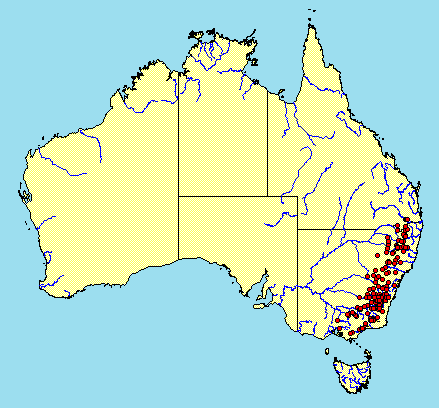
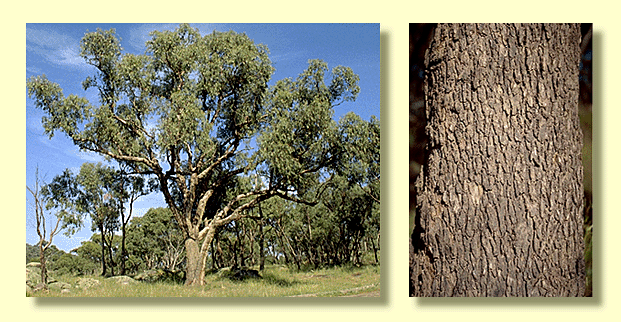
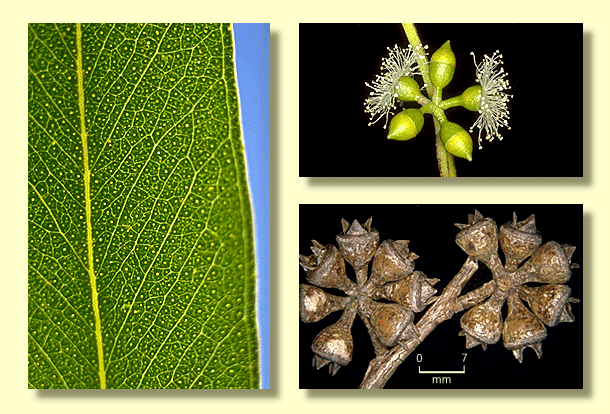
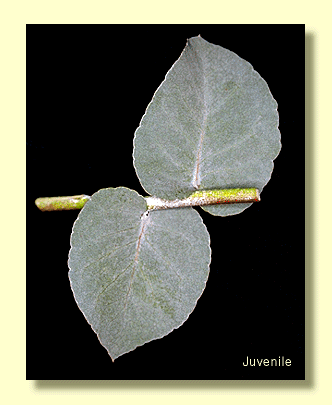
Eucalyptus bridgesiana R.Baker, Proc. Linn. Soc. New South Wales 23: 164 (1898). T: Gippsland, Vic., A.W.Howitt 101-104, 18: syn: MEL; Colombo, N.S.W., W.Bäuerlen s.n.; syn: (?) NSW; Albury, N.S.W., 21 June 1897, Dr Andrews; syn: NSW ; Gerogery, N.S.W., J.Manns; syn: (?) NSW; Rylstone, N.S.W., R.T.Baker; syn: (?) NSW; Bathurst, N.S.W., W.Woolls; syn: (?) NSW. E. bridgesiana var. amblycorys (Blakely) Cameron, Victorian Naturalist 63: 41 (1946); E. stuartiana var. amblycorys Blakely, Key Eucalypts 145 (1934). T: Tumut, N.S.W., Jan. 1897, E.Betche s.n.; (NSW). [E. stuartiana auct. non F.Muell. ex Miq.: A.K.Cameron, Victorian Naturalist 62: 47-50 (1945).] Tree to 25 m tall; bark rough over whole trunk and larger branches, fibrous, usually tessellated and mottled grey and white. Juvenile stem rounded in cross-section, usually glaucous, warty, or smooth; juvenile leaves sessile, opposite for many pairs, becoming shortly petiolate and alternate, orbicular to ovate or cordate, 2.5-10 cm long, 2-8 cm wide, margin crenulate, glaucous. Adult leaves alternate, petiole 1.2-3.5 cm, lanceolate, 12-20 cm long, 1.5-2.5 cm wide, concolorous, glossy, green; weakly penniveined, reticulation moderate to dense, intramarginal vein parallel to and well removed from margin, with few small island oil glands, sometimes apparently glandless. Inflorescences axillary, unbranched; peduncles to 1.5 cm long, 7-flowered; buds pedicellate, ovoid, to 0.8 cm long, 0.4 cm diam., scar present; operculum beaked or conical; stamens irregularly flexed, anthers dorsifixed, versatile, cuneate, dehiscing by longitudinal slits, locules 3(4), the placentae each with ovules in 4 vertical rows; flowers white. Fruit pedicellate, hemispherical, to 0.7 cm long, 0.7 cm diam.; disc raised-annular; valves 3(4), exserted; seed brownish black, flattened-ovoid, usually lacunose, dorsal surface shallowly pitted, hilum ventral. NOTES Eucalyptus bridgesiana (after F. Bridges, ?) A small to medium-sized woodland tree of central and eastern Victoria, the tablelands of New South Wales and the far south-east of Queensland. The bark is rough, box type, usually breaking into distinct tesserae (thick flakes). Limbs may be smooth but are usually rough. The juvenile leaves are notably orbicular to cordate, glaucous, sessile, opposite at first but then subopposite or alternate. It is related to three other species, viz. E. angophoroides, a species of better quality sites in south coastal New South Wales and East Gippsland in Victoria, and which has slightly discolorous adult leaves and green juvenile leaves; E. malacoxylon, restricted to the Moonbi area of the Northern Tablelands of New South Wales, a species with larger, coarse buds and fruits; and E. dunnii which is a tall forest tree of subcoastal hills and ranges of northern New South Wales, and has a rough butt but is otherwise smooth-barked and has green juvenile leaves. The form of E. bridgesiana on the western side of the Northern Tablelands has very conspicuous glaucous stems and leaves on saplings to > 2 m tall. USES Gums, honey. |
    |