|
 |
home | glossary | about eucalypts | about EUCLID | browse species Eucalyptus cinerea subsp. cinerea |
|
Argyle apple, Mealy stringybark |
|
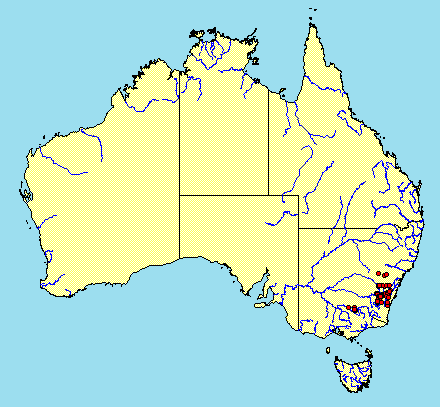
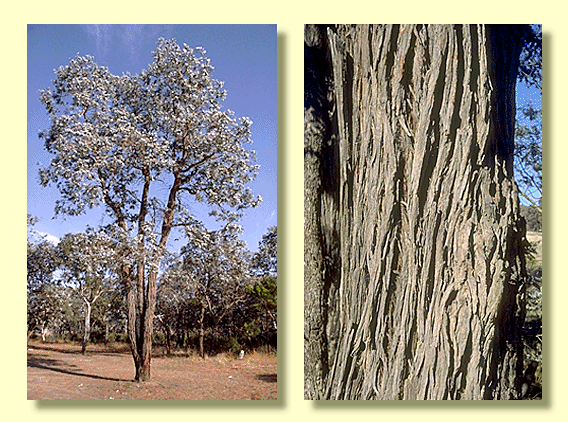
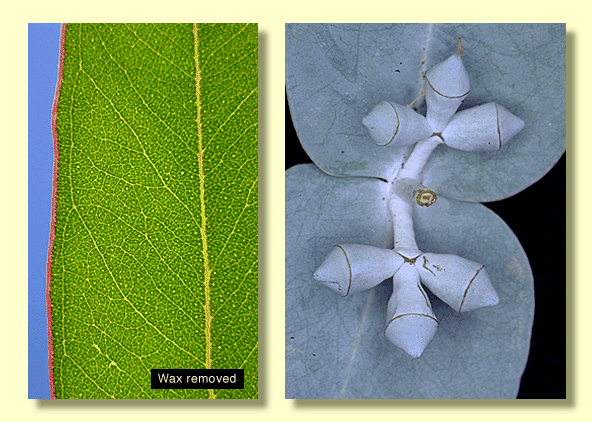
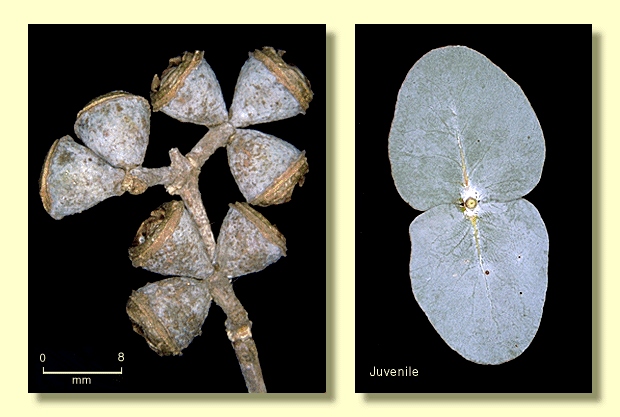
Eucalyptus cinerea F.Muell. ex Benth., Fl. Austral. 3: 239 (1867) subsp. cinerea. T: Lachlan R. near Bathurst, N.S.W., A.Cunningham 39; syn: K. E. pulverulenta var. lanceolata Howitt, Rep. 7th Meeting Austral. Assoc. Advancem. Sci. 7: 518 (1898); E. stuartiana var. cordata R.Baker & H.G.Smith, Res. Eucalypts 105 (1902) nom. illeg. T: between Pilot Ra. & Beechworth, Vic., F.Mueller; near Ovens R., Vic., C.Falk 4: syn: MEL; Ovens district, Vic., D.Ingle. [E. pulverulenta auct. non Sims: F.Mueller, Fragm. 2: 70 (1860)] Tree to 15 m tall. Bark rough to small branches, thick, fibrous, furrowed longitudinally, grey over red-brown. Crown of mature tree composed of juvenile and intermediate leaves. Juvenile stems rounded, glaucous; juvenile leaves sessile, opposite for many pairs, orbicular to broadly ovate, to 8 cm long, 4.5 cm wide, base amplexicaul, lobed or rounded, apex rounded to emarginate or pointed, glaucous. Intermediate leaves opposite with petioles 0.4-1.5 cm, ovate to lanceolate, 4.8-9 cm long, 2-4.5 cm wide. Adult leaves (rarely formed) petiolate, alternate, lanceolate to slightly falcate, 9-14 cm long, 1.5- 5 cm wide, base rounded or tapering to petiole, concolorous, dull, grey-green to glaucous, penniveined, reticulation dense, intramarginal vein remote from margin, with few to numerous island oil glands. Inflorescences axillary unbranched; peduncle to 0.2-0.9 cm long, 3-flowered; buds sessile or with central bud shortly pedicellate, diamond-shaped, to 1.1 cm long, 0.5 cm diam., scar present, operculum conical, stamens inflexed, anthers dorsifixed, cuneate, versatile, dorsifixed, dehiscing by longitudinal slits, locules 3 or 4, the placentae each with ovules in 4 vertical rows; flowers white. Fruit sessile or shortly pedicellate, obconical to campanulate, 0.5-0.9 cm diameter, disc raised-annular, valves 3 or 4, rim level or slightly exserted. Seed grey-brown to blackish, flattened-ovoid, minutely pitted, hilum ventral. NOTES E. cinerea is small tree distributed from the central western slopes of New South Wales in the Wattle Flat area south to Beechworth in northern Victoria. It is notable for the thick rough bark and the mature crown of largely grey or glaucous sub-adult leaves. It consists of two subspecies: subsp. cinerea (Latin cinereus, ashen, refers to the white, waxy bloom of the leaves, flower buds and fruits) which has a high proportion of orbicular to broadly ovate juvenile leaves in the mature crown subsp. triplex (Latin triplex triple, three-fold, refers to the -3-flowered inflorescences) which has a high proportion of ovate intermediate leaves and lanceolate adult leaves in the crown. The latter is only is known from two granitic mountains south of Canberra and a population north-west of Captains Flat in nearby New South Wales. USES Gums, honey, ornamental. |
    |