|
 |
home | glossary | about eucalypts | about EUCLID | browse species Angophora floribunda |
|
Apple, Rough-barked apple |
|
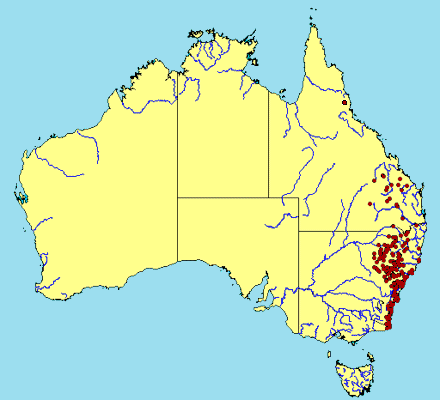
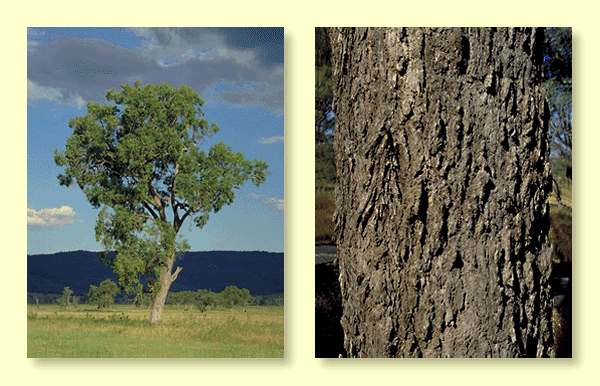
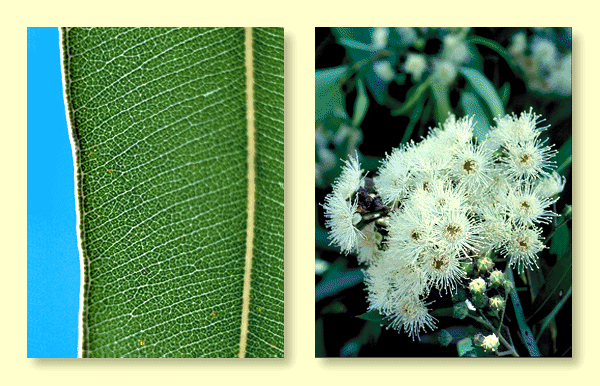
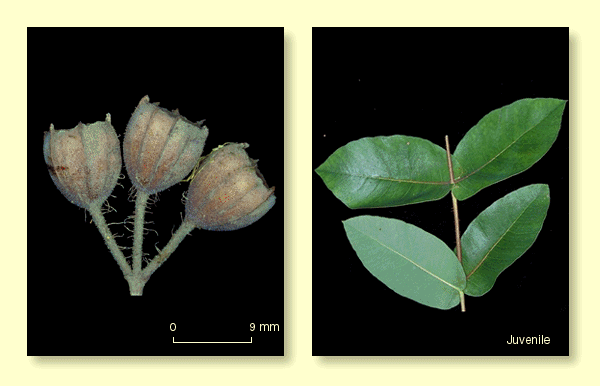
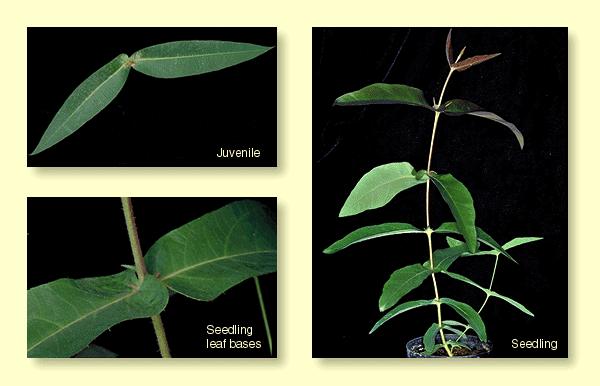
Angophora floribunda (Smith) Sweet, Hort. Brit. 2nd edn., 209 (1830) Metrosideros floribunda Smith, Trans. Linn. Soc. London 3: 267 (1797) Acmena floribunda (Smith) DC., Prodr. 3: 262 (1828) T: Port Jackson, N.S.W., 1795, J. White; holo: LINN Angophora intermedia DC., Prodr. 3: 222 (1828) T: New Holland, 1816, A.B. Lambert s.n.; holo: G-DC Angophora ochropylla R. Baker, Proc. Soc. Linn. New South Wales 38: 601 (1914) T: Myall Creek, near Bingarra, N.S.W., Apr. 1911, C.F. Laseron NSW 167269; lecto: NSW Medium-sized to large tree to 30 m tall. Bark rough to the small branches, shortly fibrous and generally furrowed, grey to brown. Juvenile stem rounded in cross-section, pubescent or glabrous, juvenile leaves opposite, petiolate or sessile, cordate to oblong to narrowly lanceolate to ovate, 4.5-12 cm long, 2-5 cm wide, base amplexicaul to rounded, margin entire or rarely finely toothed, apex acute, green, pubescent or glabrous. Adult leaves opposite, petioles 0.6-1.5 cm long, leaf blade narrowly lanceolate to ovate, occasionally falcate, 5.5-15 cm long, 1-5 cm wide, flat to undulate, base tapering to petiole or rounded, margin entire, apex acute, discolorous, glossy green to dull grey-green, penniveined, densely to very densely reticulate, intramarginal vein present, oil glands island. Inflorescences terminal, peduncles 1-3.3 cm long, 3 or 7-flowered. Buds pedicellate, globular, hypanthium pubescent or glabrous, longitudinally ribbed; petals white with a green keel; stamens inflexed, anthers oblong, versatile, dehiscing by longitudinal slits (non-confluent), style long, stigma blunt, mop-like, locules 3 or 4, the placentae each with 5 vertical ovule rows; flowers white or creamy white. Fruit pedicellate, barrel-shaped to cup-shaped, 0.7-1.1 cm wide, longitudinally ribbed, disc descending, valves 3 or 4, enclosed. Seed reddish brown to brown, 5.5-7 mm long, flattened-ellipsoidal, dorsal surface smooth, hilum ventral. NOTES Angophora floribunda (Latin floribundus, profusely flowering) We believe the Angophoras divide logically into three taxonomic series; Angophora, Floribundinae, and Costatitae. A. floribunda belongs to the series Floribundinae which is diagnosed by the rough bark and petiolate adult leaves. It is a medium-sized to tall tree differing from A. bakeri which is a smaller tree with shorter petioles and narrower adult leaves (usually less than 1.5 cm wide). Another member of the series, A. inopina, a small stunted tree from the Wyee area just north of Sydney, is very close to A. floribunda and may be no more than a stunted coastal form of that species. The other species of the series, A. woodsiana, differs by having longer pedicels, usually longer than 10 mm. A. floribunda is very widely distributed in south-eastern Queensland from south of Rolleston and east of Roma, and throughout eastern New South Wales apart from the northern coast, and extends just into far eastern Victoria. There is also a disjunct occurrence between Cairns and Ravenshoe in far northern Queensland. It is a species that varies, particularly in the width of the adult leaf. Populations in western New South Wales tend to be much narrower than those of the coastal ranges and in some parts grade towards A. bakeri. |
     |