|
 |
home | glossary | about eucalypts | about EUCLID | browse species Eucalyptus sp. aff. goniocalyx |
|
Anglesea box (= Brooker 11794) |
|
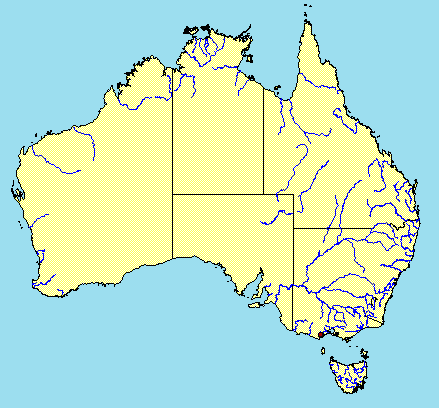
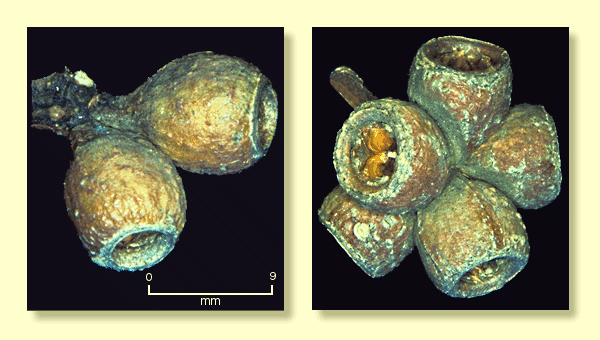
sp. aff. goniocalyx (= Brooker 11794) Tree to 8 m tall. Bark rough on part or all of trunk, fibrous, grey; branches smooth pale grey to creamy. Juvenile stems square in cross-section, sometimes winged, slightly glaucous; juvenile leaves opposite and sessile for many pairs, highly variable in shape and size, from grossly orbicular to ovate, 3.5-12.5 cm long, 3-11.5 cm wide, bases amplexicaul, apex rounded to pointed, slightly discolorous, glossy green above, sometimes slightly glaucous below, often thick. Adult leaves alternate, petiole 2-4 cm long, lanceolate to falcate, 12-21 cm long, 2-3.3 cm wide, base tapering to petiole or rounded, concolorous, glossy, green, penniveined, densely reticulate, intramarginal vein parallel to and well removed from margin, oil glands mostly island. Inflorescences axillary unbranched, peduncles broad, 1-1.7 cm long, 7-flowered; buds sessile or pedicellate, oblong, usually with longitudinal ribs or angles, scar present, operculum conical, stamens irregularly flexed, anthers cuneate, versatile, dorsifixed, dehiscing by longitudinal slits (non-confluent), style long, stigma blunt, locules 3 or 4, the placentae each with 4 vertical ovule rows; flowers white. Fruit sessile or pedicellate, cylindrical, cup-shaped or barrel-shaped, 0.8-1.1 cm wide, often angled longitudinally, disc descending, valves 3 or 4, near rim level. Seed dark grey, brown or black, 2-3 mm long, ovoid to depressed-ovoid, often pointed at one end, sometimes lacunose, dorsal surface shallowly pitted, hilum ventral. NOTES Populations on low hills around Anglesea in southern Victoria have affinity with both E. goniocalyx and E. cypellocarpa. Bark is rough over whole trunk, juvenile leaves are large, ovate to orbicular, glossy green and buds are cylindrical. |
  |