|
 |
home | glossary | about eucalypts | about EUCLID | browse species Eucalyptus goniocalyx |
|
Long-leaved box, Bundy, Apple, Olive-barked box |
|
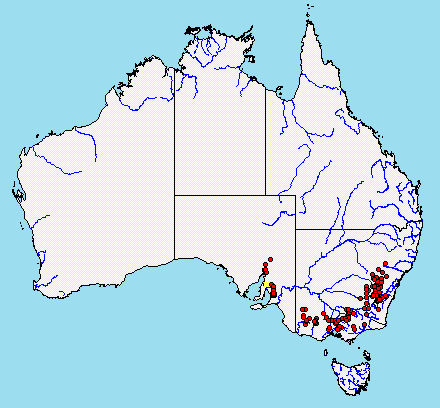
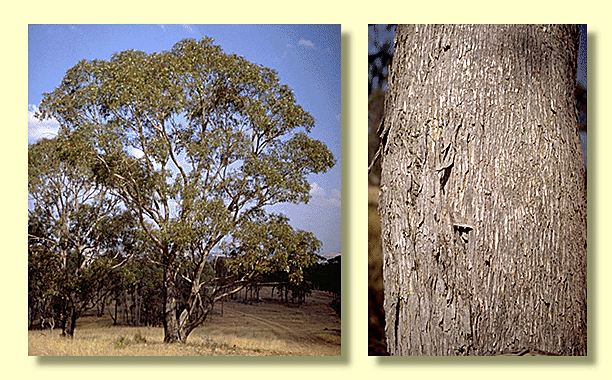
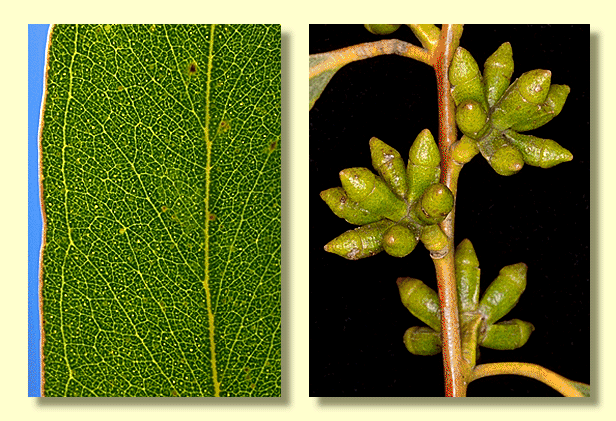
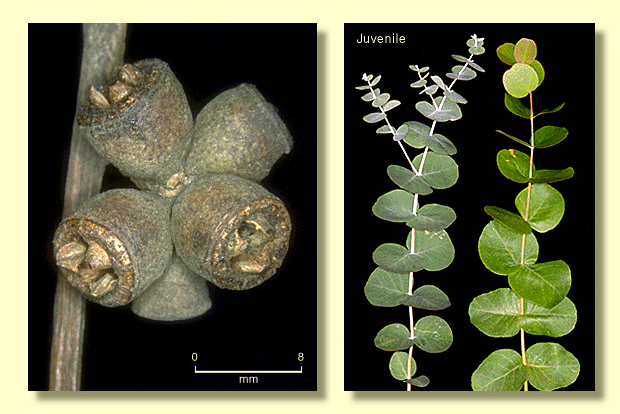
Eucalyptus goniocalyx F.Muell. ex Miq., Ned. Kruidk. Arch. 4: 134 (1856). T: Buffalo Ra., Vic., 1853, F.Mueller; holo: MEL; iso: K, NSW. E. elaeophora F.Muell., Fragm. 4: 52 (1864). T: Macalister R., Vic., Jan, 1863, F.Mueller; holo: MEL; iso: NSW. E. cambagei Deane & Maiden, Proc. Linn. Soc. New South Wales 25: 106 (1900). T: Hassans Walls, N.S.W., 8 Apr. 1900, J.H.Maiden; syn: BM, NSW; Mt Bulaway, N.S.W., Oct. 1899, W.Forsyth; syn: NSW. E. cordieri var. brachypoma Blakely, Key Eucalypts 147 (1934). T: Mt McDonald., near Cowra, N.S.W., May 1900, R.H.Cambage s.n.; (NSW). Tree to 15 m tall. Bark rough to small branches or the branches smooth; rough bark fibrous or box-type, grey, grey-brown, or mottled with grey and white patches; smooth bark white, cream or grey. Juvenile stem rounded or square in cross-section, glaucous or occasionally non-glaucous; juvenile leaves opposite and sessile for many pairs, orbicular, 3.5-10 cm long, 3.5-11 cm wide, margin entire or crenulate, apex rounded sometimes apiculate, or emarginate, quite to slightly glaucous, or rarely green. Adult leaves alternate, petiole 1-4 cm long, lanceolate to falcate, 6-25 cm long, 1.3-4 cm wide, flat or undulate, base tapering to petiole, concolorous, glossy, green, penniveined, densely reticulate, intramarginal vein parallel to and well removed from margin, oil glands island, intersectional or obscure. Inflorescences axillary unbranched, peduncles 0.5-1.5 cm long, 7-flowered; buds sessile or pedicellate, oblong to ovoid to clavate, green to yellow, often slightly angled longitudinally, scar present, operculum conical to rounded, stamens irregularly flexed, anthers cuboid or cuneate, versatile, dorsifixed, dehiscing by longitudinal slits (non-confluent), style long, stigma blunt or tapered, locules 3 or 4, the placentae each with 4 vertical ovule rows; flowers white. Fruit sessile, cup-shaped or cylindrical to barrel-shaped, 0.6-1 cm wide, sometimes slightly angled longitudinally, disc usually descending, valves 3 or 4, slightly exserted to enclosed. Seed black, brown or grey, 1.5-2.5 mm long, ovoid or depressed-ovoid, sometimes lacunose, dorsal surface smooth or shallowly pitted, hilum ventral. NOTES Eucalyptus goniocalyx (Greek gonio- corner and calyx, calyx, refers to the angles on the fruit) A small to medium-sized tree, often of poor form, on tablelands and hills from the Northern Tablelands of New South Wales to central-western Victoria, also from the Mt Lofty to the Flinders Ranges of South Australia. In eastern Australia it differs from the often co-occurring E. bridgesiana in the following ways - rough bark does not become tessellated, the glaucous round juvenile leaves remain opposite rather than becoming subopposite to alternate, and by the sessile buds and fruit. On Mt Arapiles in Victoria there is a population of E. goniocalyx with only glossy green-leaved (ie non-glaucous) seedlings - such seedlings are rare in other populations but do occur for example at Mulligan's Flat, ACT. A related species, E. nortonii, occurs on poorer sites with shallow soil and differs by the glaucous adult leaves, buds and fruit. |
    |