|
 |
home | glossary | about eucalypts | about EUCLID | browse species Eucalyptus kartzoffiana |
|
Araluen gum |
|
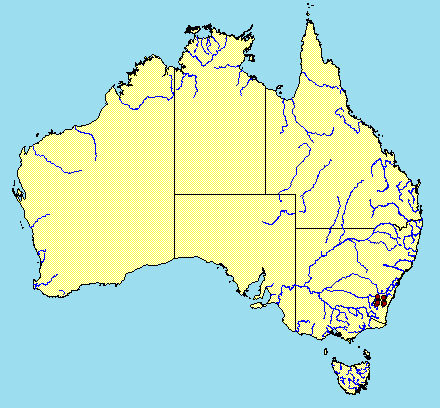
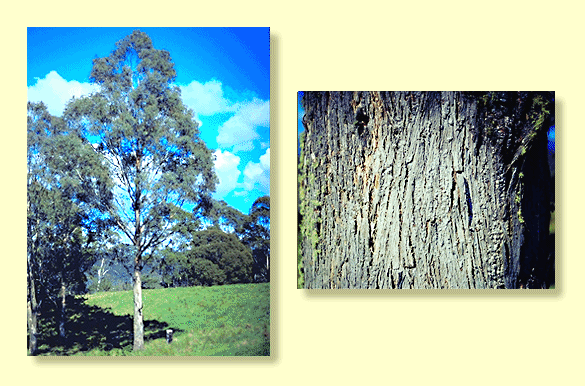
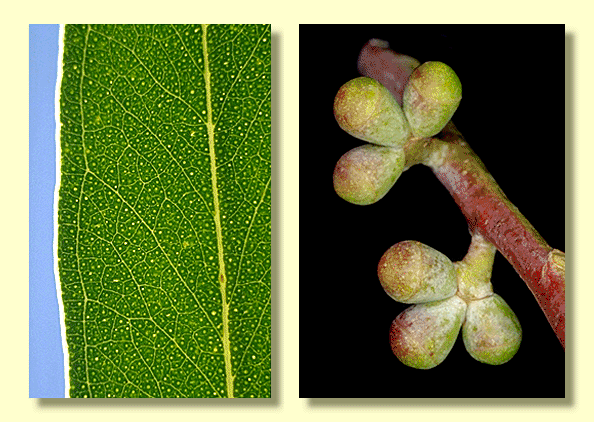
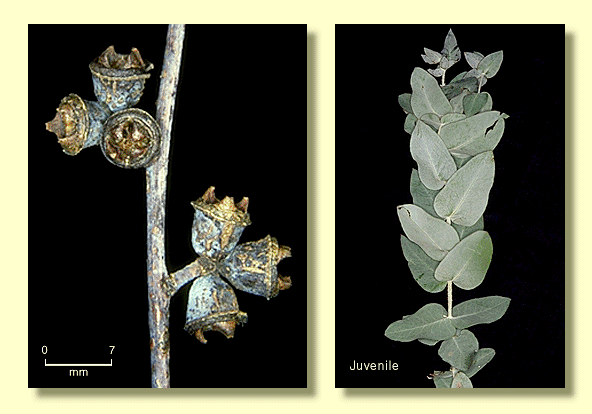
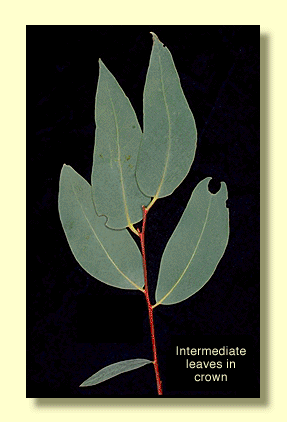
Eucalyptus kartzoffiana L.Johnson & Blaxell, Contr. New South Wales Natl Herb. 4: 455 (1973). T: c. 4 miles [6.5 km] N of Araluen (on Braidwood road), N.S.W., 5 Jan. 1968, L.A.S.Johnson NSW 132571; holo: NSW; iso: CANB. Tree to 30 m tall. Bark rough on part or most of trunk, fibrous or box-type, grey or grey-brown; smooth bark white, cream, brown, grey or green, occasionally with with horizontal black scars, commonly with long ribbons of decorticated bark in the crown; branchlets often glaucous. Juvenile stem rounded or square in cross section, glaucous, warty; juvenile leaves opposite and sessile for many pairs, cordate or ovate, 1.5-6.5 cm long, 1.5-4.5 cm wide, margin sometimes crenulate, glaucous. Crown often consisting of alternate, petiolate, broadly lanceolate intermediate leaves and adult leaves. Adult leaves alternate, petiole 1-4.1 cm long, falcate to lanceolate or narrowly lanceolate, 8-26.5 cm long, 1.2-3.6 cm wide, base tapering to petiole, concolorous, dull, green to blue-green to glaucous, penniveined, moderately reticulate, intramarginal vein parallel to and remote from margin, oil glands mostly island. Inflorescences axillary unbranched, peduncles 0.2-0.5 cm long, 3-flowered; buds sessile or pedicellate, oblong, green to yellow or creamy, often glaucous, often angled longitudinally, scar present, operculum rounded to conical, stamens inflexed, anthers cuboid to oblong, versatile, dorsifixed, dehiscing by longitudinal slits (non-confluent), style long, stigma blunt, locules 3 or 4, the placentae each with 4 vertical ovule rows; flowers white. Fruit sessile, campanulate, 0.5-0.9 cm wide, glaucous, or non-glaucous, disc raised-convex or oblique, or level, valves 3 or 4, strongly exserted. Seed dark brown or grey to black, 1.5-2.5 mm long, ovoid or depressed-ovoid, often pointed at one end, strongly lacunose, dorsal surface smooth, hilum ventral. NOTES Eucalyptus kartzoffiana (after M. Kartzoff, forester and collector) A medium-sized tree of very restricted distribution on the eastern side of the Southern Tableland of New South Wales, in the vicinity of Majors, Bell and Araluen Creeks, south-east of Braidwood, on granite-derived soils. One of many species with three buds, the tree may superficially resemble globulus subsp. maidenii with which it grows but is distinguished by the smaller, opposite, ovate glaucous juvenile leaves, the 3-budded inflorescences, the short peduncles, cylindrical buds and campanulate fruit. |
     |