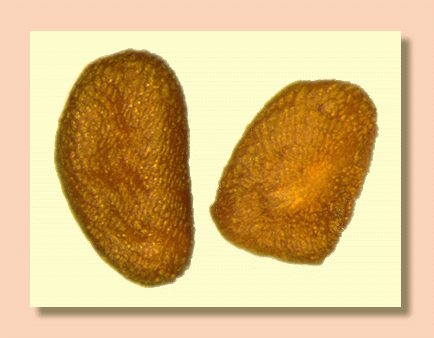
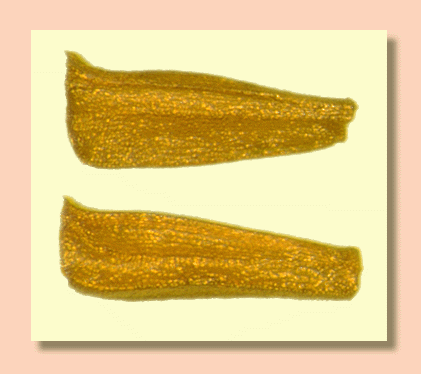
One useful feature that is not immediately available in the field is
the seeds. Until the vascular connections between the individual fruits
held in the crown and the parent tree are broken, the valves will not open.
Otherwise, eucalypt fruit are held on the branchlets often for years. Seed
from detached fruits, however, can be ready for inspection after about
24 hours by placing unopened fruits in a paper bag where they dry out quickly
and shed the seeds and the thinner chaff particles. There is a great number of seed
forms and these can be seen either with the naked eye or by means of
a lens. Fortunately, related species have identical seeds and the character
is therefore one of high reliability.
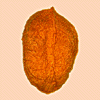 |
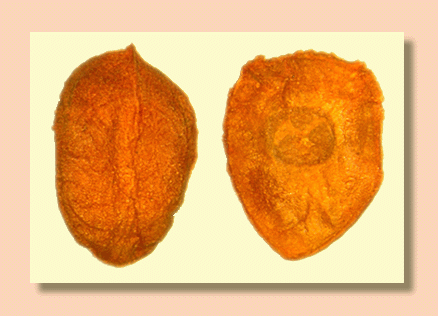
Flattened or saucer-shaped
The seed is somewhat flattened with a distinct upper (dorsal) and lower
(ventral) side. The ventral side may be somewhat concave, with the hilum
in the centre. |
|
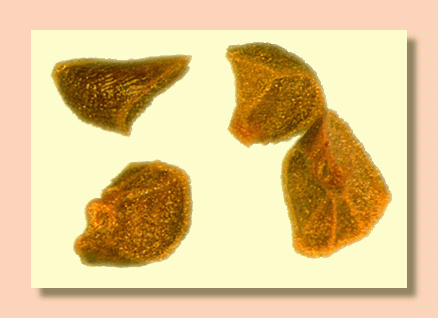
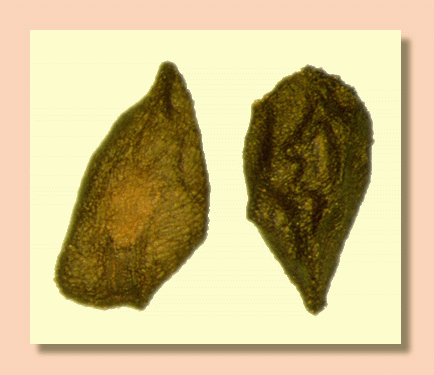
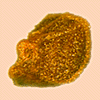
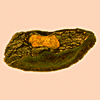
Pyramidal or obliquely pyramidal
The seed is pyramid shaped with a relatively smooth or lacunose, flat
or rounded dorsal side. The ventral side is usually ribbed, wrinkled or
angled and is surmounted by a narrowed face at the summit where the hilum
is.
|
|
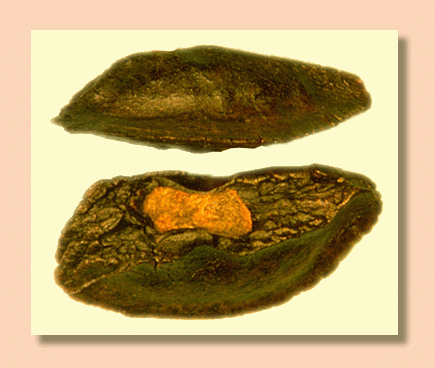
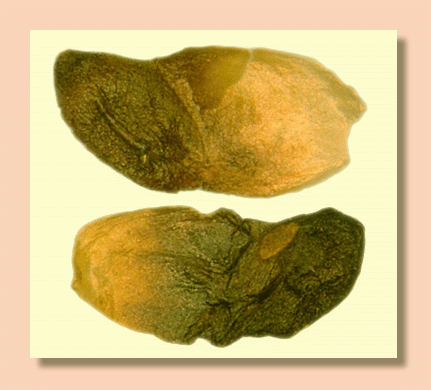
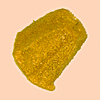
Boat-shaped
The seed is elongated and strongly keeled dorsally with a large,
conspicuous hilum in the middle of the flat underside. The edges may be
flanged or narrowly winged.
|
|
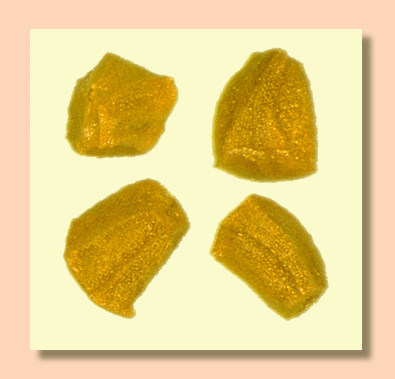
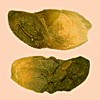
Cuboid
The seed is chunky, often with a smooth, shiny or somewhat granular,
sometimes slightly rounded, dorsal side. The hilum is situated on a smaller
terminal face separated from the dorsal side by the side walls of the seed.
These walls are often angular. The chaff is usually similar to the seed,
but somewhat smaller and lighter coloured.
|
|
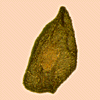
Ellipsoidal with terminal wing
The flattened-ellipsoidal body of the seed occurs at the lower end
(considering the disposition of the ovule in the intact bud), with a transparent
wing as long as the body of the seed at the top end. Overall colour of
the seed is reddish or yellowish brown. The wings may be seen, just before seed shed, emerging
from the top of the ovary. The hilum is usually positioned near one edge
not far from the start of the wing.
|
|
Pointed at one end
The seed is somewhat flattened, usually rounded at one end and pointed
at the other. It may be described as teardrop-shaped.
|
|
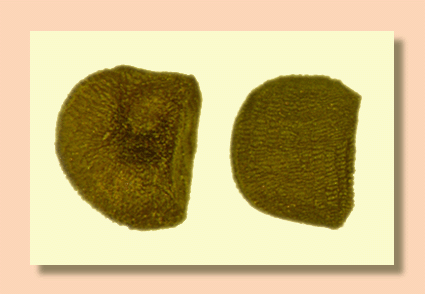
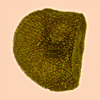
D-shaped
The seed is roughly disc-like with a short straight side and a longer
connecting curved side.
|
|
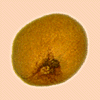
Spherical
The seed is more or less spherical (e.g. E. desmondensis).
|
|
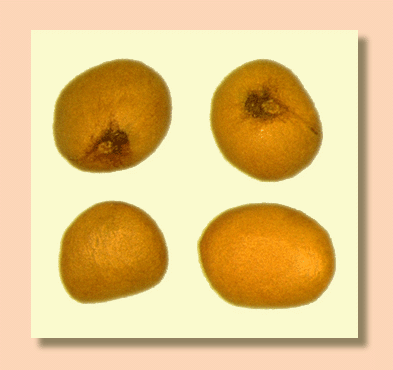
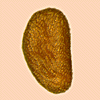
Ovoid or depressed ovoid
The seed is ovoid or elliptical in outline but flattened with the hilum
on the more or less concave ventral side.
|
|
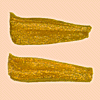
Linear
The seed is narrow and elongated, with a very small dorsal surface,
long sides and terminal hilum (only E. curtisii).
|