
Geographic range, population structure and conservation status of the green python (Morelia viridis), a popular snake in the captive pet trade
David Wilson A B C and Robert Heinsohn AA Fenner School of Environment and Society, Australian National University, Canberra, ACT 0200, Australia.
B Present address: School for Tropical and Marine Biology, James Cook University, Townsville 4811, Australia.
C Corresponding author. Email: david.wilson2@jcu.edu.au
Australian Journal of Zoology 55(3) 147-154 https://doi.org/10.1071/ZO06078
Submitted: 12 September 2006 Accepted: 15 May 2007 Published: 28 June 2007
Abstract
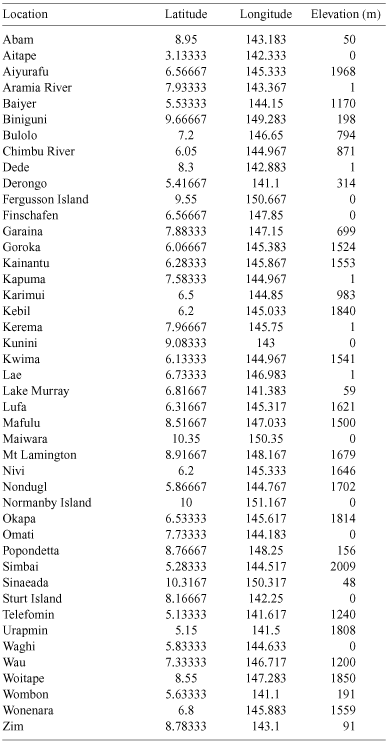
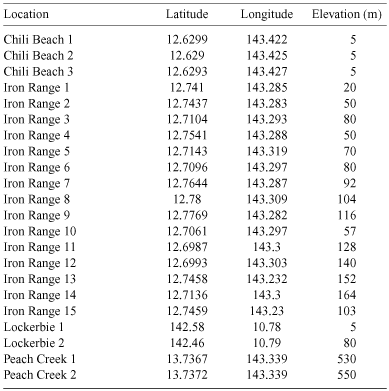
Accurate knowledge of distribution and population size is required for effective conservation and management of wild species. Here we report on the first estimates of the distribution and density of the green python (Morelia viridis), an iconic rainforest species widely kept in captivity. We used climatic modelling to predict its distribution in Papua New Guinea, and both climate and vegetation mapping to predict its Australian distribution. We used mark–recapture methods to estimate the density and population structure of green pythons at Iron Range, northern Australia. Bioclimatic analyses suggested that there is extensive climatically suitable habitat in Papua New Guinea (≥200 000 km2), but very little in Australia (~300 km2). However, use of vegetation maps increases the predicted suitable area of occupancy in Australia to 3127 km2, including nine regional ecosystems. Density estimates at Iron Range were 4–5 ha–1 in the complex vine forest regional ecosystem; however, only half of these were mature adults. The large predicted area of occurrence and the high density in the one intensively studied area suggest that the species is not vulnerable to extinction in the short term. However, more studies are needed in both New Guinea and Australia, especially to quantify the impact of harvesting green pythons for the pet trade.
Acknowledgements
We thank all the people who helped search for specimens in the field, especially K. and A. Goetze, S. Legge, S. Murphy, B. Robinson, E. Sobey and K. Wilson. K. Nissen and J. Stein helped to generate maps. This research was funded by the Australian Geographic Society, National Geographic Society and the Hermon Slade Foundation. Appropriate permits were issued by the Queensland Environmental Protection Agency (WITK00337502) and the Australian National University (C.RE.24.02 and 27.02).
Brown, G. , and Shine, R. (2002). Influence of weather condition on activity of tropical snakes. Austral Ecology 27, 596–605.
| Crossref | GoogleScholarGoogle Scholar |
Crisp, M. , Laffan, S. , Linder, H. , and Monro, A. (2001). Endemism in the Australian flora. Journal of Biogeography 28, 183–198.
| Crossref | GoogleScholarGoogle Scholar |
Gibbons, J. , and Andrews, K. (2004). PIT tagging: simple technology at its best. Bioscience 54, 447–454.
| Crossref | GoogleScholarGoogle Scholar |
Legge, S. , Heinsohn, R. , and Garnett, S. (2004). Availability of nest hollows and breeding population size of eclectus parrots, Eclectus roratus, on Cape York Peninsula Australian Wildlife Research 31, 149–161.
| Crossref | GoogleScholarGoogle Scholar |
Meyer, C. , and Thuiller, W. (2006). Accuracy of resource selection functions across spatial scales. Diversity & Distributions 12, 288–297.
| Crossref | GoogleScholarGoogle Scholar |
Olsen, P. , and Doran, B. (2002). Climatic modelling of the Australian distribution of the grass owl (Tyto capensis): is there an inland population? Wildlife Research 29, 117–125.
| Crossref | GoogleScholarGoogle Scholar |
Pearson, D. , Shine, R. , and Williams, A. (2005). Spatial ecology of a threatened python (Morelia spilota imbricata) and the effects of anthropogenic habitat change. Austral Ecology 30, 261–274.
| Crossref | GoogleScholarGoogle Scholar |
Schulte, R. (1988). Observaciones sobre la boa verde, Corallus caninus, en el Departmento San Martin-Peru. Boletín de Lima 55, 21–26.
Sumner, J. , and Dickman, C. (1998). Distribution and identity of species in the Antechinus stuartii–A. flavipes group (Marsupialia: Dasyuridae) in south-eastern Australia. Australian Journal of Zoology 46, 27–41.
| Crossref | GoogleScholarGoogle Scholar |
White, G. , and Burnham, K. (1999). Program MARK: survival estimation from populations of marked animals. Bird Study 46S, 120–138.
Wilson, D. , Heinsohn, R. , and Legge, S. (2006a). Spatial ecology of dichromatic green pythons (Morelia viridis) in Australian tropical rainforests. Austral Ecology 31, 577–587.
| Crossref | GoogleScholarGoogle Scholar |

Wilson, D. , Heinsohn, R. , and Wood, J. (2006b). Life history traits and colour change in the arboreal tropical python Morelia viridis. Journal of Zoology 270, 399–407.
| Crossref | GoogleScholarGoogle Scholar |
Wilson, D. , Heinsohn, R. , and Endler, J. (2007). The adaptive significance of ontogenetic colour change in a tropical python. Biology Letters 3, 40–43.
| Crossref | GoogleScholarGoogle Scholar | PubMed |
|
|