
Breeding behaviour and ecology of the grey fantail (Rhipidura albiscapa)
Kat MunroDepartment of Zoology, University of Cambridge, Cambridge, CB2 3EJ, UK. Present address: Department of Botany and Zoology, Australian National University, ACT 2602, Australia. Email: kat_munro@hotmail.com
Australian Journal of Zoology 55(4) 257-265 https://doi.org/10.1071/ZO07025
Submitted: 2 May 2007 Accepted: 10 July 2007 Published: 24 September 2007
Abstract
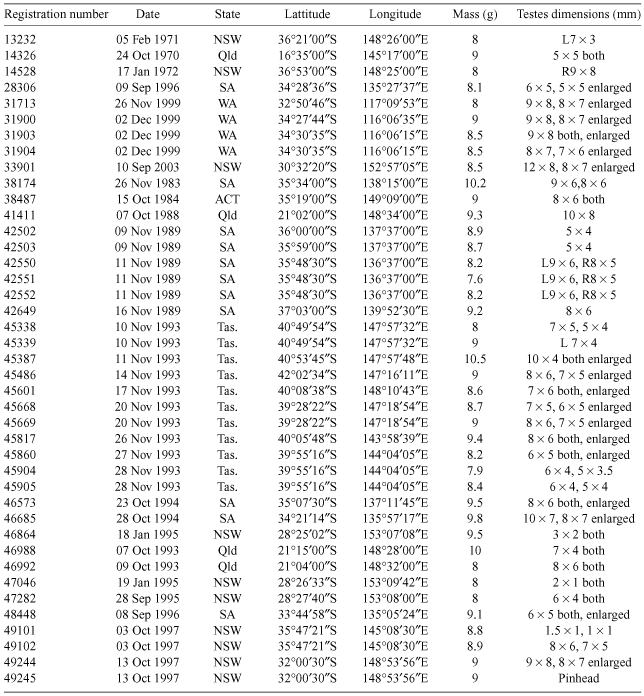
The grey fantail (Rhipidura albiscapa) is a common Australian flycatcher, yet no detailed reports have been made of its breeding ecology. A population of grey fantails was studied over four seasons in the Australian Capital Territory. Males had large testes and pronounced cloacal protuberances, morphology suggestive of sperm competition. Although two polyandrous trios were observed, most individuals bred as part of a season-long monogamous pair, suggesting that extra-pair copulation may be the principal cause of sperm competition. Indeed, behavioural observations revealed that males regularly intruded other territories, targeting those with building, rather than incubating, females. Intruding males were observed harassing, attempting to copulate and successfully copulating with resident females. Males did not mate guard, but regularly attacked their mates during each building attempt. Despite the probability that extra-pair paternity is common in this species, grey fantails were monomorphic and monochromatic, with a high level of paternal care. Nest depredation was common, with 83% of all clutches depredated before fledging. High levels of male care in care in this species may be better explained by an increase in fledging success associated with high male contribution to offspring care than confidence of paternity.
Acknowledgements
Thank you to Ellen Partington, Megan Dickens, Nev Broadis, Rachel Gylee, Beth Woodward, Oded Berger-Tal and Reut Berger-Tal for collecting field data. Becky Kilner provided invaluable support and advice throughout the study. Andrew Cockburn inspired the project and provided support throughout. Naomi Langmore, Becky Kilner and two anonymous referees provided helpful advice on the manuscript. Data on testes size were provided by the Australian National Wildlife Collection (ANWC), CSIRO, Canberra (R. Palmer, L. Joseph). The Australian Defence Force and Environment ACT granted access to the study site. The work was carried out under licence from the Australian Bird and Bat Banding Scheme and Environment ACT and with the approval of the Australian National University Animal Experimentation Ethics Committee. The work was supported by a Biotechnology and Biological Sciences Research Council student grant (02/A/S/08087) and Australian Bicentennial Scholarship (Menzies Centre for Australian Research, University of London).
Ashmole, N. P. (1963). The regulation of numbers of tropical oceanic birds. Ibis 103, 458–473.
Castro, I. , Minot, E. O. , Fordham, R. A. , and Birkhead, T. R. (1996). Polygynandry, face-to-face copulation and sperm competition in the Hihi Notiomystis cincta. The Ibis 138, 765–771.
Colwell, M. A. , and Oring, L. W. (1989). Extra-pair paternity in the spotted sandpiper: a female mate acquisition tactic. Animal Behaviour 38, 675–684.
| Crossref | GoogleScholarGoogle Scholar |
Davies, N. B. , Hartley, I. R. , Hatchwell, B. J. , and Langmore, N. E. (1996). Female control of copulations to maximise male help: a comparison of polygynandrous alpine accentors, Prunella collaris, and dunnocks, P. modularis. Animal Behaviour 51, 27–47.
| Crossref | GoogleScholarGoogle Scholar |
Ford, J. R. (1971). Evolution, distribution and stage of speciation in the Rhipidura fuliginosa complex in Australia. Emu 81, 128–143.
Houde, A. E. , and Endler, J. A. (1990). Correlated evolution of female mating preferences and male colour patterns in the guppy Poecilia reticulata. Science 248, 1405–1408.
| Crossref | GoogleScholarGoogle Scholar | PubMed |
Hutchison, J. B. , and Lovari, S. (1976). Effects of male aggressiveness on behavioural transitions in the reproductive cycle of the Barbary dove. Behaviour 59, 296–318.
| PubMed |
Powlesland, M. H. (1982). A breeding study of the South Island fantail (Rhipidura fuliginosa fuliginosa). Notornis 29, 181–195.
Slagsvold, T. (1982). Clutch size variation in passerine birds: the nest predation hypothesis. Oecologia 54, 159–169.
| Crossref | GoogleScholarGoogle Scholar |
Tokue, K. , and Ford, H. A. (2006). Influence of food and nest predation on the life histories of two large honeyeaters. Emu 106, 273–281.
| Crossref | GoogleScholarGoogle Scholar |
Tuttle, E. M. , Pruett-Jones, S. , and Webster, M. S. (1996). Cloacal protuberances and extreme sperm production in Australian fairy-wrens. Proceedings of the Royal Society of London. Series B. Biological Sciences 263, 1359–1364.
| Crossref | GoogleScholarGoogle Scholar |
Valera, F. , Hoi, H. , and Krištín, A. (2003). Male shrikes punish unfaithful females. Behavioral Ecology 14, 403–408.
| Crossref | GoogleScholarGoogle Scholar |
Weatherhead, P. J. , Montgomerie, R. , Gibbs, H. L. , and Boag, P. T. (1994). The cost of extra-pair fertilizations to female red-winged blackbirds. Proceedings: Biological Sciences 258, 315–320.
| Crossref | GoogleScholarGoogle Scholar |

Westmoreland, D. , and Best, L. B. (1986). Incubation continuity and the advantage of cryptic egg colouration to mourning doves. The Wilson Bulletin 98, 297–300.
Woinarski, J. C. Z. (1985). Breeding biology and life history of small insectivorous birds in Australian forests: response to a stable environment? Proceedings of the Ecological Society of Australia 14, 159–168.
Yom-Tov, Y. (1987). The reproductive rates of Australian passerines. Australian Wildlife Research 14, 319–330.
| Crossref | GoogleScholarGoogle Scholar |
Zahavi, A. (1975). Mate selection-a selection for a handicap. Journal of Theoretical Biology 53, 205–214.
| Crossref | GoogleScholarGoogle Scholar | PubMed |
Zenone, P. G. , Simms, M. E. , and Erickson, C. J. (1979). Male ring dove behaviour and the defense of genetic paternity. American Naturalist 114, 615–626.
| Crossref | GoogleScholarGoogle Scholar |
|