Terrestrial avifauna of the Gippsland Plain and Strzelecki Ranges, Victoria, Australia: insights from Atlas data
James Q. Radford A B and Andrew F. Bennett AA Landscape Ecology Research Group, School of Ecology and Environment, Deakin University, 221 Burwood Highway, Burwood, Vic. 3125, Australia.
B Corresponding author. Email: jradford@deakin.edu.au
Wildlife Research 32(6) 531-555 https://doi.org/10.1071/WR04012
Submitted: 13 February 2004 Accepted: 20 July 2005 Published: 18 October 2005
Abstract
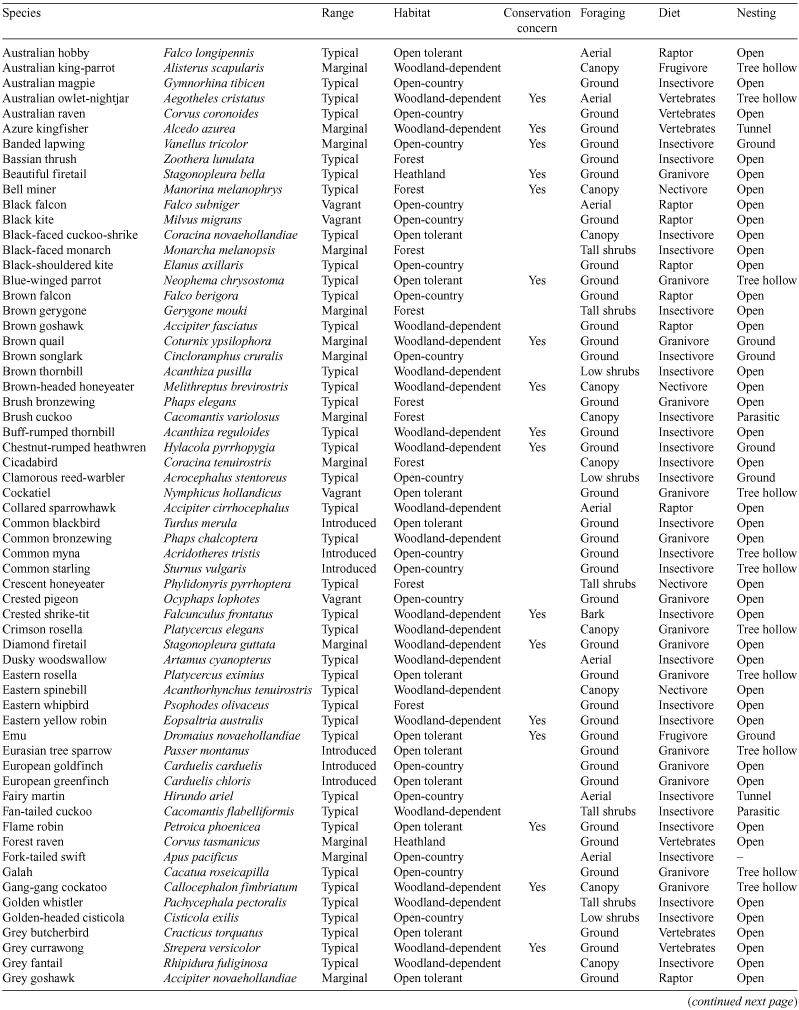
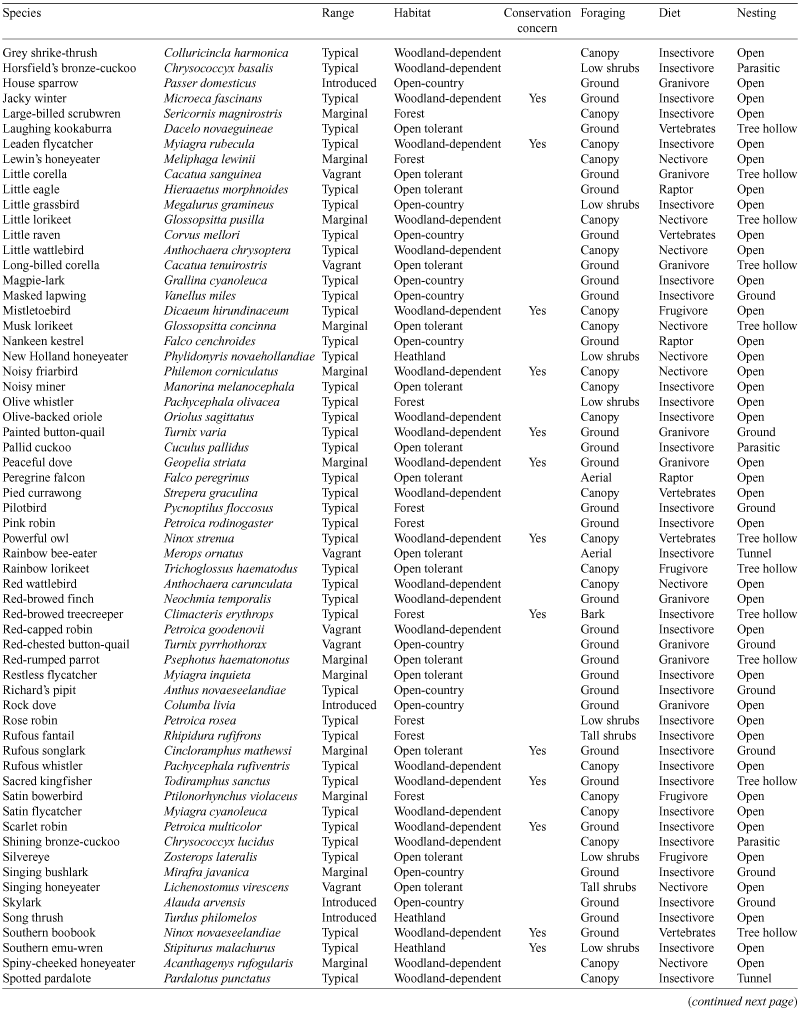
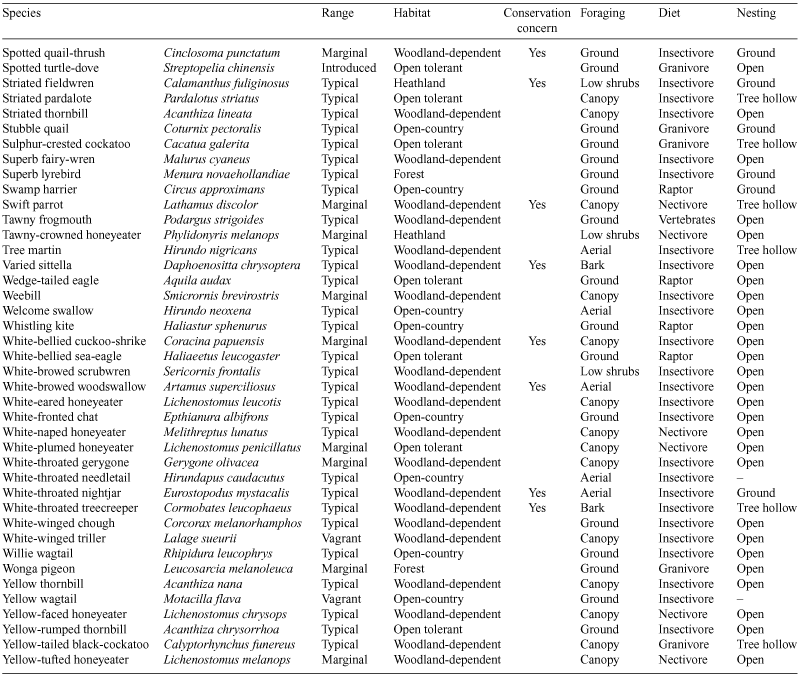
The rate and spatial scale at which natural environments are being modified by human land-uses mean that a regional or national perspective is necessary to understand the status of the native biota. Here, we outline a landscape-based approach for using data from the ‘New Atlas of Australian Birds’ to examine the distribution and status of avifauna at a regional scale. We use data from two bioregions in south-east Australia – the Gippsland Plain and the Strzelecki Ranges (collectively termed the greater Gippsland Plains) – to demonstrate this approach. Records were compiled for 57 landscape units, each 10′ latitude by 10′ longitude (~270 km2) across the study region. A total of 165 terrestrial bird species was recorded from 1870 ‘area searches’, with a further 24 species added from incidental observations and other surveys. Of these, 108 species were considered ‘typical’ of the greater Gippsland Plain in that they currently or historically occur regularly in the study region. An index of species ‘occurrence’, combining reporting rate and breadth of distribution, was used to identify rare, common, widespread and restricted species. Ordination of the dataset highlighted assemblages of birds that had similar spatial distributions. A complementarity analysis identified a subset of 14 landscape units that together contained records from at least three different landscape units for each of the 108 ‘typical’ species. When compared with the 40 most common ‘typical’ species, the 40 least common species were more likely to be forest specialists, nest on the ground and, owing to the prevalence of raptors in the least common group, take prey on the wing. The future status of the terrestrial avifauna of the greater Gippsland Plains will depend on the extent to which effective restoration actions can be undertaken to ensure adequate representation of habitats for all species, especially for the large number of species of conservation concern.
Acknowledgments
We thank Geoff Barrett, Rory Poulter and Andrew Silcocks at Birds Australia for access to the Atlas data and their invaluable help and patience with data retrieval. We are especially indebted to the hundreds of dedicated volunteers who collected data for the Atlas. We are grateful to Richard Loyn, Greg Horrocks, Mick Bramwell, Mark Antos and Grant Palmer, who generously gave their time to scrutinise the species classifications. This project was funded by the Land and Water Australia Native Vegetation Program (Project DUV06), and the Victorian Department of Sustainability and Environment. We also thank Rob Price (DSE, Bendigo) for ongoing logistical and infrastructure support. Comments from two anonymous referees greatly improved earlier versions of this manuscript.
Andrèn, H. (1994). Effects of habitat fragmentation on birds and mammals in landscapes with different proportions of suitable habitat: a review. Oikos 71, 355–366.
Bellamy, P. E. , Brown, N. J. , Enoksson, B. , Firbank, L. G. , Fuller, R. J. , Hinsley, S. A. , and Schotman, A. G. M. (1998). The influences of habitat, landscape structure and climate on local distribution patterns of the nuthatch (Sitta europaea L.). Oecologia 115, 127–136.
| Crossref | GoogleScholarGoogle Scholar |
Bennett, A. F. , and Ford, L. A. (1997). Land use, habitat change and the conservation of birds in fragmented rural environments: a landscape perspective from the Northern Plains of Victoria, Australia. Pacific Conservation Biology 3, 244–261.
Berry, L. (2001). Breeding biology and nesting success of the eastern yellow robin and the New Holland honeyeater in a southern Victorian woodland. Emu 101, 191–197.
| Crossref | GoogleScholarGoogle Scholar |
Bromham, L. , Cardillo, M. , Bennett, A. F. , and Elgar, M. (1999). Effects of stock grazing on the ground invertebrate fauna of woodland remnants. Australian Journal of Ecology 24, 199–207.
| Crossref | GoogleScholarGoogle Scholar |
Cunningham, R. B. , Lindenmayer, D. B. , Nix, H. A. , and Lindenmayer, B. D. (1999). Quantifying observer heterogeneity in bird counts. Australian Journal of Ecology 24, 270–277.
| Crossref | GoogleScholarGoogle Scholar |
Donald, P. F. , and Fuller, R. J. (1998). Ornithological atlas data: a review of uses and limitations. Bird Study 45, 129–145.
Fahrig, L. (1998). When does fragmentation of breeding habitat affect population survival? Ecological Modelling 105, 273–292.
| Crossref | GoogleScholarGoogle Scholar |
Gaston, K. J. , and Rodrigues, A. S. L. (2003). Reserve selection in regions with poor biological data. Conservation Biology 17, 188–195.
| Crossref | GoogleScholarGoogle Scholar |
Gilmore, A. M. (1977). A survey of vertebrate animals in the Stradbroke area of South Gippsland, Victoria. Victorian Naturalist 94, 123–128.
Lindenmayer, D. B. , Cunningham, R. B. , Donnelly, C. F. , Nix, H. , and Lindenmayer, B. D. (2002). Effects of forest fragmentation on bird assemblages in a novel landscape context. Ecological Monographs 72, 1–18.
Loyn, R. H. , McNabb, E. G. , Volodina, L. , and Willig, R. (2001). Modelling landscape distributions of large forest owls as applied to managing forests in north-east Victoria, Australia. Biological Conservation 97, 361–376.
| Crossref | GoogleScholarGoogle Scholar |
Margules, C. R. , and Pressey, R. L. (2000). Systematic conservation planning. Nature 405, 243–253.
| Crossref | GoogleScholarGoogle Scholar | PubMed |
Norris, K. C. , Gilmore, A. M. , and Menkhorst, P. W. (1979). Vertebrate fauna of South Gippsland, Victoria. Memoirs of the National Museum of Victoria 40, 105–199.
Prendergast, J. R. , Wood, S. N. , Lawton, J. H. , and Eversham, B. C. (1993). Correcting for variation in recording effort in analyses of diversity hotspots. Biodiversity Letters 1, 39–53.
Recher, H. F. (1999). The state of Australia’s avifauna: a personal opinion and prediction for the new millennium. Australian Zoologist 31, 11–27.
Robertson, A. , Simmons, R. E. , Jarvis, A. M. , and Brown, C. J. (1995). Can bird atlas data be used to estimate population size? A case study using Namibian endemics. Biological Conservation 71, 87–95.
| Crossref | GoogleScholarGoogle Scholar |
Rodrigues, A. S. L. , Gaston, K. J. , and Gregory, R. (2000). Using presence–absence data to establish reserve selection procedures which are robust to temporal species turnover. Proceedings of the Royal Society of London. Series B. Biological Sciences 267, 897–902.
| Crossref | GoogleScholarGoogle Scholar |
Soulé, M. E. , Bolger, R. T. , Alberts, A. C. , Wright, J. , Sorice, M. , and Hills, S. (1988). Reconstructed dynamics of rapid extinctions of chaparral requiring birds in urban habitat islands. Conservation Biology 2, 75–92.
| Crossref | GoogleScholarGoogle Scholar |
Teesdale, B. (2003). Archies Creek reforestation group. A best practice Bushcare demonstration site. Greening Australian 6, 11–12.
Williams, P. , Gibbons, D. W. , Margules, C. , Rebelo, A. , Humphries, C. , and Pressey, R. (1996). A comparison of richness hotspots, rarity hotspots, and complementary areas for conserving diversity of British birds. Conservation Biology 10, 155–174.
| Crossref | GoogleScholarGoogle Scholar |

With, K. A. , and Crist, T. O. (1995). Critical thresholds in species’ responses to landscape structure. Ecology 76, 2446–2459.
|
|
|