Algae of Australia: Marine Benthic Algae of Lord Howe Island and the Southern Great Barrier Reef
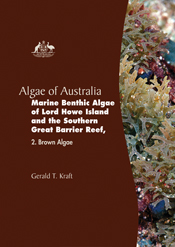
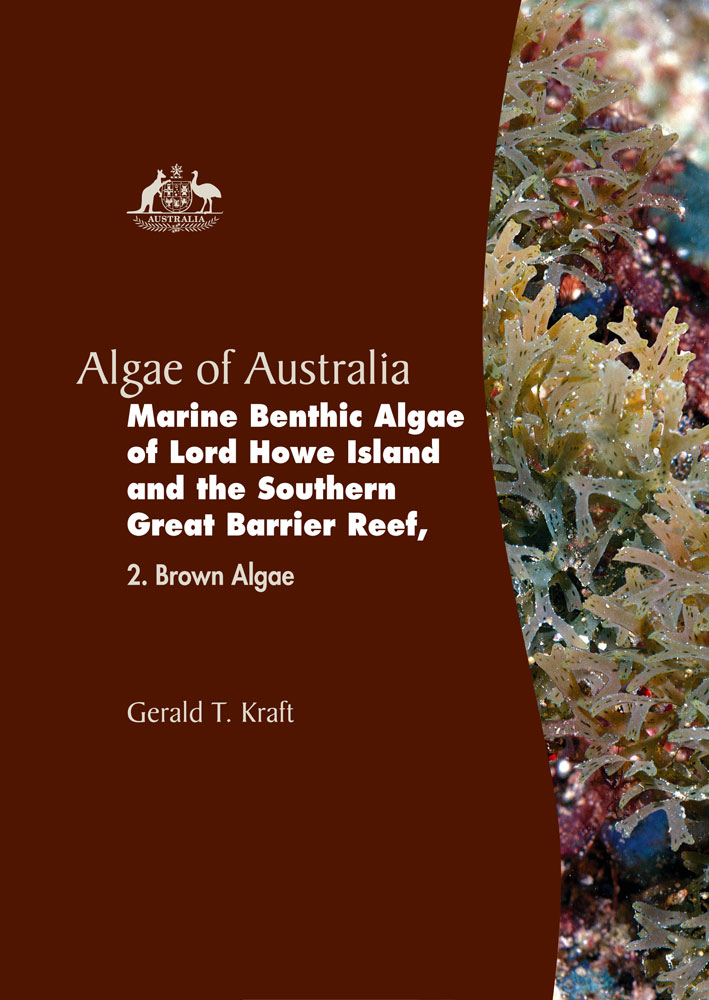




Documents the 7 orders, 12 families, 38 genera and 92 species of benthic brown algae found on Lord Howe Island and the southern Great Barrier Reef.
Lord Howe Island, an oceanic outcrop of volcanic origin situated between Australia and New Zealand, is fringed by the world's southernmost consolidated coral reef. The Capricorn Group of the southern Great Barrier Reef is a series of patch reefs and low coral cays. For more than 30 years Dr Gerry Kraft, along with his students and colleagues, has studied the species-rich marine algal communities of these reefs, paying special attention to subtidal habitats. This authoritative account, documenting the brown algae of Lord Howe Island and the southern Great Barrier Reef, follows a highly commended volume on the green algae (2007) and will, in due course, be followed by treatments of the red algae. + Full description
This volume includes 7 orders, 12 families, 38 genera and 92 species of benthic brown algae. Richly illustrated with photographs, many of them in colour, it includes an introduction to the islands, identification keys to genera and species and a comprehensive description and discussion of each taxon. The genera Lucasia (Sporochnales) and Herringtonia (Dictyotales) are newly described, as are 29 species of the genera Discosporangium, Feldmannia, Hincksia, Hecatonema, Myrionema, Streblonema, Compsonema, Myriactula, Lucasia, Sphacelaria, Dictyota, Distromium, Lobophora, Padina, Spatoglossum and Sargassum.
- Short descriptionReviews
"Kraft has created an exceptional treatment on the brown algae that is well written and amply illustrated…This book will be a must-have guide for specialist phycologists and marine biologists (thanks to its many illustrations) working not only on the southern Great Barrier Reef or Lord Howe Island, but worldwide owing to the detailed discussions."
Mark M Littler and Diane S Littler, Journal of Phycology, June 2010
"The book was a delight to use; the keys are well designed, the descriptions incredibly detailed and the illustrations copious and informative. This is an excellent volume of which Gerry can be justly proud…sets a new benchmark that will force the rest of us to try that little bit harder. It is truly a stunning work that will be a seminal reference for years to come."
John M Huisman, Australian Systematic Botany Society Newsletter, 142, March 2010
Details
Hardback | November 2009 | $150.00ISBN: 9780643097377 | 370 pages | 250 x 176 mm
Publisher: CSIRO Publishing
Colour illustrations, Illustrations
Features
- An up-to-date account of a significant and highly attractive component of the Australian marine algal flora
- Authoritative identification keys
- Full descriptions and synonymy
- Habitat information
- 72 superb colour photographs, and more than 100 plates of b & w photographs
Authors
Gerald T. Kraft is based in the School of Botany at The University of Melbourne.Related titles