
Macropods
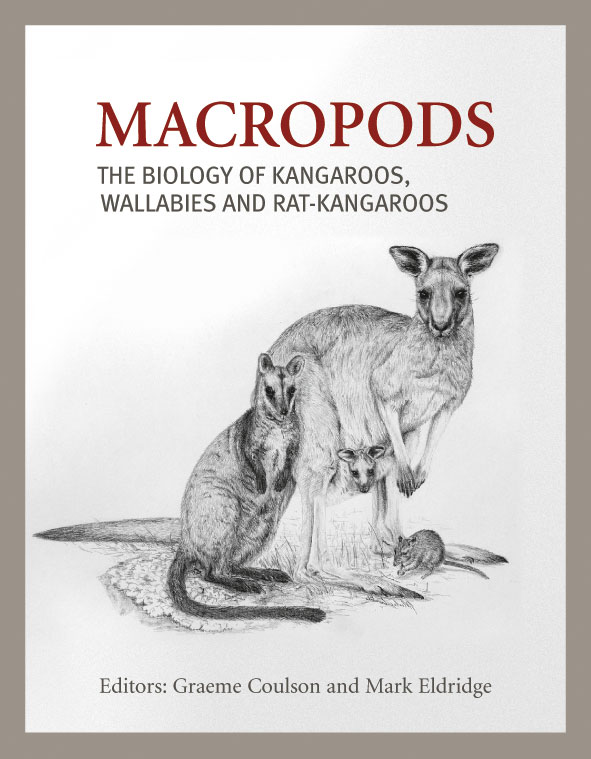
The Biology of Kangaroos, Wallabies and Rat-kangaroos
Edited by: Graeme Coulson, Mark Eldridge


Brings together the many recent advances in the biology of this diverse group of marsupials.
This book covers the proceedings of a major 2006 symposium on macropods that brought together the many recent advances in the biology of this diverse group of marsupials, including research on some of the much neglected macropods such as the antilopine wallaroo, the swamp wallaby and tree-kangaroos. + Full description
More than 80 authors have contributed 32 chapters, which are grouped into four themes: genetics, reproduction and development; morphology and physiology; ecology; and management.
The book examines such topics as embryonic development, immune function, molar progression and mesial drift, locomotory energetics, non-shivering thermogenesis, mycophagy, habitat preferences, population dynamics, juvenile mortality in drought, harvesting, overabundant species, road-kills, fertility control, threatened species, cross-fostering, translocation and reintroduction. It also highlights the application of new techniques, from genomics to GIS.
Macropods is an important reference for academics and students, researchers in molecular and ecological sciences, wildlife and park managers, and naturalists.
- Short descriptionNews
No longer available in a print edition.
Reviews
"This volume will be of general interest to macropodid enthusiasts, and to those who wish to have an introduction to the diversity of literature on macropodids."
Daniel T. Blumstein, Quarterly Review of Biology, June 2011, p.151
"With its combination of authoritative reviews and important new studies, this book will (unsurprisingly)
be essential for macropodoid specialists, and should also be useful to those with a more general interest in marsupial biology."
Robin M D Beck, Journal of Mammal Evolution, Published online 6 October 2010
Details
ePDF | February 2010ISBN: 9780643098183
Publisher: CSIRO Publishing
Available from eRetailers
ePUB | February 2010
ISBN: 9780643101845
Publisher: CSIRO Publishing
Available from eRetailers
Features
- Covers the first major symposium on macropods since 1988
- Deals with a diverse group of marsupials, including research on some of the much neglected macropods such as the antilopine wallaroo, the swamp wallaby and tree-kangaroos
Contents
View the table of contents.Authors
Graeme Coulson is a Senior Lecturer in Zoology at The University of Melbourne. He has been researching macropods since 1973, with interests in behavioural ecology and population management. He and his students work on a wide range of species, from long-nosed potoroos, swamp wallabies and rock-wallabies to grey kangaroos.Mark Eldridge is a Senior Research Scientist at the Australian Museum. He has been researching macropods since 1986 using molecular genetics to study population biology, evolution, ecology and conservation. He and his students work on rock-wallabies, tree-kangaroos, pademelons, forest wallabies, hare-wallabies, grey kangaroos, wallaroos, tammar and swamp wallabies, as well as long-nosed potoroos.
Related titles


