Woodland bird declines in the Murray–Darling Basin: are there links with floodplain change?
Heather M. McGinness A C , Anthony D. Arthur A and Julian R. W. Reid BA CSIRO Ecosystem Sciences, GPO Box 284, Canberra, ACT 2601, Australia.
B Fenner School of Environment and Society, Australian National University, Canberra, ACT 2601, Australia.
C Corresponding author. Email: Heather.McGinness@csiro.au
The Rangeland Journal 32(3) 315-327 https://doi.org/10.1071/RJ10016
Submitted: 26 March 2010 Accepted: 4 August 2010 Published: 14 September 2010
Abstract
Woodland bird population declines in Australia have been attributed to various factors including habitat loss, fragmentation, and degradation. However, the influence of altered water availability in the landscape upon woodland bird populations has not been examined, particularly in terms of changes in flood regimes and subsequent loss of floodplain productivity. In this review, we examine the importance to woodland birds of floodplains, floods, and associated vegetation communities, highlighting potential links between declining water availability, habitat degradation, and bird populations.
Floodplain woodlands and forests may be important refuges for woodland bird populations because (1) floodplain woodlands and forests comprise some of the largest and most continuous vegetation remnants in south-east Australia; and (2) floods intermittently supply water, sediment and nutrients that drive greater primary and secondary productivity than found in woodlands not subject to flooding. However, floodplains in south-east Australia have been subject to substantial flow regime change, driven predominantly by dams and irrigation water use. Consequently, habitat quality for woodland birds has been degraded, potentially exacerbating population declines.
We suggest that despite such change, floodplain communities and their requisite floods remain of great importance for the persistence, productivity and diversity of woodland birds in Australian drylands. We hypothesise that (1) the influence of flooding upon primary and secondary productivity in floodplain and riparian zones is a key driver of resident bird populations, and a key determinant of nomadic/migratory bird use of a site; (2) alterations in flooding and consequent changes in productivity and condition of floodplain vegetation have contributed to observed declines in resident woodland birds in Australian drylands; and (3) the influence of flooding upon productivity extends beyond local populations of floodplain residents to non-floodplain populations via dispersal, and that floodplain woodlands often act as a source population for surrounding non-floodplain woodlands. We make several testable predictions regarding these hypotheses.
Additional keywords: flood regime, foodweb subsidies, habitat degradation, primary productivity, secondary productivity, terrestrial fauna.
Acknowledgements
We are grateful to Sue McIntyre and Veronica Doerr for their reviews of the draft manuscript, to Matt Colloff for comments, and to Steve Henry for assistance in producing Fig. 1. This research was supported by the CSIRO Water for a Healthy Country National Research Flagship, and by the Australian National Program for Sustainable Irrigation.
Alexander P.,
Nielsen D. L., Nias D.
(2008) Response of wetland plant communities to inundation within floodplain landscapes. Ecological Management & Restoration 9(3), 187–195.
| Crossref | GoogleScholarGoogle Scholar |
(accessed 12 January 2010).
Oldroyd B. P.,
Lawler S. H., Crozier R. H.
(1994) Do feral honey-bees (Apis mellifera) and Regent parrots (Polytelis anthopeplus) compete for nest sites? Australian Journal of Ecology 19(4), 444–450.
| Crossref | GoogleScholarGoogle Scholar |
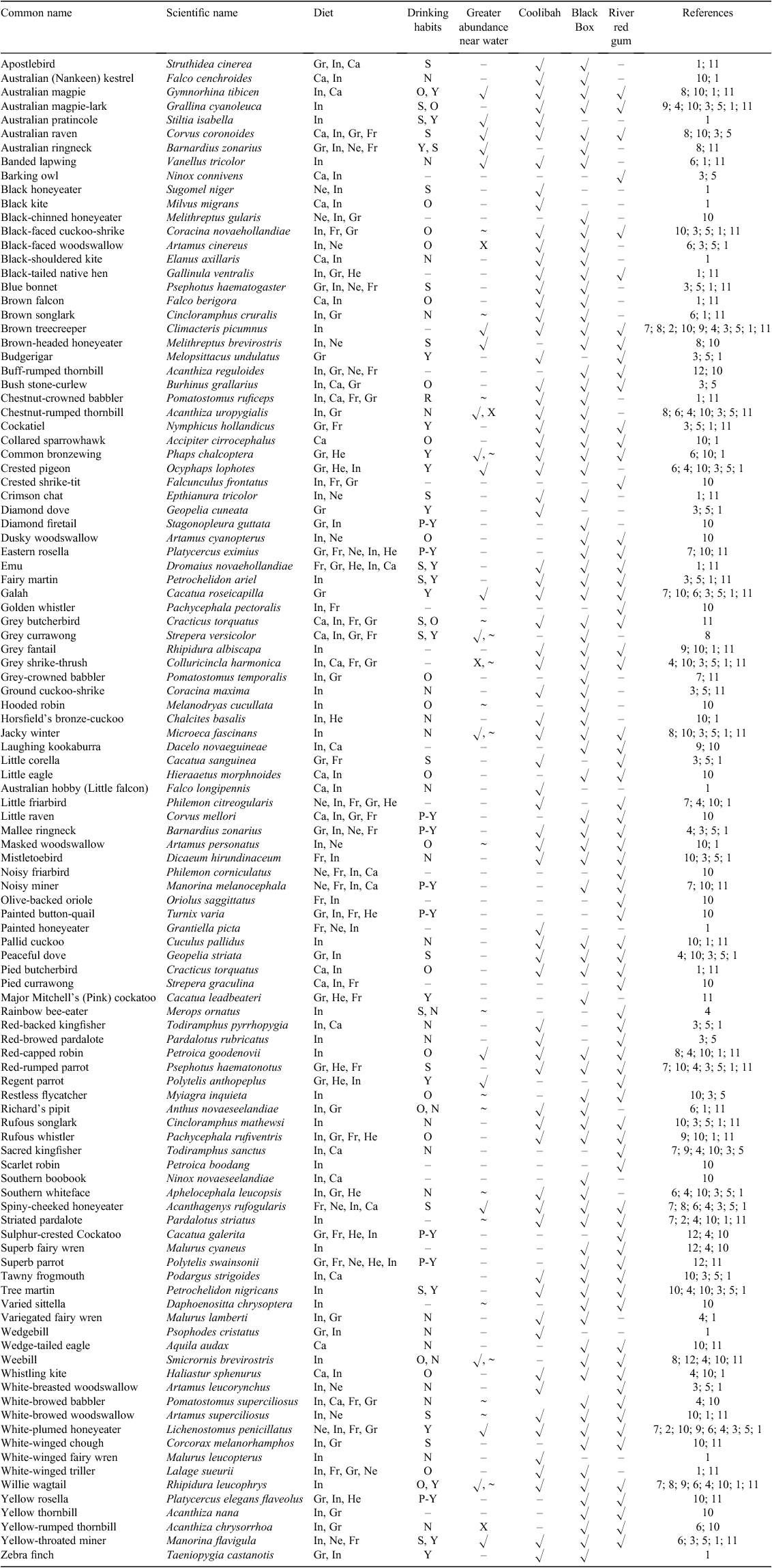
and Harrington (2002): Y, year-round drinker; S, summer drinker; O, occasional drinker; N, no drinking records. P-Y: Probable Y, based on diet in absence of other records. Abundance in proximity to water from Landsberg et al. (1997) and Harrington (2002): √: increase; X, decrease; ~, no pattern detected. References: 1, Wyndham (1978); 2, Chesterfield et al. (1984); 3, Reid (1988); 4, Carpenter (1990); 5, Reid and Puckridge (1990); 6, Landsberg et al. (1997); 7, Major et al. (2001); 8, Harrington (2002); 9, Parkinson et al. (2002); 10, Antos and Bennett (2005); 11, H. M. McGinness, T. A. Arthur, S. McIntyre (unpubl. data); 12, Mac Nally et al. (2001)