|
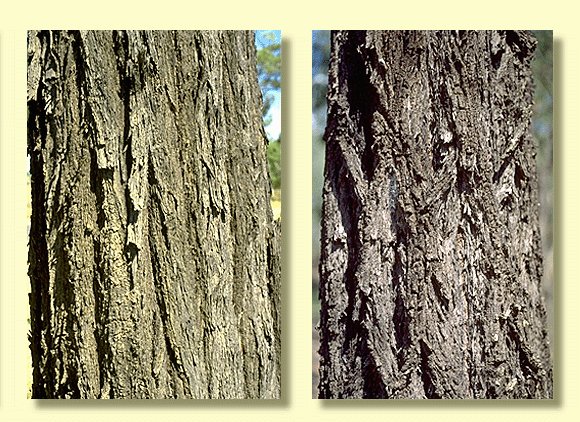
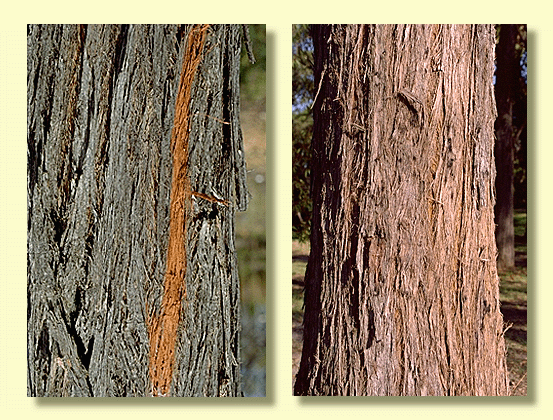
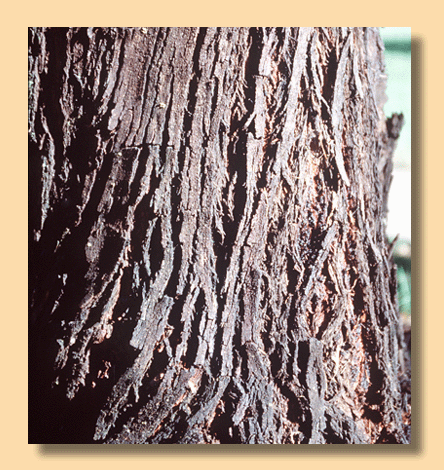
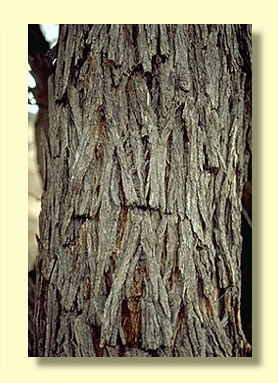
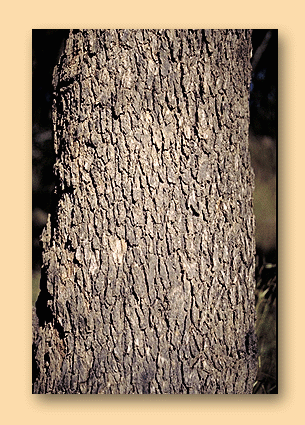
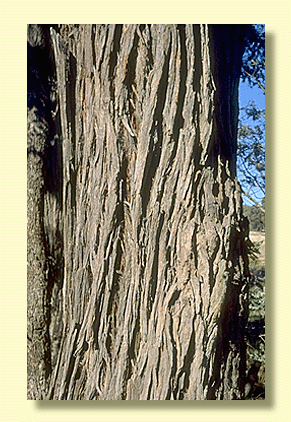
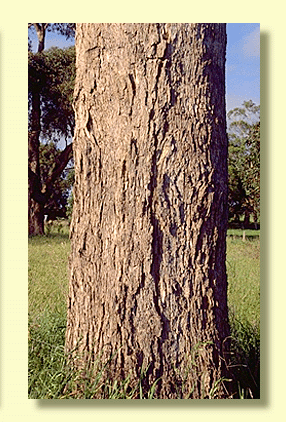
Ironbark: hard, compacted, furrowed; over whole trunk
 |
|
Perhaps the easiest bark to recognize is that of the traditional
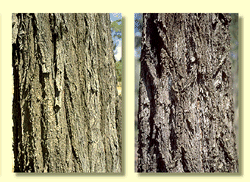
ironbarks. In these species, the rough bark becomes hard, compacted and
furrowed with age and varies in colour from grey to black or red-black.
Some ironbark species, however, have all the appearance of the hard, furrowed
ironbark character, yet the bark can be actually soft and somewhat flaky
and friable as in some forms of E. fibrosa and E. placita.
Therefore, the ironbark character may refer more to appearance and expectation
rather than to fact! In some species of unrelated groups (e.g. E.
sieberi, E. aromaphloia) the rough bark
may be thick, hard and furrowed as in the ironbarks. |
TOP
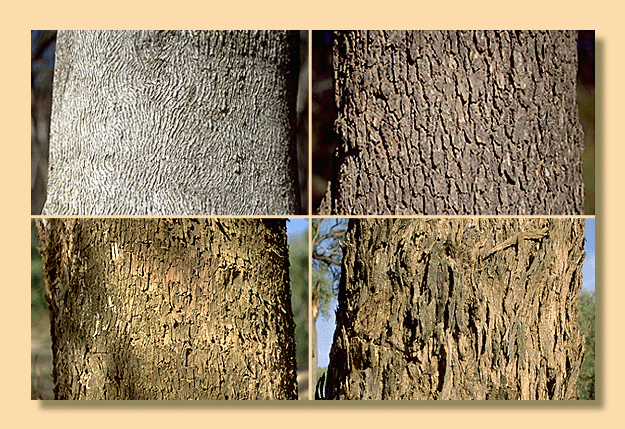
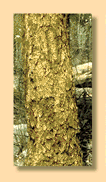
Tessellated: red bloodwoods, yellow bloodwoods, ghost gums
Red bloodwoods
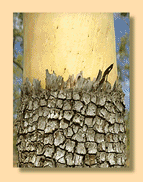
Yellow bloodwoods
Ghostgums
|
|
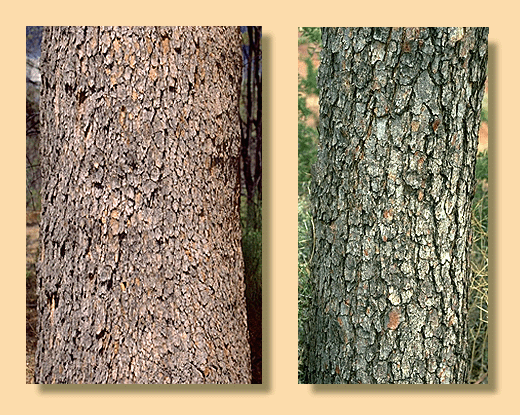
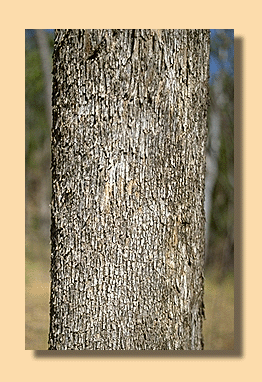
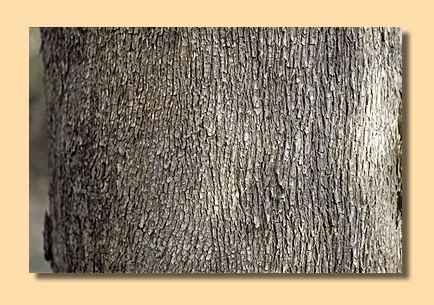
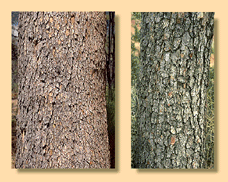
The outer dead bark breaks up into small flakes (tesserae or tessellations).
This bark may be loose or firmly held to the whole trunk and branches.
In bloodwoods, when the outer, most weathered flakes are lost by attrition,
an orange and brown mottling of the newly exposed underbark is often produced.
The texture of the rough bark is somewhat corky. Among the red
bloodwoods, particularly inland and desert species, the tessellated
bark is not retained over the whole trunk. The flakes are looser and are
most prominent on the lower trunk while the upper trunk is often smooth.
There is no wholesale shedding
of the flakes in these bloodwoods and the trunk remains permanently and
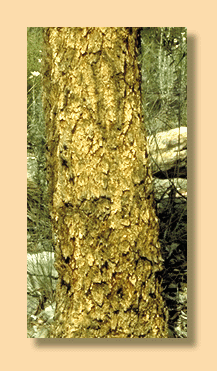
colourfully mottled. There is a smaller group with tessellated bark (yellow
bloodwoods) in which the outer, unshed bark is always loose but remains
attached covering the whole trunk and branches. The outermost layers weather
to light brown or greyish brown or shades of faded yellow but are readily
lost by attrition exposing the underlayers which are bright yellow to golden
such that the yellow bloodwood trees in a forest of mixed species can be
easily seen from a distance. While this type of bark characterizes the
yellow bloodwoods, it also occurs though often less spectacularly in the
unrelated E. similis, E. lirata and E. cloeziana.
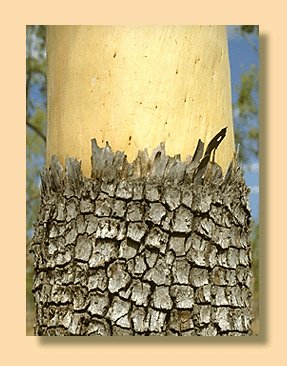
Another group, (ghost gums), has a distinctive
type of tessellated bark or lacks rough bark altogether. Some are completely
smooth-barked (e.g. E. aparrerinja) while others have a basal stocking
of distinctive tessellated rough bark with an abrupt cut-off line on the
trunk (e.g. E. tessellaris). Even in the
smooth-barked species, the tessellated nature of the bark is often revealed
after fire when the newly killed basal bark breaks up into rough flakes.
Box species often have some tessellated rough bark (e.g. E.
bridgesiana, E. moluccana, E.
hypostomatica). In the grey box, white box and black box groups,
the outer rough bark is rough, usually firmly held, somewhat fibrous though
compacted, and ultimately breaks up into small tessellations. When the
outermost, that is, the oldest part of the fragments falls away, unweathered
whitish inner bark is exposed giving a dark, grey and white mottled pattern
to the whole trunk. In old large box trees the rough bark often becomes
looser, shaggy and furrowed, particularly towards the base.
|
TOP
Stringy or fibrous: stringybarks, peppermints, mahoganies
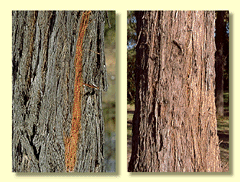
Stringybarks
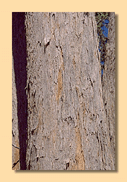
Peppermints
|
|
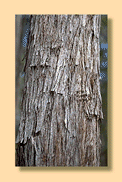
Mahoganies
|
|
|
This is a large group of species that can usually be recognized by the
thick, longitudinally-furrowed, fibrous bark over the whole trunk such
that the bark can be pulled away in long strings, ie. stringybarks (e.g. E. macrorrhyncha) and
some other species (e.g. E. cinerea, E. robusta).
The inner layers of stringy or fibrous bark can usually be seen to be criss-crossed.
In some mallee species belonging to the group, the stems may be mostly
smooth but the characteristic stringy bark can usually be seen towards
the base. The outer rough bark weathers to greyish but on stripping the
rough bark away, the underbark will usually be found to be a rich reddish
colour. Some stringybark species have the rough bark to the small limbs,
but a few have notably smooth branches (e.g. E. blaxlandii). In
another large group, peppermints, the bark is rough over the trunk and
often the branches. The rough bark is similar to that of the stringybarks
but is thinner and does not become coarsely furrowed in the old trees.
The criss-cross pattern of the underbark is often conspicuous in peppermints.
A small group, the white mahoganies, is notable for the rough fibrous bark
being held more or less in flattish strips, rather than loose criss-cross
fibres, although the character is difficult to categorise unambiguously. This type of rough bark is seen most conspicuously in the famous Western Australian endemic, jarrah (E. marginata).
|
TOP
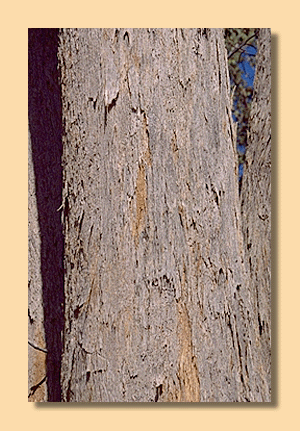
Box: short-fibred, grey, sometimes mottled grey and white or even
brown-yellow
 |
|
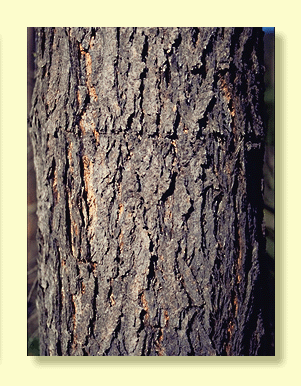
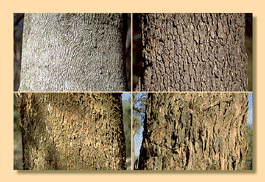
The boxes are one of the most difficult groups to summarize. The
bark is often tightly held, sometimes tessellated (see above), but may
in some species be quite flaky.Thickness is variable and shedding is irregular
or in many species does not occur at all. The boxes are a large group of
closely related species, but box-type bark also occurs in other distantly
related species (e.g. E. angophoroides).
|
TOP
Minnirichi
 |
|
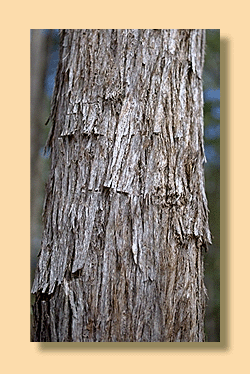
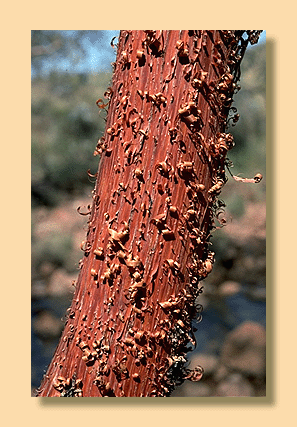
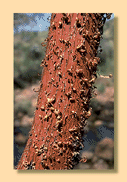
This is an easily recognised bark form seen in western species only, in which
the outer layer of bark splits longitudinally and curls outwards at the
edges while remaining attached along the middle. The newly exposed surface
is usually greenish while the weathered colour of the older exposed bark
is dark reddish (e.g. E. caesia).
|
TOP
Compacted
 |
|
A few species (e.g. E. elata) are rough for the basal 1-3
m only. They may be known as blackbutts. This originally fibrous bark becomes
suffused with exudates and hardens the bark somewhat similarly to the unrelated
ironbarks. The bark colour is invariably very dark brown to black. In
E. sieberi this type of bark may cover the whole trunk and be quite
fissured or furrowed, while the branches are conspicuously smooth.
|
TOP
Loose basal slabs: apparently rough, particularly the lower bole
 |
|
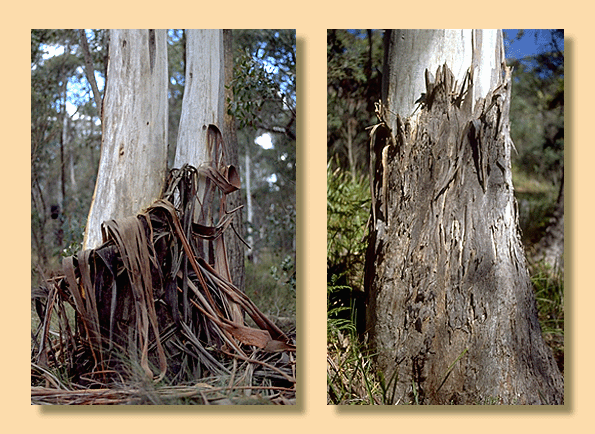
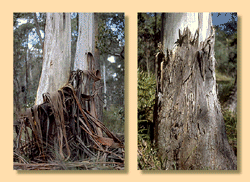
All smooth-barked species shed their dead bark at some time. Many
species, particularly in cultivation, hold some of their dead bark loosely
over the bole for some time before being shed. Particularly old individuals
may also exhibit this character. This type of "rough" bark is to be distinguished
from distinct, firmly-held rough bark. Clearly, this is an ambiguous bark
type which takes experience to assess. If no decision can be made, this
and another bark form will have to be selected, or the rough bark character
can be bypassed altogether.
|
TOP
BACK TO BARK TYPES
|
|