
Phylogenetic analysis of the Squilloidea (Crustacea : Stomatopoda)
Shane T. AhyongDepartment of Marine Invertebrates, Australian Museum, 6 College St, Sydney, NSW 2010, Australia. Email: shanea@austmus.gov.au
Invertebrate Systematics 19(3) 189-208 https://doi.org/10.1071/IS04037
Submitted: 2 December 2004 Accepted: 16 May 2005 Published: 15 July 2005
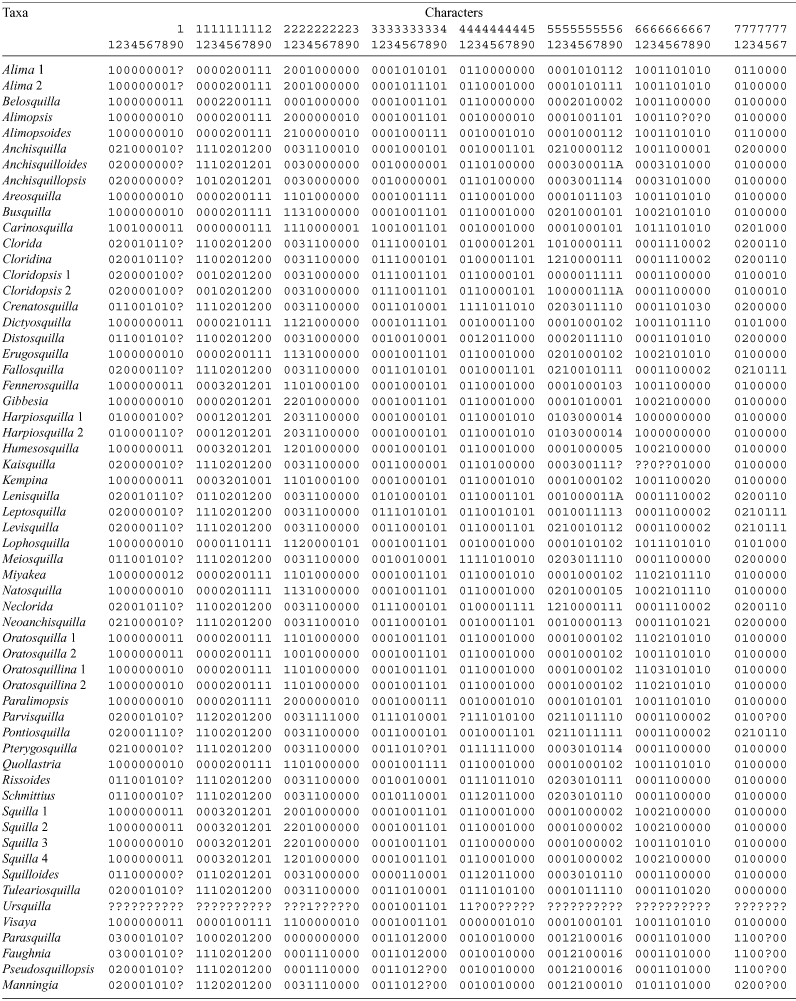
Abstract
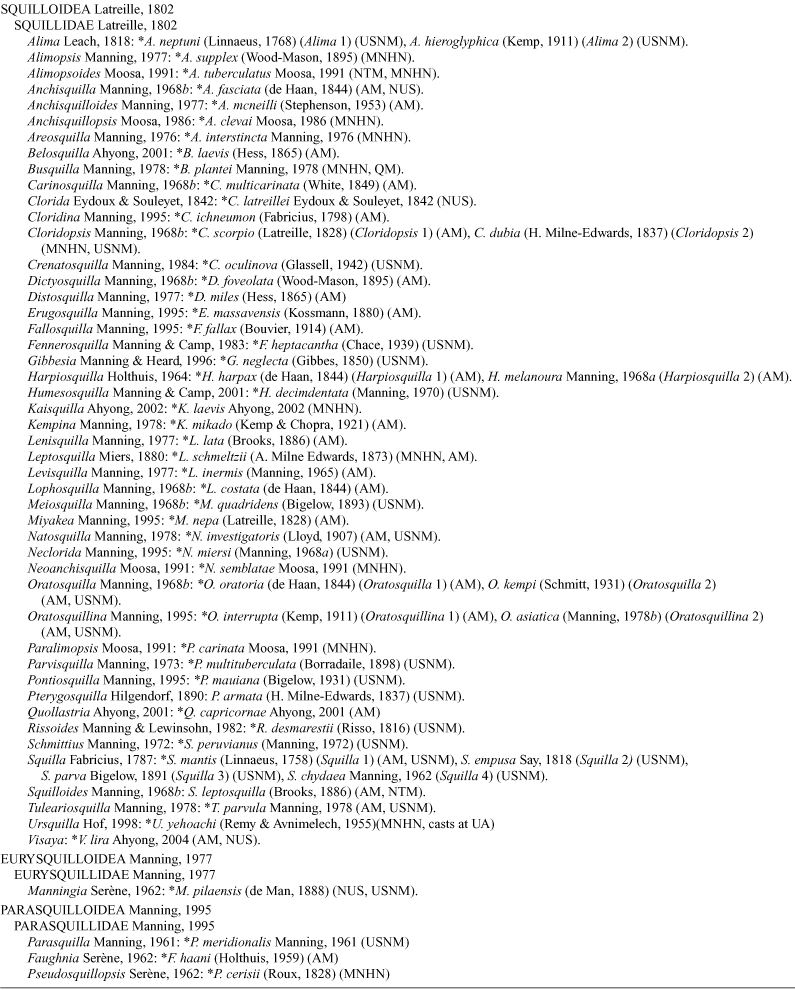
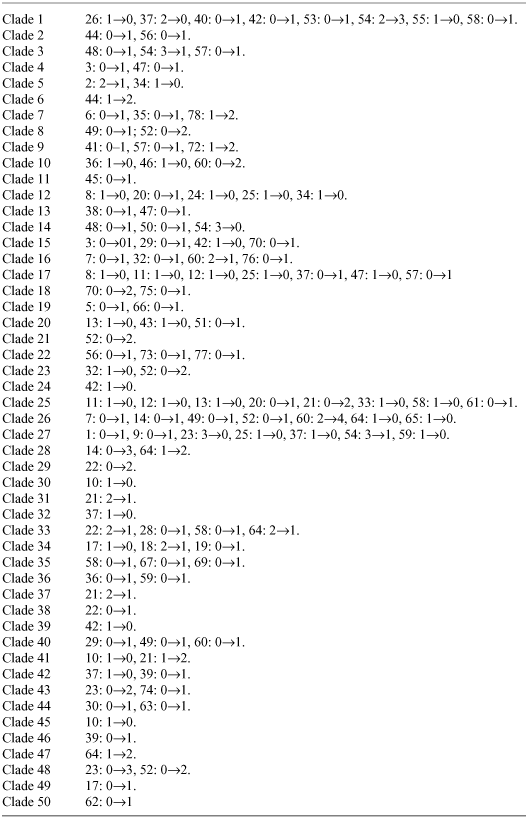
Squilloidea is the most speciose of the stomatopod superfamilies and comprises more than 40 genera. Until 2001, three families were recognised: two extant (Harpiosquillidae, Squillidae) and one extinct (Ursquillidae). Recent studies, however, suggested that Harpiosquillidae is nested among other squillids and was thus synonymised with Squillidae. Interrelationships of all squilloid genera are studied by cladistic analysis based on somatic morphology. Results are used to assess the familial classification and investigate the ‘shape’ of squilloid evolution. The phylogeny of the squilloids shows general trends in the armature of the raptorial claw, increased dorsal carination, a tendency for bilobation of the lateral processes of the exposed thoracic somites, and a change in telson shape from trianguloid with movable submedian teeth, to quadriform with fixed submedian teeth. Harpiosquilla Holthuis, 1964 is deeply nested among other squillid genera, supporting the recent synonymy of the Squillidae and Harpiosquillidae. Characters of the late Cretaceous Ursquillidae show that it is highly derived and is therefore synonymised with Squillidae. Although the antiquity of Ursquilla Hof, 1998 does not show it to be a basal or stem-lineage squilloid, it does show that the squilloids had already undergone significant diversification by the end of the Cretaceous. Species of most squilloid genera are regionally restricted, either to the Indo-west Pacific or Atlanto-east Pacific. Only Alima Leach, 1818, Cloridopsis Manning 1968b, and Pontiosquilla Manning, 1995 are represented in both regions.
Additional keywords: Harpiosquillidae, phylogeny, Squillidae, Stomatopoda, Ursquillidae.
Acknowledgments
Thanks are due to Buz Wilson (AM) for comments on an early draft. Thanks to Nguyen Ngoc-Ho and Alain Crosnier (MNHN), Karen Coombes and Gavin Dally (NTM), Peter Davie (QM), Peter Ng (NUS), Karen Reed and the late Raymond B. Manning (USNM) for the loan of stomatopod specimens. Cees Hof (UVA) is gratefully acknowledged for assistance with literature concerning fossil squilloids. Financial support from a Sydney Grammar School Fellowship and a grant from the Joyce Vickery Research Fund (Linnean Society of New South Wales) is gratefully acknowledged.
Ahyong S. T.
(1997) A phylogenetic analysis of the Stomatopoda (Crustacea: Malacostraca). Journal of Crustacean Biology 17, 695–715.

Ahyong S. T.
(2001) Revision of the Australian Stomatopod Crustacea. Records of the Australian Museum Suppl. 26, 1–326.
Ahyong S. T.
(2002) Stomatopod Crustacea of the Karubar Expedition in Indonesia. Zoosystema 24, 373–383.
Ahyong S. T.
(2004) New species and new records of stomatopod Crustacea from the Philippines. Zootaxa 793, 1–28.
Ahyong S. T., Ebach M.
(1999) First occurrence of a subfossil stomatopod crustacean from Australia. Alcheringa 3/4, 227–228.
Ahyong S. T., Erdmann M. V.
(2003) The stomatopod Crustacea of Guam. Micronesica 35–36, 315–352.
Ahyong S. T., Harling C.
(2000) The phylogeny of the Stomatopod Crustacea. Australian Journal of Zoology 48, 607–642.
| Crossref | GoogleScholarGoogle Scholar |
Alikunhi K. H.
(1952) An account of the stomatopod larvae of the Madras plankton. Records of the Indian Museum 49, 239–319.
Bigelow R. P.
(1891) Preliminary notes on some species of Squilla. Johns Hopkins University Circulars 10, 93–94.
Bigelow R. P.
(1893) Preliminary notes on the Stomatopoda of the Albatross collections and on other specimens in the National Museum. Johns Hopkins University Circulars 12, 100–102.
Bigelow R. P.
(1931) Stomatopoda of the southern and eastern Pacific Ocean and the Hawaiian Islands. Bulletin of the Museum of Comparative Zoölogy, Harvard University 72, 105–191.
Borradaile L. A.
(1898) On some Crustaceans from the South Pacific-Part I: Stomatopoda. Proceedings of the Zoological Society of London 1898, 32–38.
Bouvier E. L.
(1914) Sur la faune carcinologique de l’ile Maurice. Comptes Rendus Hebdomadaires des Séances de l’Academie des Sciences, Paris 159, 698–704.
Bremer K.
(1994) Branch support and tree stability. Cladistics 10, 295–304.
| Crossref | GoogleScholarGoogle Scholar |
Brooks W. K.
(1886) Report on the Stomatopoda collected by H.M.S. Challenger during the years 1873–76. The Voyage of the H.M.S. Challenger, Zoology 16, 1–116.
Caldwell R. L., Dingle H.
(1976) Stomatopods. Scientific American 234, 80–89.
| PubMed |
Camp D. K.
(1973) Stomatopod Crustacea. Memoirs of the Hourglass Cruises 3, 1–100.
Chace F. A.
(1939) Preliminary descriptions of one new genus and seventeen new species of decapod and stomatopod Crustacea. Reports on the scientific results of the first Atlantis expedition to the West Indies, under the joint auspices of the University of Havanna and Harvard University. Memorias de la Sociedad Cubana Historia Natural 13, 31–54.
Dall W.
(1991) Zoogeography of the Penaeidae. Memoirs of the Queensland Museum 31, 39–50.
de Man J. G.
(1888) Report on the podophthalmous Crustacea of the Mergui Archipelago, collected for the trustees of the Indian Museum, Calcutta, by Dr. John Anderson, F.R.S., Superintendent of the Museum. Journal of the Linnean Society, London, (Zoology) 22, 1–312.
Eydoux F., Souleyet L. F. A.
(1842) Crustacés Voyage autour du Monde exécuté pendent les années 1836 et 1837 sur la Corvette La Bonite Commandée par M. Vaillant, Capitaine de Vaiseau, Zoologie 1, 219–272.
Förster R.
(1982) Heushreckenkrebse (Crustacea, Stomatopoda) aus den Alttertiär von Helmstedt und Handorf (Niedersachsen) und der Oberkreide von Nigeria. Neues Jabruch für Geologie und Paläontologie, Monatshefte 1982, 321–335.
Gibbes L. R.
(1850) On the carcinological collections of the cabinets of natural history in the United States, with an enumeration of the species contained therein, and descriptions of new species. Proceedings of the American Association for the Advancement of Science 3, 167–201.
Giesbrecht W.
(1910) Stomatopoden, Erster Theil. Fauna und Flora des Golfes von Neapel Monographie 33, 1–239.
Glassell S. A.
(1942) A new stomatopod crustacean from the west coast of Mexico. Proceedings of the United States National Museum 92, 53–56.
Harling C.
(2000) Reexamination of eye design in the classification of stomatopod Crustaceans. Journal of Crustacean Biology 20, 172–185.
Hess W.
(1865) Beitrage zur Kenntniss der Decapoden-Krebse Ost-Australiens. Archiv für Naturgeschichte 31, 127–173.
Hilgendorf F.
(1890) Eine neue Stomatopoden-Gattung Pterygosquilla.
Sitzungs-Berichte der Gesellschaft Naturforschender Freunde 1890, 172–177.
Hof C. H. J.
(1998) Late Cretaceous stomatopods (Crustacea, Malacostraca) from Israel and Jordan. Contributions to Zoology (Amsterdam, Netherlands : 1995) 67, 257–266.
Hof C. H. J., Schram F. R.
(1998) Stomatopods (Crustacea: Malacostraca) from the Miocene of California. Journal of Palaeontology 72, 317–331.
Holthuis L. B.
(1959) Stomatopod Crustacea of Suriname. Studies on the Fauna of Suriname and other Guyanas 10, 173–191.
Holthuis L. B.
(1964) Preliminary note on two new genera of Stomatopoda. Crustaceana 7, 140–141.
Karasawa H.
(1996)
Shako, a new Miocene stomatopod Crustacea from Japan. Transactions and Proceedings of the Palaeontological Society of Japan 182, 413–418.
Karasawa H., Nakagawa T.
(1992) Miocene crustaceans from Fukui and Ishikawa Prefectures, central Japan. Bulletin of the Japan Sea Research Institute In Japanese with English abstract. 24, 1–18.
Kemp S.
(1911) Preliminary descriptions of new species and varieties of Crustacea Stomatopoda in the Indian Museum. Records of the Indian Museum 6, 93–100.
Kemp S.
(1913) An account of the Crustacea Stomatopoda of the Indo-Pacific region, based on the collection in the Indian Museum. Memoirs of the Indian Museum 4, 1–217.
Kemp S., Chopra B.
(1921) Notes on Stomatopoda. Records of the Indian Museum 22, 297–311.
Kossmann R.
(1880) Malacostraca. Zoologische Ergebnisse einer im Auftrage der königlichen Academie der Wissenschaften zu Berlin ausgeführten Reise in die Küstengebiete des Rothen Meeres 2, 1–140.
Latreille P. A.
(1828) Squille, Squilla. Encyclopédie Méthodique. Entomologie ou Histoire naturelle des Crustaces, des Arachnides et des Insectes 10, 467–475.
Lemos de Castro A.
(1955) Contrbuiçáo ao conhecimento dos crustáceos do ordem Stomatopoda do litoral brasilero: (Crustacea, Hoplocarida). Boletim do Museu Nacional, Rio de Janeiro, nova série. Zoologia 128, 1–68.
Lloyd R. E.
(1907) Contributions to the fauna of the Arabian Sea, with descriptions of new fishes and Crustacea. Records of the Indian Museum 1, 1–12.
Maddison W. P.
(1993) Missing dataversus missing characters in phylogenetic analysis. Systematic Biology 42, 576–581.
Manning R. B.
(1961) Stomatopod Crustacea from the Atlantic coast of northern South America. Allan Hancock Atlantic Expedition, Report 9, 1–46.
Manning R. B.
(1962) Seven new species of stomatopod crustaceans from the northwestern Atlantic. Proceedings of the Biological Society of Washington 75, 215–222.
Manning R. B.
(1963) Preliminary revision of the genera Pseudosquilla and Lysiosquilla with descriptions of six new genera. Bulletin of Marine Science of the Gulf and Caribbean 13, 308–328.
Manning R. B.
(1965) Stomatopoda from the collection of His Majesty The Emperor of Japan. Crustaceana 9, 249–262.
Manning R. B.
(1967) Preliminary account of a new genus and a new family of Stomatopoda. Crustaceana 13, 238–239.
Manning R. B.
(1968a) Stomatopod Crustacea from Madagascar. Proceedings of the United States National Museum 124, 1–61.
Manning R. B.
(1968b) A revision of the family Squillidae (Crustacea, Stomatopoda), with the description of eight new genera. Bulletin of Marine Science 18, 105–142.
Manning R. B.
(1969a) A revision of the genus Harpiosquilla (Crustacea, Stomatopoda), with descriptions of three new species. Smithsonian Contributions to Zoology 36, 1–41.
Manning R. B.
(1969b) Stomatopod Crustacea of the western Atlantic. Studies in Tropical Oceanography, Miami 8, 1–380.
Manning R. B.
(1970) Nine new American stomatopod crustaceans. Proceedings of the Biological Society of Washington 83, 99–114.
Manning R. B.
(1972) Notes on some stomatopod Crustaceans from Peru. Proceedings. Biological Society of Washington 85, 297–308.
Manning R. B.
(1973) Preliminary definition of a new genus of Stomatopoda. Crustaceana 23, 299–300.
Manning R. B.
(1976) Redescriptions of Oratosquilla indica (Hansen) and Clorida verrucosa (Hansen), with accounts of a new genus and two new species (Crustacea, Stomatopoda). Beaufortia 25, 1–13.
Manning R. B.
(1977a) A monograph of the West African stomatopod Crustacea. Atlantide Report 12, 25–181.
Manning R. B.
(1977b) Preliminary accounts of five new genera of stomatopod crustaceans. Proceedings. Biological Society of Washington 90, 420–423.
Manning R. B.
(1978a) New and rare stomatopod crustacea from the Indo-West Pacific region. Smithsonian Contributions to Zoology 264, 1–36.
Manning R. B.
(1978b) Further observations on Oratosquilla, with accounts of two new genera and nine new species (Crustacea: Stomatopoda: Squillidae). Smithsonian Contributions to Zoology 272, 1–44.
Manning R. B.
(1980) The superfamilies, families, and genera of Recent Stomatopod Crustacea, with diagnoses of six new families. Proceedings. Biological Society of Washington 93, 362–372.
Manning R. B.
(1984)
Crenatosquilla, a new genus of stomatopod crustacean from the East Pacific. Proceedings. Biological Society of Washington 97, 191–193.
Manning R. B.
(1995) Stomatopod Crustacea of Vietnam: the legacy of Raoul Serène. Crustacean Research, Special No. 4, 1–339.
Manning R. B., Camp D. K.
(1983)
Fennerosquilla, a new genus of stomatopod crustacean from the northwestern Atlantic. Proceedings. Biological Society of Washington 96, 317–322.
Manning R. B., Camp D. K.
(2001) A new genus of stomatopod from the Caribbean Sea (Stomatopda: Squillidae). Journal of Crustacean Biology 21, 202–204.
Manning R. B., Heard R.
(1996) Stomatopod Crustaceans from the Carolinas and Georgia, Southeastern United States. Gulf Research Reports 9, 303–320.
Manning R. B., Lewinsohn Ch.
(1982)
Rissoides, a new genus of stomatopod Crustacean from the East Atlantic and South Africa. Proceedings. Biological Society of Washington 95, 352–353.
Miers E. J.
(1880) On the Squillidae. Annals and Magazine of Natural History 108–127 5, 1–30.
Milne Edwards A.
(1873) Descriptions de quelques Crustacés nouveaux ou peu connus provenant du Musée de M. C. Godeffroy. Journal du Muséum Godeffroy 4, 77–88.
Moosa M. K.
(1986) Stomatopod Crustacea. Résultats du Campagnes MUSORSTOM I & II Philippines, 2. Mémoires du Muséum National d’Histoire Naturelle, Paris, series A. Zoologie 133, 367–414.
Platnick N. I.,
Griswold C. E., Coddington J. A.
(1991) On missing entries in cladistic analysis. Cladistics 7, 337–343.
Reaka M. L., Manning R. B.
(1987) The significance of body size, dispersal potential, and habitat for rates of morphological evolution in stomatopod Crustacea. Smithsonian Contributions to Zoology 448, 1–46.
Remy J.-M., Avnimelech M.
(1955)
Eryon yehoachi nov. sp. et Cenomanocarcinus cf. vanstraeleni Stenzel. Crustacés Décapodes du Crétacé supérieur del’état d’Israël. Bulletin Soc. géologie
France 5, 311–314.
Say T.
(1818) An account of the Crustacea of the United States. Journal of the Academy of Natural Sciences of Philadelphia 313–319, 374–401, 423–444, 445–458 1, 235–253.
Schmitt W. L.
(1931) Chinese Stomatopoda collected by S.F. Light. Lingnan Science Journal 8, 127–155.
Serène R.
(1962) Révision du genre Pseudosquilla (Stomatopoda) et définition de genres nouveaux. Bulletin de l’Institut océanographique. Monaco 1241, 1–27.
Stephenson W.
(1953) Three new Stomatopoda (Crustacea) from eastern Australia. Australian Journal of Marine and Freshwater Research 4, 201–218.
White A.
(1849) Description of two new species of Crustacea. Proceedings of the Zoological Society of London [dated 1848, pubished 1849; also published in The Annals and Magazine of Natural History, series 2, 4: 381–382, 1849] 15, 144.
Yun H.
(1985) Some fossil Squillidae (Stomatopoda) from the Pohang Tertiary basin, Korea. Journal of the Palaeontological Society of Korea 1, 19–31.
|
|
|