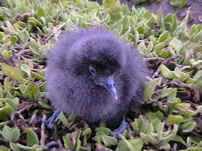
The sialic acid profiles in the respiratory tracts of raptors are unknown. We examined the distribution of the sialic acids in the respiratory tracts of raptors and observed that raptors expressed both sialic acids that serve as the primary receptors for avian and human influenza A viruses respectively. Our results suggest that raptors could be a potential host for influenza viruses.
During the last 15 years, satellite tracking technologies have had a transforming effect on wildlife management, improving our understanding of animal movements on a local and global scale. Continued demand for long-distance remote wildlife tracking has resulted in the development of a variety of satellite tracking technologies. This research assesses the technology options and associated costs of satellite tracking technologies to help wildlife researchers select the best tracking solution for their needs. Photograph by Bindi Thomas.
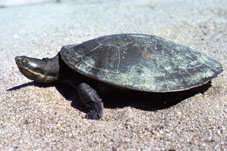
Freshwater turtles are one of the world’s most threatened animal groups. This study found evidence of severe population decline over the past 35 years for two of three turtle species inhabiting a section of Australia’s Murray River, most likely due to climatic drying in association with predation by introduced foxes. Turtle conservation in this region is likely to depend on appropriate environmental water allocation coupled with effective predator control. Photograph by Bruce Chessman.
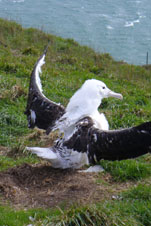
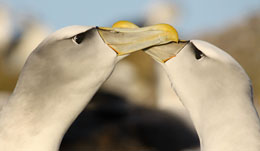
Albatross are threatened by human activities and are the focus of international conservation efforts. Here we assess the status and trends of the Australian endemic shy albatross and investigate influencing factors. These new data indicate that the three populations are stable or declining and raise concerns for the global conservation status of the species and identify priority areas for monitoring and research. Photograph by Rachael Alderman.
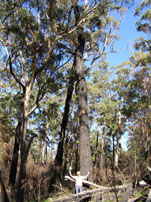
Retaining habitat for hollow-using fauna in harvested forests is an important management action, yet there is little research into its effectiveness. By studying brushtail possum den use in multi-aged harvested and unharvested forest, we found that retained trees were used as the forest regenerates. We conclude that the retention of hollow-bearing trees in harvested forest can be an effective management action, but the retention of habitat in the surrounding landscape is also important to provide habitat as the harvested forest regenerates. Photograph by Lisa Cawthen.
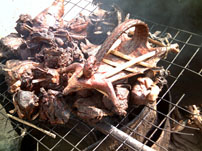
Bushmeat hunting in tropical Africa is one of the main threats to wildlife conservation; yet it has received little attention from potentially contributing fields such as conservation genetics. Mitochondrial DNA-typing of a bushmeat market in south-western Nigeria allowed the identification of 17 mammalian species characteristic of the Dahomey Gap assemblage, of which the cryptic, newly described Walter’s duiker was the most hunted. Mitochondrial DNA-typing proved a valuable diagnostic tool for species sold on the bushmeat market, and shall contribute to set up a better monitoring of wildlife extirpation in tropical Africa. Photograph by Akinlabi Oyeyiola.
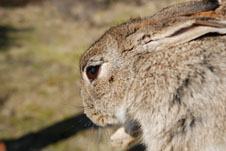
Viral diseases strongly affect persistence and colonisation of habitat patches by wild rabbits. In the coastal dunes in the Netherlands, rabbit haemorrhagic disease (RHD) has led to many local extinctions in woodland habitats, but only rarely in grasslands. Woodland habitats may remain permanently unoccupied, resulting in a smaller area inhabited by rabbits in the presence of RHD. Photograph by Jasja Dekker.
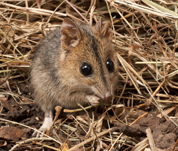
In northern Australia, the cane toad (Rhinella marina) has caused serious population declines of reptilian and mammalian predators, and is implicated in the recent decline of small dasyurid predators. To determine whether toads threaten the red-cheeked dunnart (Sminthopsis virginiae), we carried out feeding trails with predators and live cane toads. We found that red-cheeked dunnarts rapidly learnt to avoid cane toads as prey, suggesting that toads are unlikely to cause serious population declines of this species via lethal toxic ingestion. Photograph by Jonathan Webb.
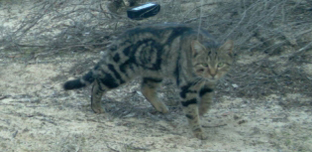
The ability to monitor changes in wildlife or pest animal abundances is fundamental to effective population management, but practical and widely-relevant methods for observing changes in feral cat populations have so far been elusive. We found that photographic observations of feral cats captured from animal-triggered cameras could be used to detect changes in a feral cat population subjected to a control program. These methods might also be useful for detecting changes in populations of feral cats in other areas, which should enhance the effective management of this important environmental pest. Photograph by Andrew Bengsen.
Recent advances in bio-logging devices have greatly advanced some areas of wildlife research, including studies of seabirds. However, researchers must also recognise tracking devices may have an effect on birds’ behaviour, reproduction and survival. This study found no evidence of negative effects of attaching data-loggers on breeding short-tailed shearwaters. These data suggest that appropriate sized loggers are an effective method to obtain information at-sea from seabirds. Photograph by Mark Carey.
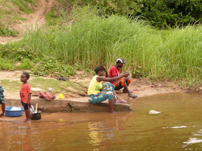
Competition for limited resources by people and wildlife is guaranteed to cause confrontations. The existing mitigation for human–crocodile conflict in Zambia is ineffective. The negative attitude towards wildlife needs to be addressed and a suitable response formulated. The most favoured type of mitigation suggested by local people was more boreholes and the removal of crocodiles. Photograph by Kevin Wallace.
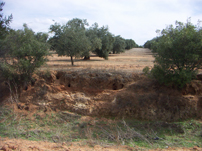
Analysing rabbit warren distribution can help the management of wild rabbits in agricultural lands, where they cause significant damage to crops. We investigated the spatial pattern of warrens in an intensively managed agricultural landscape within the rabbit’s native range, and found most warrens in unploughed patches close to other occupied warrens. The management of such areas is therefore critical to the management of rabbits as an agricultural pest. Photograph by Isabel C. Barrio.