
165 RE-EXPANSION AND QUALITY OF SPLIT BOVINE EMBRYOS IN VITRO
P. Kesseler A , E. Mahabir A , M. Köster A , M. Gilles A , K. Wimmers A , S. Ponsuksili A and K. Schellander AInstitute of Animal Breeding Science, Bonn, Germany. email: Karl.Schellander@itz.uni-bonn.de
Reproduction, Fertility and Development 16(2) 205-205 https://doi.org/10.1071/RDv16n1Ab165
Submitted: 1 August 2003 Accepted: 1 October 2003 Published: 2 January 2004
Abstract
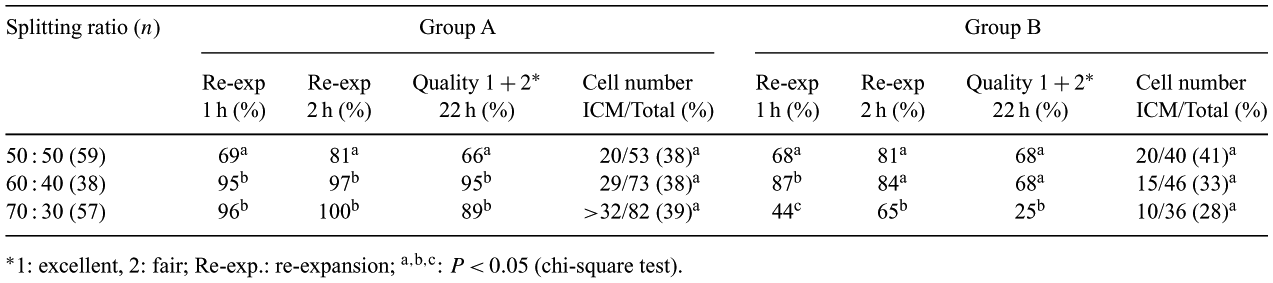
Transferring split bovine embryos results in a higher number of calves born per embryo. In addition to generating genetically identical progeny, biopsies can be made for molecular biological analyses. We aimed to determine the effect of splitting ratio on the in vitro development of Day 7 (164 to 168 h post insemination) IVP bovine embryos. The inner cell mass (ICM) and trophoblast cells were split in three ratios (50:50, 60:40 and 70:30) with a Beaver microblade (Becton Dickinson, N.J., USA.) fixed to a micromanipulator under an inverse microscope at 100 X (Leica, Bensheim, Germany). Split blastocysts were cultured singly in 50 μL drops of CR1aa medium at 39°C under 5% CO2 in a moisture-saturated atmosphere. After 1 and 2 h culture, the morphology was assessed by judging the shape of the embryos and re-development of the blastocoel. On Day 8 (after 22 h culture), the shape of the blastocysts, development of the ICM, blastocoel, proportion of degenerated cells and embryos and re-expanded blastocysts were recorded. Embryos were stained with propidium iodide and Hoechst 33258 for cell counting. The re-expansion status of Group A (50, 60 and 70%) and B (50, 40 and 30%) embryos after 1 and 2 h and their quality after 22 h culture (1: excellent = <10% degenerated cells, well-defined ICM; 2: fair = <20% degenerated cells) are shown in Table 1. With regards to Group A split blastocysts, a higher (P < 0.05) percentage of embryos that re-expanded after 1 and 2 h and which yielded Quality 1 and 2 embryos suitable for embryo transfer was observed with the 60% and 70% than with demi-embryos. There were significant differences (P < 0.05) between all split blastocysts in Group B after 1 h culture. The 30% split embryos showed the lowest re-expansion rate and quality of embryos after 2 h and 22 h culture, respectively. No differences (P < 0.05) were seen in the ratio of the ICM to the total number of cells in both Group A and B. This study showed that the ratio in which blastocysts were split had a significant effect on re-expansion and quality but not on the number of cells.
|